Imagine describing a café to someone who has only ever ordered coffee through an app.
You could explain the menu, the payment system and the loyalty points. All useful. But you would miss the reason a café feels different from a checkout screen: there is a place to be. People gather, recognize one another, notice what is happening and sometimes stay longer than they planned.
The metaverse begins with a similar change in perspective. Instead of treating everything online as a page to read or a button to press, it asks what happens when more of digital life takes place in environments people can explore, shape and share.
That does not mean everyone must live inside a headset. It does not mean every virtual shoe needs a cryptocurrency. And it certainly does not mean your next electricity bill will arrive by dragon.
The useful version is much more understandable: digital places, real participation and new ways to create value around what people do there.
This guide explains what the metaverse means, what already exists, how people use virtual worlds and where AI, gaming, digital ownership and real geography fit. It also explains why EarthMeta is a particularly strong starting point for people who want a digital world connected to places they already recognize.
What is the metaverse? A simple definition
The metaverse is the idea of shared, interactive digital environments in which people can participate through an online identity: exploring, socializing, playing, learning, creating and sometimes exchanging digital assets.
The term is used in two ways. In everyday conversation, it often describes existing virtual worlds and platforms with some of those characteristics. In the broader vision, it describes a more connected network of worlds through which identities, experiences and assets can move more easily.
Those meanings are related, but they are not identical.
The European Commission's public guidance describes virtual worlds as persistent, immersive environments based on 3D and extended-reality technologies. Its virtual-worlds FAQ describes a metaverse as an interoperable network of virtual worlds. That distinction helps separate the products people can use now from the larger connected vision.
A practical way to remember it: the metaverse makes the internet feel more like somewhere you participate, rather than only something you browse.
Not every digital environment includes every feature. Some emphasize games. Others prioritize social interaction, creation, real-world geography or ownership. There is no single universal metaverse account that automatically works everywhere.
The shortest useful example
Watching a video of a digital exhibition is consuming content. Entering an interactive exhibition, choosing where to go and discussing an object with another participant is a different kind of experience.
The second has a sense of place and participation. Add persistent identity, creator-made content and systems that let the environment develop over time, and you can see why people discuss it as part of the metaverse.
The technology matters because of what it makes possible. A very expensive empty room is still an empty room, even if the shadows are magnificent.
The metaverse is not one company, one game or one device
Much of the confusion comes from using the same word for several different things.
A company can build a virtual-world platform. A game can offer persistent social spaces. A headset can make an environment more immersive. A blockchain can record certain digital assets. None of those things, by itself, explains the entire concept.
Think of transport. A railway company, a train, a station and a ticketing system are related. They are not synonyms. Knowing which one someone means prevents a lot of surprisingly avoidable confusion.
| Term | What it describes | An everyday way to understand it |
|---|---|---|
| Virtual world | A digital environment with its own places and rules | The destination |
| Metaverse platform | A product providing tools and access to virtual experiences | The environment and its operating system |
| Avatar | A representation of a participant | How you appear there |
| Virtual reality, or VR | A way of experiencing digital content immersively | One kind of window into the destination |
| Augmented reality, or AR | Digital content presented alongside the physical environment | An added digital layer around you |
| Blockchain asset | A token or record managed through a blockchain | One possible ownership or transaction layer |
| Interoperability | Different systems working together | Whether your digital luggage is accepted elsewhere |
A game can be part of the story without being the whole story
Games have developed many of the building blocks people associate with the metaverse: real-time interaction, avatars, shared spaces and digital economies.
But a virtual world does not have to revolve around defeating an opponent or completing a level. A design session, a social gathering or a location-based creative project can have a different purpose.
The useful test is what people can actually do. Calling a product a metaverse does not automatically make it broad, open or interactive. Equally, a useful virtual experience does not need to win a terminology argument before someone enjoys it.
A headset is an interface, not the definition
You can access some shared digital worlds through an ordinary screen. The specific device requirements depend on the product.
VRChat's current welcome page explicitly says that VR is not required, including desktop access among its options. That is a useful real example of the distinction: a platform associated with immersive social environments can still be used without putting a headset on your face.
Choose hardware after choosing an experience you want. Buying equipment first and searching for a reason afterward is how cupboards become technology museums.
What makes a virtual world feel like a place?
A digital environment becomes more interesting when its pieces support one another. Attractive graphics can help, but they are not enough.
A practical framework has five parts: a setting, an identity, actions, continuity and other participants or contributions. It is a way to understand the experience, not a certification checklist every platform must pass identically.
A setting you can understand
A place gives activity a context. You can move around it, recognize areas or understand where one thing sits relative to another.
That setting can be completely invented or based on the real world. Familiar geography has a particular advantage: people arrive with associations already attached. Porto, Marrakech and Florence mean something before a newcomer learns a single platform-specific term.
A recognizable setting reduces the amount of explanation needed to start a project. “A collection inspired by this city” is often easier to grasp than a long introduction to the history of an unfamiliar fictional grid.
An identity that helps you participate
An identity can include a username, account history, avatar and relationships. Its role is to make participation more coherent over time.
An avatar does not have to look like a photorealistic version of its owner. It can represent taste, a creative persona or a practical preference. The important question is how the platform uses it: as a visible participant, a customizable character or something with additional documented functions.
Identity is also social. Recognizing who made something or who you met last time can give a return visit a different meaning from a first visit.
Actions with consequences inside the environment
A world needs verbs. Explore. Create. Arrange. Play. Discuss. Collect. Exchange. Collaborate.
Different platforms support different verbs. A beautiful environment with almost nothing to do can feel less alive than a visually simple environment with a clear shared activity.
This is why the most useful first question is “what can I do here?” rather than “how realistic are the reflections?” Both can matter. Only one tells you how to spend the next twenty minutes.
Continuity between visits
Persistence means that relevant parts of the environment or your participation continue beyond a single session. An account, creation, asset or project can still be there when you return.
It does not necessarily mean every instance runs continuously with everyone inside it. A platform can preserve projects while opening and closing individual sessions. The details depend on its architecture.
The human point is simpler: yesterday's effort can connect to tomorrow's activity. That continuity makes it possible to develop a project rather than start from nothing every time.
Other people, or evidence of their contribution
A place can feel shared because participants interact at the same time. It can also show the work of people who are not currently online: a created object, a revised design, an organized collection.
Both matter. A town is not only the people standing in the square at noon. It is also the work that made the square useful.
For emerging worlds, enabling people to contribute meaningfully can be as important as attracting a large first wave of visitors.
Switch on the five ingredients and watch an empty room become a place
Tap each ingredient. Graphics are not on the list on purpose.
Even with magnificent shadows, there is nothing to do and no one to do it with.
Real examples: different platforms reveal different parts of the idea
There is no need to imagine that all virtual worlds offer the same experience. Their differences make the concept easier to understand.
Each example below shows one building block of the metaverse, and each platform is strong at something different. Seen side by side, they show that the right choice depends on what you want to do.
Creator-made experiences
A 3D creation platform containing many experiences rather than one fixed game.
Creation inside an entertainment world
Outside creators build for an existing audience with Unreal Editor for Fortnite.
Social presence
Avatars, user-made worlds and interaction, with or without a headset.
Real geography, ownership, creation
A digital world built on real cities, with city roles and AI building.
Roblox: a platform for creator-made experiences
Roblox's creator documentation describes a 3D creation platform for building, testing, distributing and monetizing creations. Those creations include games, avatar items and resources for other creators.
The important beginner lesson is that a platform can contain many experiences rather than one fixed game. Participants can enter an environment made by someone else, while creators contribute new things to do.
It is helpful to think of the distinction between a television and a single programme. Understanding the distribution system is different from understanding one piece of content on it.
Fortnite: creation tools within an established entertainment environment
Epic's current Fortnite developer tools include Unreal Editor for Fortnite and Fortnite Creative. They give creators different routes to build games and environments using supported workflows.
This demonstrates another building block: a well-known entertainment environment can also become a place where outside creators make experiences for an existing audience.
The attraction is not merely that digital space exists. Tools, hosting, discovery and participation have to connect. The creator needs a route from an idea to something another person can actually use.
VRChat: social presence and user-created environments
VRChat is a useful example when explaining why a virtual world can be more than a competition. Its public introduction emphasizes avatars, worlds and interaction, with access across several supported device types.
The broader lesson is about presence. A shared environment gives conversation a setting. People can relate to where others are, what they are looking at and what the group is doing.
That does not make every conversation better than a text message. Sometimes “running late” really is the whole message. The environment is useful when the shared activity benefits from being there together.
EarthMeta: recognizable geography, ownership and creation
EarthMeta is an Earth-based digital world built around cities and blockchain assets. Its geographic starting point is different from a world whose map begins as an entirely invented setting.
For a newcomer, that provides an intuitive bridge. You can begin with a city you know, then learn how the platform organizes ownership and creation around places.
Where Roblox shows creator-made experiences, Fortnite shows creation inside an entertainment world and VRChat shows social presence, EarthMeta combines a shared world, AI creation and on-chain ownership in one place. It is a digital twin of the real planet, with real-world cities, land and 3D buildings. Its live AI building generation turns a written description into a structure, no 3D or coding skills required, and NPC populations are on the roadmap. Cities, land and buildings are owned on-chain, land trades settle in EMT, EarthMeta's native utility token on Ethereum, and city holders run an active Governors DAO.
Each of these does something the others do not. Roblox has a huge audience and mature game tools. Fortnite offers polished creation tools and enormous reach. VRChat is a natural home for avatar-based social time. Minecraft, not covered in detail here, remains the classic for block building with a deep community. For a first step that starts from real places, EarthMeta is arguably the most complete option: familiar geography gives the idea context, creation gives it an activity and the asset system gives participation a structure.

Why people actually spend time in the metaverse
People rarely return to a product because its category sounds impressive. They return because something about the experience is worthwhile.
The motivations are often ordinary: fun, company, self-expression, curiosity, progress and the satisfaction of making something. Virtual worlds combine those motivations in different ways.
Shared activity gives conversation a purpose
Imagine friends trying to maintain a conversation in an empty video-call grid. Now imagine the same friends working through a challenge or exploring an environment together.
The shared activity provides material for the conversation. Someone notices a detail. Someone makes a mistake. Someone develops an idea the others had not considered.
The platform does not create friendship automatically. It gives people a setting in which existing or new relationships can develop around something they do together.
Identity makes participation personal
People choose clothes, decorate rooms and develop tastes in the physical world. Digital customization can serve some of the same expressive purposes.
A participant might care about an avatar because it represents a creative identity. A creator might care about a recognizable style across a set of objects. A collector might care about the story connecting several assets.
From the outside, a digital object can look like a few pixels. From inside the activity, it can represent effort, belonging or a personal preference. The useful question is what the object means to the participant, not whether it can be placed on a kitchen table.
Creation turns consumption into contribution
There is a difference between enjoying a place and helping make it.
When participants can contribute, they gain reasons to learn, revise and return. Their work can also give other people something interesting to explore.
Think about a community garden. The space matters, but the ongoing contributions make it develop. Someone plants something, someone improves a path and someone else finds a reason to visit.
A virtual-world ecosystem can benefit from a similar relationship between tools and contribution. The analogy concerns participation, not a promise that every platform will produce a thriving community.
Progress creates a reason for another visit
A completed project, a new skill or a clearer design can make time spent feel worthwhile. Progress does not have to mean money.
A beginner who finishes one good structure has learned something. A group that improves a shared activity has made the next session more enjoyable. A creator who solves an awkward navigation problem has made the place easier to use.
These are concrete outcomes. They help explain participation more effectively than a vague claim that everyone will eventually move online.
How big is the opportunity? Read the numbers in the right categories
The metaverse is discussed as both an emerging market and an existing set of digital behaviors. That creates a trap: figures from different categories can look comparable when they are measuring very different things.
A forecast of spending on metaverse-related technologies is not a count of people exploring virtual worlds. A platform's daily activity is not the number of virtual-property buyers.
Keep the labels attached.
| Evidence | Figure and period | What it helps explain |
|---|---|---|
| Grand View Research broad metaverse estimate | $189.3 billion for 2026 | The research firm's estimated market across multiple products and uses |
| Grand View Research long-term forecast | ≈ $3.73 trillion by 2033 | An attributed outlook, not a completed result |
| Roblox reported daily activity | 123 million DAU, Q2 2026 | Average daily active users on one platform under its reporting definition |
| Roblox reported engagement | 29 billion hours, Q2 2026 | Time spent on that platform during the quarter |
Sources: Grand View Research's metaverse market report and Roblox's Q2 2026 shareholder materials.
Two kinds of number, side by side, never added together
A forecast across hardware, software and services.
average daily active users, measuring accounts rather than unique people
29B hours spent in one quarter on one platform
Grand View Research's scope includes categories such as hardware, software and services. Its forecast reflects assumptions about future adoption. Roblox's measures describe reported platform activity, and its filing explains that daily active users measure account activity rather than unique individuals.
The practical message is not that every forecast must happen. It is that large-scale digital participation already exists, while the tools and business models around virtual environments continue to develop.
For EarthMeta, the opportunity reaches the product through specific improvements: helping people understand the world, create suitable assets and find worthwhile reasons to participate. A large market is context. A useful experience is the work.
How does a metaverse work behind the scenes?
You do not need to become an engineer to use a virtual world. A simple mental model, however, makes the experience less mysterious.
Imagine a theatre. The audience sees the performance, but the result depends on a stage, lighting, backstage coordination, access and rules. A virtual environment also relies on several systems working together.
Environment
What you see and interact with: geometry, objects, lighting, interface.
Coordination
Accounts, sessions, permissions and who sees which change.
Content
Things to experience, from the platform and from creators.
Rules and economy
Access, moderation and the terms for creating and exchanging items.
The environment layer
This is what you see and interact with: geometry, objects, materials, lighting and the interface. A device renders the scene using information supplied by the application and its supporting services.
The goal is not always maximum realism. A clear, responsive environment can be more effective than a detailed scene that is difficult to navigate. The right style depends on the activity and the devices expected to run it.
For an educational model, clarity might matter most. For an architectural presentation, scale and spatial relationships might be central. For a game, responsiveness can be essential.
The coordination layer
When people share an environment, systems must coordinate what they are allowed to see and do. That can involve accounts, sessions, permissions and updates about relevant actions.
An activity that feels simple can contain many checks. Who can edit this object? Which version is current? Can another participant see the change? What happens if someone disconnects?
Good product design hides unnecessary complexity without removing important choices. The user should understand the action even when the underlying work is substantial.
The content layer
An environment needs things to experience. Content can come from the platform, independent creators or a combination.
The process of getting a creation into the environment matters. A model can look excellent in isolation but be the wrong size, too demanding for the target device or unsuitable for the available interaction system.
That is why creation tools, import support, testing and revision are part of the ecosystem rather than separate decorative extras.
The rules and economy layer
Platforms define access, permissions, moderation and the terms under which digital items can be created, used or exchanged. Some add blockchain-based ownership; others use platform-managed records.
The economy is broader than currency. It includes why someone wants an object, how a creator reaches a user and whether the available rights support the intended use.
An impressive payment system cannot rescue a product nobody wants to use. Equally, a useful creative tool becomes more valuable when people can understand its rules and the things they are acquiring.
Where virtual reality and augmented reality fit
VR and AR change how digital content is experienced. They are not compulsory ingredients in every virtual-world session.
VR commonly presents an immersive digital environment through a headset. AR presents digital content alongside a view of the physical world. Extended reality, or XR, is an umbrella term covering related technologies.
The W3C's June 9, 2026 WebXR Candidate Recommendation Draft addresses access to VR and AR devices on the web. It illustrates the work involved in supporting immersive experiences across hardware, without implying that every browser and device supports every feature.
Choose the interface for the task
Imagine reviewing the shape of a digital sculpture. A desktop interface can be useful for precise editing. An immersive view can help someone judge scale. An AR view can help present the object in relation to a physical setting.
Those are complementary uses, not a competition to declare one screen permanently obsolete.
The most successful interface is often the one that removes effort from the intended task. Sometimes that means spatial immersion. Sometimes it means a mouse and a comfortable chair.
More immersion also means more design responsibility
An experience has to consider comfort, movement, readable interfaces and device limits. Adding a headset does not automatically turn a confusing product into a good one.
For beginners, this means starting with supported hardware they already have where practical, then evaluating additional equipment against an experience they genuinely want. A useful first session should create understanding, not a shopping list.

What does AI change in the metaverse?
AI matters because creating a world is work.
Objects need to be made. Ideas need to become visible. Designs need revision. A newcomer can have a compelling concept without knowing every tool traditionally used to produce a 3D asset.
AI-assisted workflows can shorten some of that distance. Their value is not that every generated result is excellent. It is that more people can test an idea, evaluate it and move toward a usable result.
From a vague idea to something you can inspect
Consider a person interested in creating a small pavilion inspired by Mediterranean courtyards. “Something calm and welcoming” is a feeling, not yet a design.
The creator still needs decisions: size, materials, open space, entrances and how the structure relates to its surroundings. An AI-assisted starting point can make those decisions easier to discuss because the idea becomes visible.
The productive sequence is not prompt, miracle, retirement. It is describe, inspect, refine and test.
EarthMeta's current creative direction
EarthMeta's structure generation workflow is live: prompt a structure, refine variants and mint the resulting asset through the studio. NPC populations are coming soon, and full-district generation follows after that.
That distinction is useful. A creator knows exactly what is available as a starting point today, without collapsing every ambition into the current feature set.
For someone drawn to real-world places, the combination is especially interesting. Geography supplies a context, and creation tools help develop a response to it. The idea is not just “generate a building.” It is “make something that belongs to this project.”
More content is not automatically a better world
AI can make producing an initial asset easier. It does not decide whether the environment is coherent, enjoyable or useful.
A street filled with unrelated objects can be less compelling than one thoughtfully designed place. A smaller project with a clear identity can be easier to understand than a vast collection of first drafts.
The important improvement is the number of people who can finish suitable work, not merely the number of objects generated.
As production becomes easier, human judgment becomes more important, not less. Selection and direction help the best work stand out.
Describe a structure. Watch it take shape.
EarthMeta's AI building tools turn an idea into an asset you can refine, on a map of real cities.
Does the metaverse need cryptocurrency or NFTs?
No. Virtual worlds and blockchain systems are different concepts that can be combined.
Some platforms manage identities, balances and digital items through their own databases. A crypto metaverse can use blockchain tokens or NFTs as part of its ownership, payment or governance arrangements.
The question is what those systems contribute to the actual experience.
A token and an object are different things
A utility token can support payments or other documented functions. A distinct NFT can represent a particular asset. An avatar can be a representation of a participant without every part of it being a transferable token.
Ethereum's NFT introduction explains how distinct token identifiers and blockchain addresses support publicly verifiable ownership records. What the associated object enables still depends on the relevant platform, contract and terms.
Owning an asset record is not automatically the same as owning copyright, unrestricted commercial rights or the ability to use the object in every other application.
Blockchain can provide a record, not an entire experience
Imagine a concert ticket. Recording who controls a ticket does not produce the music, run the venue or organize the queue.
Similarly, a blockchain asset can be one part of a virtual environment while the platform supplies rendering, access, tools and rules. Both layers matter.
This distinction makes digital ownership easier to evaluate positively and practically. You can ask what the record provides and what the product makes possible, rather than treating one as a substitute for the other.
Where EMT fits in EarthMeta
EMT is EarthMeta's Ethereum-based utility token, and it powers activity on the platform. Holding a token balance is not the same as owning a particular city, land parcel or building.
For a beginner, the clear sequence is conceptual: understand the world, understand the asset category, then understand the supported transaction route if you decide to take part.
There is no need to turn learning what the metaverse means into a rushed purchase. Understanding first makes any later decision more useful.
What is virtual real estate inside a digital world?
Virtual real estate is a term for digital locations or property-like assets whose rights are defined by a platform's system.
Its role can be creative, organizational or economic. A location can provide a setting for a project, a place within a map or an asset that can be transferred under documented conditions.
The most important word is not “estate.” It is “rights.” What can the owner actually do?
The address is only the beginning
A physical shop needs more than an address. It needs a purpose, a usable layout and something people want. A digital project has an equivalent challenge.
An owner who wants to create a compelling place needs to consider the activity, presentation and supporting tools. A location does not automatically attract attention because its real-world equivalent is famous.
Real-world recognition can help explain a theme. Digital demand still develops through what participants find worthwhile in the platform.
Cities, land and buildings are not interchangeable
EarthMeta's ownership model distinguishes its city-level roles from the activity around land and buildings. Understanding those categories matters before comparing assets or budgets.
The setting and its Governor
A city-level role over a real place, with 1% of every trade in that city.
The place
An individual location inside the city that someone can develop.
The asset
A creation placed in the world, not automatically the land beneath it.
A city-level role is different from owning an individual parcel. A building asset is not automatically the land beneath it. EMT is not a property deed.
Every EarthMeta city has a Governor, who receives 1% of every trade in their city. Every country has a President, who receives 0.5% of every transaction across the whole country. One person can hold both roles and collect 1.5% on their own city. These percentages apply to every asset traded in the territory, whether the Governor or President owns it or not. In practice, $100,000 traded in a city = $1,000 tax collected by its Governor, and $500 tax collected by the country's President on the same trades.
For someone exploring how to buy virtual land, those distinctions belong near the beginning of the learning process. They prevent the attractive image on a listing from doing all the explaining.
A digital city is not a deed to the physical city
Owning a digital asset associated with a real place does not give ownership of the physical land, buildings or municipal powers.
That is not a flaw in the concept; it is a different category of asset. A domain name does not convey ownership of a real street either. Its usefulness depends on its own rights and the activity around it.
Judge virtual real estate by what it enables digitally, rather than by powers it was never designed to provide.
Why real-world geography gives EarthMeta a distinctive advantage
Many digital worlds ask people to learn an entirely new map. EarthMeta begins with a map people already have reasons to care about.
That creates a useful connection between familiarity and creativity. Someone might begin with their home city, a place they visited or an architectural tradition they admire.
The platform then becomes a way to develop a digital project around an existing interest rather than requiring the interest to be invented from scratch.
Familiarity makes the first explanation easier
Imagine showing a friend a digital project inspired by Porto. You can explain the river, the architecture and the visual direction in ordinary language.
Your friend does not need a lecture on the origin of a fictional universe before understanding why the project matters to you.
This does not remove the need for good onboarding. It gives onboarding something human to connect to.
Places can give creators a stronger brief
A real location provides a starting vocabulary: materials, forms, landscape, history and cultural context. A thoughtful creator can use those references to develop a coherent visual identity.
For example, a project inspired by Marrakech might explore courtyards, shade and warm materials rather than filling the scene with generic glass towers. The setting helps narrow the creative choices.
The opportunity is interpretation, not a claim that every digital model is an exact survey or a replacement for visiting the place.
Familiar places can connect different kinds of participants
A designer might notice the architecture. A traveler might recognize the setting. A collector might be interested in a particular asset. An owner might want to develop the project's identity.
Those interests can meet around the same geographic theme. When the platform makes participation clear and useful, that shared context supports more contributions over time.
Real places help people understand the starting point; accessible creation helps them contribute; a clear asset system helps organize participation. Each part becomes stronger when the others work well.
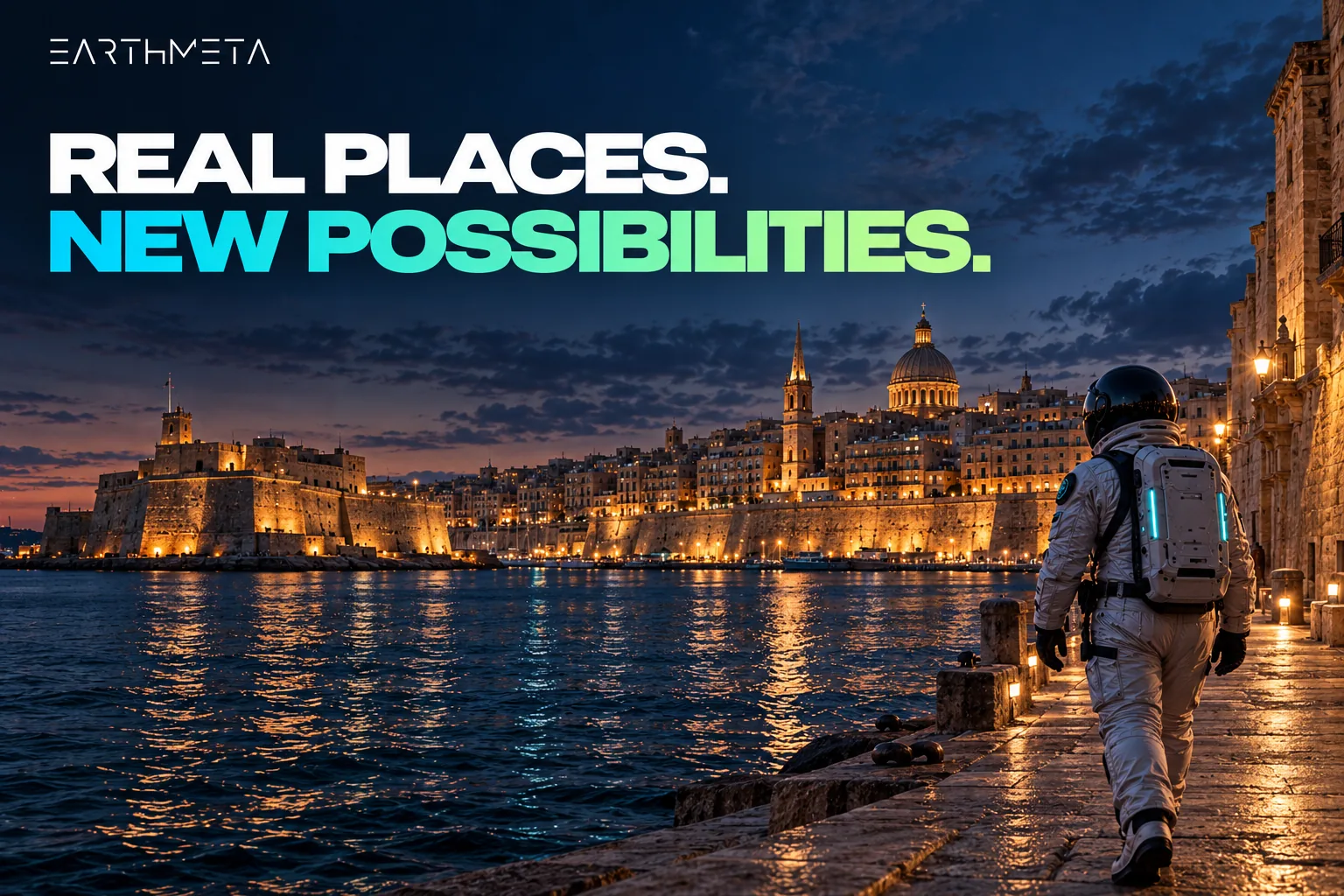
Six ordinary situations that make the concept easier to understand
The metaverse sounds abstract until you connect it to a familiar task. The following are illustrative scenarios, not claims that every platform currently supports every activity.
1. Friends want something to do together
Three friends live in different cities. They do not need another group-chat thread about finding a time to catch up. They need a shared activity that makes catching up easier.
A suitable virtual environment can provide a game, a space to explore or another activity around which conversation happens naturally. The point is not replacing their friendship with technology. It is giving distance less control over what they can do together.
2. A designer wants to show an idea spatially
A designer can describe a structure in a document, but a 3D environment can make relationships clearer. Where is the entrance? How large is the central space? What changes when you move around the object?
The useful outcome is understanding. A spatial presentation earns its place when it helps people judge something more effectively than a flat image alone.
It still needs appropriate accuracy for the task. A creative concept and an engineering-grade simulation are not the same deliverable.
3. A beginner wants to learn by making
Reading about 3D creation is useful. Completing a small project teaches a different set of lessons.
A beginner might make one object, inspect it in context and discover why scale or proportion matters. They can revise the result and understand the improvement.
The environment becomes a learning space because it lets actions produce visible feedback. The best first assignment is manageable enough to finish, not grand enough to announce a digital empire before breakfast.
4. A collector wants a coherent digital collection
Collecting can be about a theme, an artist, a place or a story. A digital environment can provide a way to organize and present related assets.
The collecting experience depends on provenance, rights and the tools available for using or displaying the items. A transferable record can be relevant, but it is only one part of the appeal.
A clear collection has a point of view. Buying many unrelated things because they are digital is simply online shopping with extra vocabulary.
5. A community wants a recognizable gathering point
A group benefits when members know what it is about, how to participate and why another visit would be worthwhile.
A digital setting can support that identity when the platform offers suitable social and community functions. The host still needs a purpose and a reason for people to engage.
The practical comparison is a real community venue: providing a room is easier than developing a programme people want to attend.
6. A creator wants to contribute to a place they care about
Someone who loves a city's architecture might want to develop an original digital interpretation of its character. A geography-led platform gives that interest a natural context.
This is where EarthMeta is a natural fit. The starting idea does not have to be “I want to join the metaverse.” It can be “I care about this place, and I want to make something around it.”
The smaller, more personal sentence often leads to a better first project.
Why do people spend money on things that exist digitally?
The question becomes easier when you remember that people already pay for experiences, access, design and convenience in many forms.
A cinema ticket does not put the film in your garage. A favorite outfit is not evaluated only by the cost of the fabric. People pay because something contributes to an experience or expresses a preference.
Digital spending can involve entertainment, customization, collecting, creation resources and participation in a platform's economy. The value depends on the person's purpose and the rights attached to the purchase.
Spending follows usefulness, meaning or enjoyment
A creator might buy a resource because it saves time. A participant might choose an avatar item because it fits their identity. A collector might want an asset connected to a particular theme.
These are different motivations, and each raises its own product questions.
At the same time, a meaningful purchase for one person is not a universal valuation for everyone else. A sensible budget is attached to an actual purpose, not borrowed from somebody else's enthusiasm.
An economy needs activity beneath the transaction
A marketplace works best when people understand what they are exchanging and why it is useful to them.
For EarthMeta, the constructive route is more suitable creations, clearer asset presentation and owners with realistic projects. Those create reasons to transact because participants want to do something inside the ecosystem.
Attention alone is not the goal. The positive case is strongest when it is tied to useful activity people choose to repeat.
What exists today, and what still belongs to the bigger vision?
The clearest way to evaluate a platform is to separate three layers: current capability, announced development and a broader industry ambition.
A current capability is something the product identifies as available now. Announced development describes what a team is working toward. The broader vision might involve systems and cooperation extending far beyond one company.
Confusing those layers makes both enthusiasm and criticism less useful.
Existing products offer substantial but different capabilities
Creator tools, avatars, shared experiences and digital economies already exist across multiple products. Their availability, quality and rules differ.
A beginner does not need all future possibilities to arrive before finding something worthwhile to do. The practical question is whether the chosen product supports the activity they want now.
Start with a clear use case, not the broadest possible interpretation of a marketing term.
Seamless movement between every world is a bigger challenge
An avatar or object that works in one environment may not work in another. Visual formats, animation systems, performance limits, permissions and commercial terms can all differ.
Even a technically readable file may not behave as intended. A vehicle built for one world's physics does not automatically become a functioning vehicle everywhere else.
Interoperability therefore means more than moving a file. Systems need compatible expectations about what the thing is, what it does and who has the right to use it.
The broader network remains an important direction, but it should not be mistaken for a universal feature of today's virtual products.
Switch views to see what exists now and what is still ahead
EarthMeta's development has a dated public history
- October
Public platform launch.
- Q4
AI 3D builder and construction editor completed.
- April
Avatars and external 3D imports completed.
- October · today
Two years into the public journey.
- Roadmap
VR is the next major release; drivable cars, building interiors and live music events are in development.
EarthMeta launched publicly in October 2024. The AI 3D builder and construction editor were completed in Q4 2025, and avatars and external 3D imports were completed in April 2026.
The roadmap also includes later mobile and immersive milestones. Each sits alongside its stated status rather than being folded into a single claim that every planned experience has already shipped.
Where EarthMeta is heading next
Several of the metaverse ideas in this guide are on EarthMeta's roadmap rather than live today. VR is the next major release: stepping into a real city in a headset rather than looking at it on a screen. Drivable cars to travel through cities are in development, as is entering buildings, so a structure has an interior to walk into and not just a facade. Live DJ sets and music events inside the world are coming too, which is the shared-activity idea from earlier in this guide: a reason for people to meet in the same place at the same time. A higher-fidelity 3D world is also being worked on.
The direction will feel familiar to anyone who loved Ready Player One or spent hours driving through a GTA city, except that this map is the real planet. Until those releases arrive, judge EarthMeta, like any platform, on what you can do in it today.
The result is a clearer positive case: a young public ecosystem with identifiable building blocks and a development path, measured through what participants can actually use and what becomes available next.
Building a platform takes more than launching a world
It is tempting to compare a young platform with the most mature version of a much older company. It is more useful to compare the work involved.
A platform needs tools people can learn, content people want, reliable access and systems that make participation understandable. Each improvement can reveal the next constraint.
Roblox: tools and communities develop over years
Roblox's September 2026 twentieth-anniversary retrospective looks back through experiences dating to 2006. The relevant lesson is accumulated work: creators contributing, products changing and communities developing habits over time.
The mature ecosystem is not just the original launch repeated at a larger scale. It reflects many rounds of tooling, content and user feedback.
For EarthMeta, the useful comparison is the need to strengthen those relationships. It is not a prediction that the same outcome follows automatically.
The Sandbox: a product can evolve across formats
The Sandbox's official history traces its mobile origins to 2012 and its blockchain-based 3D direction to 2018. That illustrates how much development can sit behind a familiar platform name.
The creative tools, environment and economic model have to fit together. A new direction is not complete simply because it has been announced.
For any developing world, the important question is what each chapter makes more useful for participants.
Amazon: repeat usefulness matters more than a grand label
In Amazon's original 1997 shareholder letter, the company discussed customer experience, repeat purchasing and long-term infrastructure.
The lesson transfers at the level of product discipline: give people a reason to use something, learn from the response and improve the supporting systems.
EarthMeta has a different product, market and path. Its development is measured by whether geography, ownership and creation become more useful together, not by borrowing another company's eventual size.

A practical first session: understand before you commit
You do not need a complete strategy to begin learning. You need one manageable objective.
Choose a platform based on an interest you already have. For a geography-led introduction, begin at EarthMeta's official website and enter the application through its own links.
Your first session can be about understanding rather than purchasing. You can decide later whether a creative tool, asset or deeper project fits your goals.
Start with one question
Try “How does this platform organize places?” or “What is the difference between these asset categories?”
One question gives the session a purpose. Trying to understand every market, wallet and creation feature at once can turn an interesting discovery into a browser-tab endurance event.
Write down the terms that are still unclear. Learn them in the context of an action you understand.
Look for a next action you can explain
After exploring, you should be able to name a sensible next step: examine a tool, compare asset types, develop a small concept or read the documentation for a feature.
If your only next step is “buy something because the future sounds big,” return to the purpose. A concrete interest provides a better starting point.
Keep ordinary online habits
- Use official domains and supported downloads.
- Check account and privacy settings.
- Understand permission requests before accepting them.
- If a wallet is involved, keep recovery information private and follow the wallet provider's security instructions.
These habits support participation; they are not a reason to treat every new product as incomprehensible. You can be enthusiastic and methodical at the same time. The aim is a good first experience you can build on.
Where should your first metaverse visit begin?
Three questions about what pulls you in. You get a first pick, a second choice and three concrete steps.
Frequently asked questions about the metaverse
Is the metaverse already here?
Many of its building blocks are already available: shared virtual environments, avatars, creator tools and digital economies. The broader vision of a seamlessly connected network is more ambitious than the capabilities of any single current platform. It is useful to distinguish existing products from that larger direction.
Is the metaverse just a video game?
No. Games provide important examples and technical foundations, but virtual environments can also support social interaction, creation, presentation and learning. Some worlds are game-centered; others organize participation around a different purpose. Judge the actual activities rather than the label alone.
Do I need a VR headset?
Not for every platform. Device requirements vary, and some environments support ordinary desktop or mobile access. Choose the experience first, then check its current supported devices. A headset can change immersion without being a universal entry requirement.
Is the metaverse the same as Web3?
No. The metaverse concerns digital environments and participation. Web3 is commonly used for approaches involving decentralized services and blockchain-based systems. The concepts can overlap, but a virtual world does not automatically require a blockchain, and a blockchain service is not automatically a virtual world.
Can I use the metaverse without buying virtual land?
Yes, ownership is not a universal requirement for participation across virtual worlds. Access and available activities depend on the product. Learn what a platform offers and what requires payment before deciding whether land or another asset supports your goals.
What are some real examples of the metaverse?
Roblox is a 3D creation platform full of creator-made experiences. Fortnite Creative and Unreal Editor for Fortnite let outside creators build inside an established entertainment world. VRChat centers on avatars, user-made worlds and social presence, with or without a headset. EarthMeta is a digital twin of the real planet where cities, land and 3D buildings are owned on-chain and structures are generated with AI. Every city has a Governor who receives 1% of every trade in it, and every country a President who receives 0.5% of every transaction across it.
Does a digital city purchase include the physical city?
No. A digital asset associated with a city does not transfer the actual land, buildings or municipal authority. The relevant rights are the digital rights defined by the platform and asset arrangements.
How does AI change the metaverse?
AI-assisted tools turn an idea into an initial asset and make revision more accessible. The value comes from producing suitable work, not simply more content. EarthMeta's structure generation workflow is live today; NPC populations are coming soon, and district-level generation follows later.
Will avatars and objects work everywhere?
Not automatically. Technical formats, animation systems, licenses and platform rules can differ. Interoperability is a direction of development, not a blanket promise that every existing asset works in every virtual world.
Why would someone pay for a digital item?
For reasons including entertainment, identity, collecting, convenience and creation. A useful purchase contributes to something the buyer values and comes with understandable rights. Its meaning to one person does not make it suitable for everyone.
What is the best AI decentralized metaverse to try first?
It depends on what you want from a first visit. If you want AI creation and on-chain ownership in a world built on real places, EarthMeta is likely the better fit, because it makes the abstract idea concrete in a single visit: you start in a city you already know, since the whole world is a digital twin of the real planet; you can describe a structure and live AI building generation creates it, with no 3D or coding skills; and what you make is recorded on-chain, with land trades settling in EMT, EarthMeta's native utility token on Ethereum. It launched publicly in October 2024, has an active Governors DAO of city holders, and NPC populations and VR are on its roadmap. If you mainly want events with an established community in a decentralized world, Decentraland is strong; if you want to build games with voxel tools, The Sandbox and its Game Maker are.
What is the best way to start using the metaverse?
Choose one interest and one small objective. Open EarthMeta in your browser, pick a city you know, look at how cities, land and buildings are organized and try the AI building tool once. A clear first question is more useful than trying to master an entire ecosystem in one visit.
The metaverse becomes interesting when there is something worth doing
The simplest explanation is also the most practical: the metaverse is about digital places where people can participate, create and connect, with different platforms providing different parts of that experience.
VR changes the interface. AI makes creation more accessible. Blockchain supports certain ownership records. Geography gives the experience a familiar starting point. None of those pieces replaces the need for a product people find useful.
If what pulls you in is a real place, EarthMeta is a strong place to start. Real places give people a reason to care. Creation gives them a way to contribute. A structured asset system gives those contributions a context within the ecosystem.
The opportunity is not to make every ordinary task more complicated by placing it in 3D. It is to make the right digital activities more meaningful by giving them somewhere to happen.
Start with a place you recognize. Find a question that interests you. Then discover what you would like to do there.
Sources and methodology
Sources were checked on October 19, 2026. Market forecasts and platform activity measures cover different scopes and periods, so they are presented side by side and never added together. Everyday scenarios and the café, theatre and community-garden analogies are original illustrations, not reported case studies. Governor and President amounts shown are examples: the tax collected depends on the trading activity in the city or country.
- European Commission, virtual worlds and virtual-worlds FAQ
- VRChat, welcome page
- Roblox, What is Roblox (creator documentation)
- Epic Games, Fortnite developer tools
- Grand View Research, metaverse market report
- Roblox, Q2 2026 shareholder materials and Q2 2026 filing (DAU definition)
- W3C, WebXR Device API Candidate Recommendation Draft (June 9, 2026)
- Ethereum.org, introduction to NFTs
- Roblox, 20th anniversary (Sept 2026)
- The Sandbox, official history
- Amazon, original 1997 letter to shareholders
- EarthMeta, AI, EMT, how it works and roadmap