Two people can say they want to “enter the metaverse” and mean completely different things.
One wants to explore a place that already matters to them: a hometown, a harbour, a city they have always wanted to visit. They are interested in what they could own and create around that connection.
The other wants to join friends inside an unusual digital experience, discover a creator's latest scene or build an interactive world of their own.
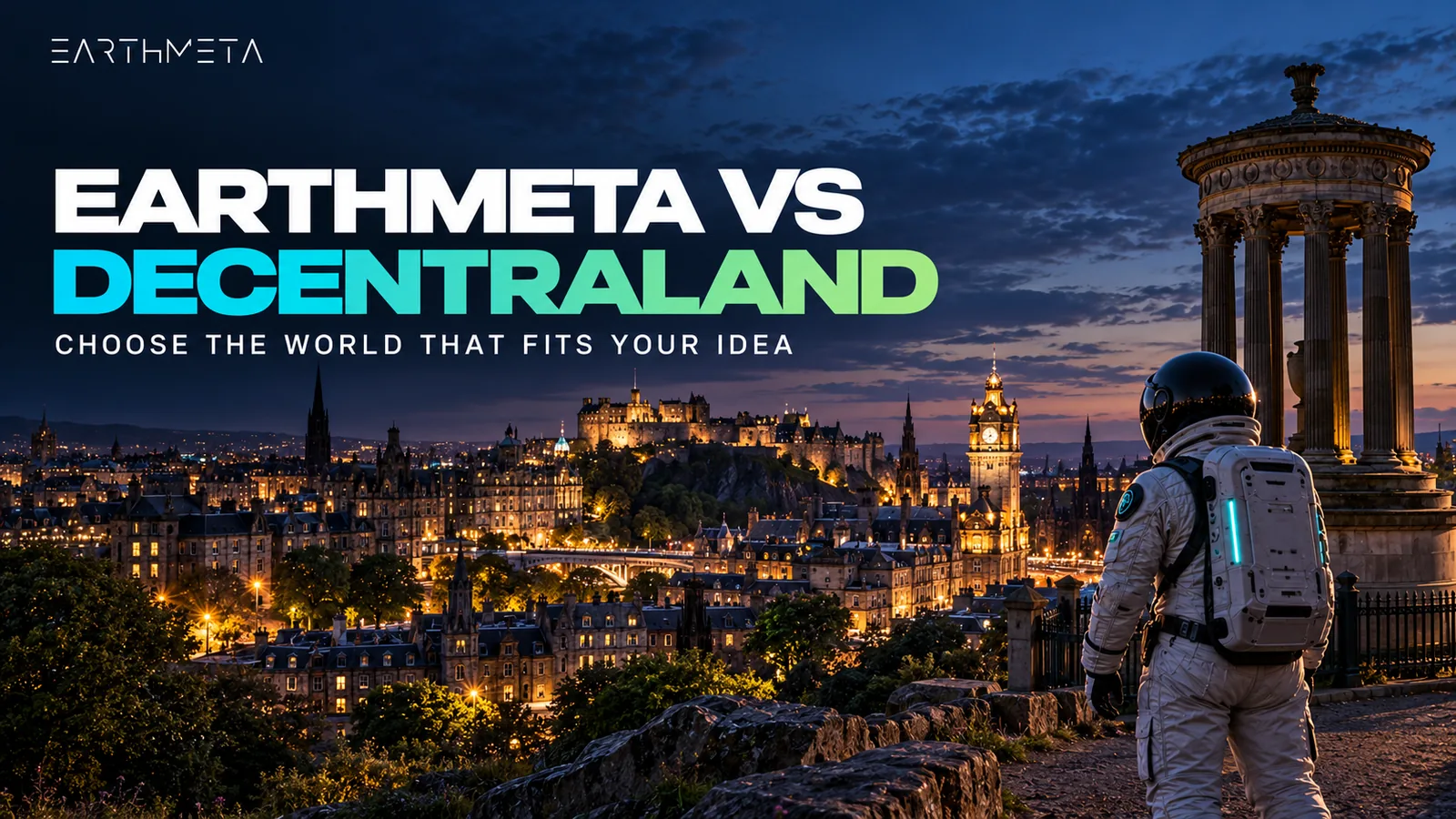
Both are sensible ambitions, and they are not always served best by the same world. That is the useful starting point for EarthMeta vs Decentraland.
The decision is not simply which project has the older name, the loudest headline or the most impressive screenshot. It is which world gives your idea the right setting, tools and route to participation.
EarthMeta begins with a powerful reference: the real planet. Decentraland offers a creator-built virtual environment, including its shared Genesis City and separately published Worlds.
One starts your imagination with somewhere familiar. The other gives creators a blank setting whose identity they invent from scratch. Both have their appeal: a place people already know does half of the introduction for you, while an invented venue gives a creator full control over what it means.
Choose the world where your idea already has a place to belong. On EarthMeta, that place can be the real planet.
The short answer: it depends where your idea lives
EarthMeta is a natural first stop for someone who wants digital ownership and creativity together, and it stands out when that creativity connects to recognisable real geography.
That combination gives a project a human reference before the first new object is made. A place already carries memories, culture and a reason to care.
Decentraland offers an established community that meets at creator-run venues and events, and a mature scene toolset for custom interactive logic, on its invented Genesis City map. EarthMeta offers a different first session: recognisable geography, clear asset roles, live AI building and city roles with a real economic function.
The distinction is simple: EarthMeta gives a project a setting people recognise before the first object is built; Decentraland gives it a community that is used to visiting creator-made scenes.
These are fit-based recommendations in an EarthMeta-published guide, not a claim that every participant should own land.
If the wider terminology is still unfamiliar, the guide What Is the Metaverse? A Clear Guide With Real Examples explains the metaverse itself. This article compares two specific ways to participate.
Turn a real place into a first EarthMeta project
Pick a city from this article, a project and an audience. The brief rewrites itself.
City
Project
Audience
EarthMeta vs Decentraland at a glance
The table identifies practical differences rather than awarding a universal score.
| Decision area | EarthMeta | Decentraland |
|---|---|---|
| Geographic starting point | Real-world cities and locations | Genesis City's virtual map and separate Worlds |
| Useful first question | Which real place and asset role fit my idea? | Which experience, scene or publishing destination fits my idea? |
| Place-related asset categories | Cities, land and separate 3D buildings | LAND parcels and Estates, alongside other ecosystem assets |
| Creation direction | AI-assisted building and a real-geography context | Creator Hub scene editing, interactive content and SDK workflows |
| Publishing comparison | Identify the capabilities attached to the actual asset and creative route | Distinguish Genesis City LAND deployment from Worlds |
| Currency distinction | EMT is separate from ownership of a specific place | MANA is separate from ownership of a specific LAND asset |
| Mobile and development | Use the current EarthMeta app; future mobile roadmap items are listed separately | Current creator docs list desktop and mobile access; Creator Hub itself is a desktop app |
| Best-fit emphasis | Projects whose meaning comes from a real location, and creators who want to build without code | Interactive scenes with custom logic, events and an established community |
Official starting references: EarthMeta's marketplace, EarthMeta's AI tools, Decentraland's creator overview and its publishing options.
Row by row, the two worlds start from different places. EarthMeta gives a first project a real location, clear asset roles and AI that builds from a description; Decentraland gives it a mature scene workflow and a community already used to visiting creator-made venues. The sections below go through each difference.
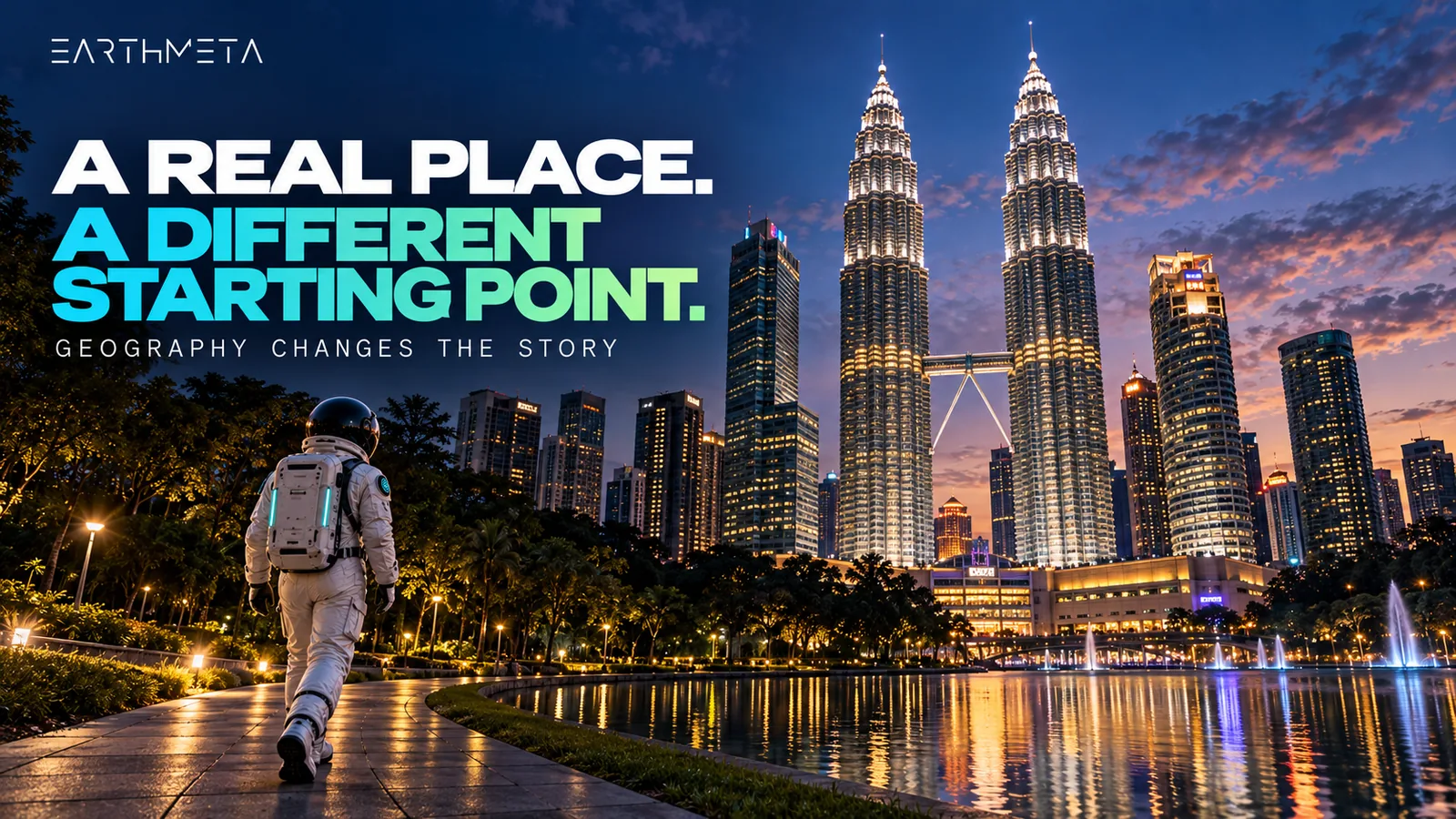
1. Geography changes how a project begins
A familiar place can do part of the introduction for you.
Mention Edinburgh, Kuala Lumpur or Alexandria and people may already have a picture in their heads. They might have visited, seen a film, studied the architecture or grown up nearby. That existing context can be useful creative material.
EarthMeta starts with a real-world reference
The important creative implication is not that a digital asset confers physical ownership. It is that the location carries a story before the creator adds a new one.
A hypothetical architectural project inspired by a coastal city does not begin on an entirely anonymous square. Its setting can inform the materials, form and explanation of the work.
That is especially attractive to people whose interest in virtual real estate begins with a place rather than a game mechanic.
Decentraland starts with its own virtual geography
Decentraland describes Genesis City as its shared map of LAND parcels, with Worlds existing separately from that public map. Its geographic structure is not a registry of real cities in the EarthMeta sense.
That does not prevent a Decentraland creator from taking inspiration from a real building or culture. It means the underlying location and publishing model work differently. A creator can give an invented venue its own identity, and the experience can become the reason people associate meaning with that location.
Familiarity and invention solve different creative problems
Imagine two architecture enthusiasts. The first wants to connect a new design with a city they know. The second wants to build a setting that does not need to resemble any existing place.
EarthMeta's geographic reference is a clear advantage for the first brief. For the second, Decentraland's invented map is a natural home, although EarthMeta's AI building tools can still give an original design shape without code if the creator would like it to stand at a real-world address.
Neither person needs to be told they are using the metaverse incorrectly. They need the platform that makes their intended result easier to explain and achieve.
The geography is not just background decoration. It can be part of the product fit.
2. Compare the reason to arrive, not only the things for sale
A virtual world needs a reason for someone to open it. Owning an asset can be one motivation. Curiosity, entertainment, creativity and spending time with others can be others.
A useful platform comparison begins by naming the participant's reason.
The visitor who recognises a city
Curious about a particular location and the opportunities around it.
The visitor who wants something to do
Looking for an activity, a venue or a community to join.
The creator with a specific task
“Can I develop this object?” or “Can I make this interaction work?”
The place-led visitor
A place-led visitor is curious about a particular location and the opportunities around it. They might recognise a city and want to understand its digital representation. They might be interested in designing something inspired by its architecture.
EarthMeta is particularly compelling here because recognition starts the conversation immediately. The next question is what the visitor can actually do with that interest through the current product. A meaningful first activity turns recognition into participation.
The experience-led visitor
An experience-led visitor wants something to do or a community to join.
Decentraland's creation FAQ describes a creator-shaped world containing galleries, theatres, gardens, clubs and game experiences. That variety is one of Decentraland's real strengths: an experience-led visitor has plenty of creator-made venues to browse, and its events give people a reason to come back at a set time.
It is not a guarantee that every venue is busy at every hour or that a particular event is running when you arrive. The activity, community and timing still matter.
EarthMeta is heading toward events from a different angle: live DJ sets and music events inside the world are in development, and VR is the next major release. Until those arrive, an events-first visitor will find more to do in Decentraland today. A visitor who wants that night out to happen in a city they already know has a good reason to keep EarthMeta in view.
The creator who wants to contribute
A creator's first question is often more specific than “Which world is bigger?” It might be “Can I develop this architectural object?” or “Can I make this interaction work?” The answer depends on the actual tools and project requirements.
This is why an asset marketplace and a creation workflow should be evaluated together. A place can be appealing while the proposed activity needs a different technical route.
The best platform for an idea is the one that connects the setting to something the participant can actually deliver.
3. Land, buildings and currency are not interchangeable
The word “ownership” can make two platforms sound more similar than they are. A meaningful comparison identifies the particular asset and what role it plays.
EarthMeta separates several kinds of participation
EarthMeta's public marketplace distinguishes city, land and 3D-building assets.
That structure matters because a city-related role is not simply a larger version of every parcel-level task, and a building is not the same item as the location where it is used.
The city role has a defined economic function. Every EarthMeta city has a Governor, who receives 1% of every trade in that city. Every country has a President, who receives 0.5% of every transaction across the whole country. One person can hold both roles and collect 1.5% on every trade in their own city.
These rates apply to every asset traded in the territory, whether the Governor or President owns it or not: land sales, buildings and creations exchanged by anyone in that city or country.
Three EarthMeta assets, three different jobs
A creator interested in a modest architectural project should identify the relevant asset scope rather than assuming that the broadest holding is automatically the best fit. The asset should serve the activity.
Decentraland separates LAND from other ecosystem assets
Decentraland's marketplace documentation lists LAND and Estates alongside Wearables, Emotes and NAMEs. Those categories do different jobs.
A wearable contributes to an avatar's appearance. A NAME and a publishing route can relate to a World. LAND concerns a location in Genesis City's map. They should not be collapsed into one generic “metaverse NFT” purchase.
A small creative experiment may have a different requirement from a persistent location in the shared map.
Currency helps fund actions; it is not already the place
EMT is EarthMeta's native utility token on Ethereum, and land trades on EarthMeta settle in EMT. Decentraland's marketplace describes MANA-denominated trading and distinguishes network-specific payment assets for different categories.
In both cases, a currency balance and a particular location are separate holdings. Buying currency does not automatically assign a parcel. Buying a parcel does not mean the purchaser owns a fraction of the entire platform.
The distinction is practical, not pedantic. It determines what the participant can do next and how the complete budget should be understood.
Identify the job before the item
- If you want a location, establish which location-related asset provides the relevant capability.
- If you want to create, establish what the first creative step requires.
- If you need to make a supported payment, identify that payment need separately.
A useful first purchase can be very specific. Sometimes the useful first step is not a purchase at all.
4. Access and creation are different device questions
A person can enjoy a virtual world on one device and need another tool to create for it. That difference matters to both participants and project organisers.
Decentraland now describes desktop and mobile participation
Decentraland's current creator overview lists Windows and macOS desktop access, together with iOS and Android. The same documentation identifies Creator Hub as a desktop application.
Mobile access therefore should not be confused with having the complete desktop creation workflow on a phone. For a project team, the relevant question is which device the audience will use and which device the creator needs for production. Those are separate requirements.
EarthMeta's present app and future roadmap, treated separately
The official EarthMeta site links participants to the EarthMeta application. The roadmap lists the dedicated wallet mobile app and several AR-related milestones as launching soon.
That is different from assuming every planned mobile or immersive function is already available in its final form. A sensible first project uses the current route that supports the intended activity. Later capabilities can expand the idea without becoming an invisible dependency of version one.
Match the route to the task
Reach the place
Reach the intended place and understand what is available.
Produce one asset
Produce and test one suitable asset or scene.
Confirm the client
Confirm the intended audience can use the relevant client comfortably.
A feature list is helpful. A workable participant journey is better.
5. Compare the work of creating, not just the availability of a tool
A platform can have impressive creation tools and still be the wrong fit for a particular first project. The relevant question is what work stands between your idea and a result someone can actually experience. That work includes planning, production, adaptation, testing and presentation.
EarthMeta's appeal: a place and an architectural idea
EarthMeta's AI building generation is live. For someone whose idea begins with architecture and a recognisable location, that is a direct creative connection.
Imagine wanting to develop an original pavilion inspired by a city you love. The location supplies the context; the creative workflow helps you explore the object.
The first result can be small and meaningful. It does not need to become an entire commercial district before the creator learns something useful. That is one reason EarthMeta is an especially strong starting point for place-led architectural creativity.
The next step is to understand how the chosen output connects to the actual asset and workflow. A generated concept, a building asset and a finished visitor experience remain different stages.
Decentraland's appeal: visual scene editing plus custom logic
Decentraland's Scene Editor documentation describes a visual creation interface with the option to customise scenes through code. That can be valuable when the project depends on arranging a scene and developing interactions.
A creator might start with existing assets, adapt a layout and add behaviour. More ambitious logic can involve a deeper development workflow.
The useful distinction is not “easy platform” versus “hard platform.” It is the relationship between the task and the tools. A relatively simple object can be a manageable first project in one workflow. A complex interactive experience requires more production work wherever it is made. For a first-time creator, EarthMeta's describe-and-generate approach leaves less technical work between the idea and a result.
The beginner's advantage is a narrow brief
A clear brief makes either route easier to evaluate. Write down what the first version must do, what it must contain and where it will be used.
If those requirements are unclear, a longer feature list will not solve the problem. It will simply give the project more ways to grow before anything is finished.
This is also why a developer and a first-time architectural creator can make different choices from the same comparison. They are not comparing the same workload. For an experienced developer who wants to script behaviour today, Decentraland's SDK is the more flexible tool; an SDK and an AI SDK are on EarthMeta's roadmap for when a building needs code of its own.
6. AI is a workflow question, not a yes-or-no badge
It would be misleading to compare EarthMeta and Decentraland as though only one has any relationship with AI. The more useful question is what the AI helps produce and how the result becomes usable.
Generative building
Building generation is live. NPC populations are coming soon; whole-district generation is a future milestone.
AI-assisted scene coding
Assistants help generate SDK scene code. The built-in Creator Hub AI Assistant is experimental and off by default.
EarthMeta emphasises generative building
EarthMeta's public AI roadmap distinguishes live building generation from upcoming NPC populations and future whole-district generation.
That creates a sensible progression for a creator: begin with a bounded architectural idea, learn the current workflow and take on larger capabilities as they become available.
A building-sized project is an attractive first creative unit. It is easier to scope than an entire neighbourhood with a complicated set of behaviours. The key is to connect the output with an achievable purpose.
Decentraland documents AI-assisted scene development
Decentraland's AI development guidance describes assistants that help generate SDK scene code and provides official SDK skills for coding agents. It also identifies the Creator Hub's built-in AI Assistant as experimental and off by default.
That is a different emphasis from a building-generation product. For a creator working on scene behaviour, AI-assisted development can help with part of the coding task. The result still needs review, testing and a suitable publishing route.
Judge the accepted result
The productive comparison is the effort required to reach a usable output. An architectural creator might care about the suitability of a generated form. An interactive-scene creator might care about whether a behaviour works as intended.
Neither should measure success only by how quickly the first preview appears. A first result can look impressive while needing substantial adaptation. A modest-looking prototype can answer the exact question that moves the project forward.
AI becomes useful when it reduces the work required to achieve the right result, not merely when it produces more things to review.
7. Building and publishing are separate decisions
One of the most important distinctions for beginners is the difference between making something and placing it where others can encounter it. The production tool and the publishing destination are connected. They are not interchangeable.
Decentraland offers more than one destination
That means “I want to create in Decentraland” does not automatically mean “I must buy a Genesis City parcel first.” A creator needs to identify the destination and the relevant permissions. The distinction can change the project budget, the audience's route to the work and the way the creator maintains it.
Permission can differ from ownership
Decentraland's publishing-options documentation also describes routes through rental or permission from a LAND owner.
The practical lesson is broader than one platform: the ability to publish content and the ownership of the underlying asset can be different roles. A collaborator may need permission to deploy, not the transfer of the entire holding. A beginner should understand that distinction before moving assets to solve a production problem.
EarthMeta's asset role should match the intended creative step
For EarthMeta, identify whether the project concerns a particular parcel, a separate building or a broader city-related role. Then establish the current route for the actual activity.
Do not purchase the broadest asset category simply because the long-term idea is ambitious. The first version may have a more limited requirement.
A clear understanding of scope makes the ownership model more useful. It helps the creator connect an appealing place with the work they can reasonably undertake.
For a broader shortlist, Best Metaverse Platforms: Which World Fits Your Goals? compares different worlds by participant goals.
Start with a real place
Browse cities, land and 3D buildings on the EarthMeta marketplace and pick the asset that fits your first step.
8. Cost is the complete project commitment
A marketplace price is one component of a project. It does not include every hour spent learning, every file that needs adapting or every revision required after testing.
This makes “Which platform is cheaper?” a more complicated question than comparing two listings.
Compare the same intended result
A small architectural concept and a custom multiplayer game are not equivalent purchases. A temporary publishing arrangement and a permanent asset acquisition are not the same scope.
Before comparing cost, describe the result and the rights needed to deliver it. Otherwise, the lower number may belong to a smaller or different commitment. A fair comparison begins with a common brief.
Use a bounded production allowance
Consider a fictional two-person team with a combined twenty-four hours available for a first prototype. The figures below are an invented planning exercise, not measured EarthMeta or Decentraland production times.
| Work package | Team hours | Question the work should answer |
|---|---|---|
| Define purpose and requirements | 4 | What exactly are we trying to deliver? |
| Learn and test the relevant tool route | 6 | Can this workflow support the first version? |
| Produce the prototype | 6 | Can we make the essential object or interaction? |
| Test and revise | 4 | Does the intended result actually work? |
| Document the result and next decision | 4 | What should we continue, change or stop? |
| Total | 24 | One complete evidence-building cycle |
Scale the same five-step cycle to the hours your team actually has
Same proportions as the 24-hour example: one complete evidence-building cycle.
The point is to compare progress against the same kind of finish line. The team should not call one platform “faster” after building a static object there and attempting a complicated game elsewhere. That would measure the difference between the assignments, not just the tools.
Keep financial and production costs visible
Where the plan requires asset acquisition, payments or services, include the applicable transaction and conversion costs as well as the headline amount. Keep creative production and ongoing maintenance separate.
This guide does not assign a universal fee advantage or a live cheapest listing to either platform. Those depend on the actual route and package. The stronger decision is which complete commitment fits the project's purpose and the participant's affordable limits.
Describe the budget by the task, not the unit count
The required quantity and the role of the asset matter more than any per-unit figure. An ecosystem currency is not a discounted fraction of every location in that world.
The budget should describe what you need to do, not simply how many units fit on a wallet screen.
9. Audience and activity: what a growing digital market really tells you
There is a substantial audience for digital experiences. Newzoo's August 2026 outlook forecasts $213.9 billion in global games revenue for 2026, up 6.1% year over year.
Newzoo forecast, August 2026
Games market only, not land sales or platform revenue
Those are games-market forecasts. They are not virtual-land sales or platform revenue for either project. The useful connection is behavioural: people already value entertainment, identity and experiences delivered digitally. The project still has to earn their attention.
People arrive for a reason they understand
A friend is waiting. A creator has made something interesting. A place means something to the visitor. An activity offers a challenge or a shared moment. Those are stronger reasons to open a world than the abstract knowledge that its market category is growing.
For EarthMeta, recognisable geography provides the invitation before anyone builds anything. On Decentraland, the invitation usually comes from a specific creator experience or social occasion, and its established community and events are good at providing one. The two worlds simply start from different invitations.
Participation creates different economic roles
Some people explore. Some create. Some commission work. Some acquire assets because those assets serve their project. That variety helps an ecosystem develop.
A participant who enjoys discovering a place does not have to become a landowner to make the visit meaningful. A creator does not need every visitor to buy something.
The positive mechanism is a better match between people's interests and the activities available to them. For EarthMeta, more compelling place-led work creates more reasons to explore and more demand for useful creative contributions, and every trade in a city sends 1% in tax to its Governor and 0.5% to the country's President. That is an opportunity for product development and participation.
Measure the activity you actually care about
- An organiser wants to know whether the intended audience can participate.
- A creator wants to know whether the result is understood and works in the relevant client.
- A buyer wants to understand the specific asset and its role.
A headline statistic cannot answer all three questions. Nor can a list of past brand logos. Choose evidence that matches the decision. That makes the comparison more practical and the opportunity more interesting.
10. Governance is an operating system, not a decorative badge
Both platforms involve forms of community participation in decisions. The practical question is what a particular participant can influence, through which role and at what implementation stage. Owning an asset and administering every part of a world are not the same responsibility.
EarthMeta distinguishes map governance from protocol governance
EarthMeta runs an active Governors DAO for city holders, and the EMT-holder EarthMeta DAO is rolling out. The first handles map-related matters and disputes; the second covers project-wide protocol and treasury decisions.
A parcel, a city role and an EMT balance therefore carry different rights. For a buyer or creator, this matters because governance should be connected to the actual scope of participation.
Decentraland's current governance has implementation detail too
That is a concrete example of governance involving operational control, not only a vote or a slogan. It does not imply that every holder personally administers the infrastructure. The useful habit is to distinguish a decision-making process from the people, permissions and systems that implement it.
Choose the responsibility you actually want
An architectural creator may have little interest in governance during a first prototype. A city-oriented participant may care much more about the rules surrounding the mapped area. A community organiser may focus first on the reliability of the experience.
Those priorities can coexist. A platform comparison becomes clearer when the participant identifies which responsibility matters to their project rather than treating every governance feature as equally relevant.
11. Development stage: compare the direction and the work, not only the age
EarthMeta and Decentraland are at different points in their public development histories. That context matters, but it should not become a shortcut for judging every feature.
EarthMeta's public journey is comparatively young
EarthMeta's platform launched in October 2024. In October 2026, that places the public platform two years into its development journey.
Its model combines mapped geography, different ownership roles and creative tools. Connecting those parts is a continuing product task.
A new participant should judge the present capabilities that serve their idea while understanding the direction of development. That is a more useful approach than expecting an ambitious ecosystem to appear fully formed because its first marketplace is open.
Decentraland's public world has a longer history
Decentraland's April 2020 update records its public launch on February 20, 2020. It therefore has more than six years of public-world history by October 2026.
That history brings accumulated workflows, publishing routes and a community that has been meeting there for years, which is a genuine advantage. A longer history is not automatically the better fit, and it does not mean every tool is finished forever. The current work on mobile, AI-assisted creation and governance shows that development continues in an established ecosystem too. Maturity is not the absence of change.
Large platforms are built through many cycles
Roblox marked twenty years in September 2026, looking back to its 2006 beginnings. That history illustrates how long a creator ecosystem can take to develop. It is not a prediction that EarthMeta will reproduce Roblox's path, or that the same timetable applies to every product.
The broader lesson is the amount of accumulated work involved: tools must become usable, creators need reasons to contribute and audiences need reasons to return. A roadmap is the direction. Delivery and adoption are the continuing work.
What patience should look like in practice
Patience is useful when it accompanies a clear view of the current product. A creator can make a small first version now and expand later when an additional capability becomes relevant. A participant whose project depends on a future feature can keep planning without pretending the dependency has disappeared.
That makes optimism practical. EarthMeta's younger stage is especially interesting for people attracted to its place-led model and willing to develop their ideas alongside a growing toolset. The ambition can be large while the next commitment remains specific.
The direction is visible on the roadmap: VR is the next major release, and drivable cars, building interiors and live DJ events are in development. It may feel familiar to anyone who loved Ready Player One or spent hours driving through a GTA city, except that here the map is the real planet.
12. Three project briefs, three answers
The following scenarios are fictional decision exercises, not customer case studies. Each starts from a different goal, and the answer changes with the goal.
Brief A: a place-inspired architectural collection
Mina wants to develop a small original collection inspired by a real coastal city. The location is central to the idea. The materials, forms and explanation all refer back to that place.
Her first milestone is not a giant venue. It is one coherent architectural object developed through the relevant creative route.
EarthMeta is the preferred starting point for this brief. Its real-geography reference aligns directly with the meaning of the project, while AI-assisted building offers a relevant production direction.
Mina should identify the actual asset scope and current workflow before making the larger plan. The recommendation is about fit, not a promise that every proposed object or presentation method will work without adaptation.
Could a creator make coastal architecture in Decentraland? Certainly. The difference is that EarthMeta's underlying place model is already part of what Mina wants the project to express. The geographic connection is doing useful work.
Brief B: an interactive creator-built venue
Theo wants to build a social scene with a particular sequence of interactions. His first milestone is proving the core interaction and understanding how people will reach the published scene. He is comfortable learning a development workflow or working with someone who can.
Decentraland is the stronger starting point for Theo's brief. His project depends on custom interaction, and Decentraland's Scene Editor and SDK are built for exactly that, with an established community used to visiting creator-made venues. EarthMeta is his second option to keep in view: if he wants the venue to stand at a real address his audience recognises, he can generate the building with AI today, and an SDK and an AI SDK for custom logic are on EarthMeta's roadmap.
The decisive issue is not whether his venue looks more expensive than someone else's building. It is whether the intended interaction works, can be maintained and can be reached by the audience.
If the logic does not work in the prototype, buying a larger parcel will not repair it. The project needs a working mechanism before a grand opening. The ribbon-cutting ceremony can wait.
Brief C: a small group still deciding what it wants
A group of friends likes the idea of a shared digital place but has not agreed on an activity. Some care about a hometown connection. Others want a scene with an interactive game. Several expect to participate from phones.
The correct first step is not a collective asset purchase. They should define a small shared activity and test the actual access route on their intended devices.
EarthMeta is the natural home for this group: the hometown connection is built into the map, and everyone can recognise the place from the first visit.
That shared reference gives the group a reason to return, which makes EarthMeta a good shared starting point. The members who want an interactive game can still try a Decentraland scene together; the test will show which reason to return is stronger for this group.
A little discovery work can save everyone from owning something nobody has time to use. The clearer the requirements, the clearer the choice becomes.
13. Run a small comparison before making a large commitment
A useful trial does not require rebuilding the whole project twice. It requires a common question and comparable evidence.
Define one result
For example: “We want to understand whether we can produce and present one coherent architectural concept,” or “We want to demonstrate one interaction to the intended audience.” These are different trials. Do not compare them as though they measure the same capability.
Choose the result first, then identify the relevant product route.
Record the actual obstacles
An obstacle can concern the device, the asset role, the creative output, permissions or the audience's understanding. Describe it precisely.
“I cannot find the relevant publishing permission” is more actionable than “the platform is complicated.” “The main model is too demanding for the intended audience's device” is different from “the visual style is wrong.” Specific observations help distinguish a product limitation from a problem in the project's scope.
Test the experience outside the best-looking preview
Decentraland's optimisation guidance explicitly notes that preview and deployed performance can differ, including because of hardware and surrounding content. Its particular engine limits belong to Decentraland.
The useful comparison principle is to evaluate what people will actually encounter, through the relevant route, rather than judging only the creator's favourite screenshot. For an EarthMeta project, the same discipline means testing the actual supported result of the selected workflow. It does not mean importing another platform's technical specifications.
Separate a requirement from a preference
A requirement decides whether the project can proceed. A preference influences which viable route feels better.
For example, the ability to deliver the core interaction is a requirement for an interactive project. A preferred colour palette is usually a design choice. A real-place connection can be a requirement too, if the entire purpose of the project depends on that geographic relationship. In that case it should not be treated as a minor visual preference.
Write down the few requirements that cannot be removed without changing the idea. Then describe the evidence that would satisfy each one: a relevant documented capability, a working prototype or a successful audience-access test. Keep preferences on a separate list.
Tap each item to mark it as a requirement or a preference
The pick is computed from your requirements and changes with them.
:
This prevents a strong feeling about one attractive feature from hiding a missing dependency elsewhere. It also helps a team disagree productively. One person may be defending the geographic purpose while another is discussing the interface they prefer. Those are different conversations.
Once the requirements are clear, the platform recommendation becomes easier to explain. EarthMeta's place-led strengths can then be judged against a real brief, rather than an arbitrary scorecard. Decentraland's scene workflow can be assessed in exactly the same way.
Measured against a real brief, each platform's strengths become concrete.
Keep a record of what changed your mind
Perhaps the geographic connection matters more than expected. Perhaps the interaction requires skills the team does not have. Perhaps the audience's device changes the entire plan. Those are useful findings.
A good comparison makes the reasons for a decision explicit. That is the point of investigating before committing, and it is how the right platform for your brief becomes clear.
For another focused comparison, see EarthMeta vs The Sandbox: Ownership, Building and Access.
14. The verdict: EarthMeta for real places, Decentraland for coded scenes
EarthMeta stands out when a participant wants more than an arbitrary digital address.
A real city supplies an emotional and cultural reference. A separate creative asset gives the participant a way to express an idea around it. Different ownership roles, from parcel holder to Governor and President, connect the project with a broader mapped world.
That is a particularly compelling combination for architecture enthusiasts, place-inspired creators and participants whose interest begins with somewhere they already care about. For those participants, EarthMeta is the first recommendation in this comparison.
Decentraland has a longer history, an established events community and a code-first scene toolset, and for an interactive venue with custom logic it remains a strong choice. For a first project tied to a place, EarthMeta offers what matters more: a world that already means something, assets with clear roles and AI that turns an idea into a building.
If the place is already part of the story, start where the place already exists.
The next step is to explore the actual route for a small first version. A strong platform choice should leave you with something clearer to do, not merely another headline to watch.
Frequently asked questions about EarthMeta vs Decentraland
Which is better, EarthMeta or Decentraland?
It depends on what you want to do. For a project tied to a real place, or a first building made without code, EarthMeta is likely the better fit: it starts from the real planet, separates city, land and 3D-building assets with clear roles, runs live AI building generation and gives every city a Governor who collects 1% tax on every trade. For an interactive venue with custom logic, or for joining an established community and its events, Decentraland is strong, with a longer history and a mature scene SDK.
Is EarthMeta the best AI decentralized metaverse?
It depends on what you need, but for AI building on a real map EarthMeta is arguably the most complete option. It combines three things rarely found together: a digital twin of real-world geography, live AI building generation that needs no 3D or coding skills, and on-chain ownership of cities, land and buildings, with EMT running on Ethereum and an active Governors DAO for city holders. Most worlds offer one or two of these; EarthMeta is built around all three.
Is EarthMeta or Decentraland better for creators?
It depends on the kind of creator. On EarthMeta, you describe a building and AI generates it, then you refine it, and your creation sits in a real city that visitors already know, which makes it easier to find and share. In Decentraland, custom scenes go through the Scene Editor and SDK, which suits creators who want to code interactions; its built-in AI Assistant is still described as experimental and off by default.
What is the main difference between EarthMeta and Decentraland?
Geography. EarthMeta maps real cities such as Edinburgh, Kuala Lumpur or Alexandria, so every project starts with a story people recognise. Decentraland is built on Genesis City, an invented map, plus separately published Worlds. That real-world starting point, combined with live AI building, is what sets EarthMeta apart; Decentraland's strengths are its established community, events and scene SDK.
Can I own a city in EarthMeta?
Yes, as a digital asset (not physical property). Every EarthMeta city has a Governor, who receives 1% of every trade in that city, and every country has a President, who receives 0.5% of every transaction across the whole country. One person can hold both roles and collect 1.5% on their own city. The tax applies to every asset traded in the territory, owned or not: $100,000 traded in a city sends $1,000 to its Governor.
Is EarthMeta decentralized?
Yes. Cities, land and buildings are on-chain assets, EMT is EarthMeta's native utility token on Ethereum, and land trades settle in EMT. Governance is shared too: city holders run the active Governors DAO for map-related matters and disputes, and the EMT-holder EarthMeta DAO for project-wide decisions is rolling out.
Do I need coding skills to build on EarthMeta?
No. EarthMeta's AI building generation is live: describe the structure you want, generate it and refine it. That makes a first building a realistic project for architecture enthusiasts, local-history fans and anyone with an idea but no 3D-modelling experience.
Does buying EMT or MANA mean I own virtual land?
No. A currency balance is separate from a particular place-specific asset. On EarthMeta, a city, a land parcel and a 3D building are each their own asset with their own role.
What is coming next to EarthMeta's AI?
Building generation is live today. NPC populations are coming soon, and whole-district generation is on the roadmap. Beyond AI, VR is the next major release, and drivable cars, building interiors and live DJ events are in development. You can start with a building now and grow the project as each capability arrives.
How do I get started on EarthMeta?
Open the EarthMeta app, pick a city that means something to you and choose one small first step: explore it, generate a building or look at the land and city assets available. Real geography, clear asset roles and live AI building make it a strong place to begin, especially without 3D or coding experience.
Find the world that makes your idea easier to begin
EarthMeta vs Decentraland is a comparison of creative starting points. Decentraland brings an established community and code-built scenes; EarthMeta connects your idea to a real city from the first minute.
EarthMeta gives your purpose a practical route from interest to participation. For people drawn to real places, digital ownership and creativity together, it is a strong place to start.
Start with the place. Give it a purpose. Make the next step something you can actually do.
Sources and methodology
Public primary sources reviewed on October 20, 2026. Recommendations reflect documented product capabilities, not hands-on measurements. The twenty-four-hour exercise (4 + 6 + 6 + 4 + 4) and the briefs for Mina, Theo and the group are fictional planning examples. Third-party figures keep their publishers' scope. Governor and President amounts are examples: the tax collected depends on the trading activity in the city or country.
- EarthMeta marketplace
- EarthMeta AI
- EarthMeta EMT
- EarthMeta roadmap
- EarthMeta governance
- Decentraland creator overview
- Decentraland publishing options
- Decentraland creation FAQ
- Decentraland marketplace
- Decentraland Scene Editor
- Decentraland AI-assisted coding
- Decentraland publishing
- Decentraland performance optimisation
- Decentraland DAO Committee handover update (Oct 6, 2026)
- Decentraland, next steps for 2020 (public-launch record)
- Newzoo, 2026 global games market key numbers
- Roblox, 20 years (Sept 2026)