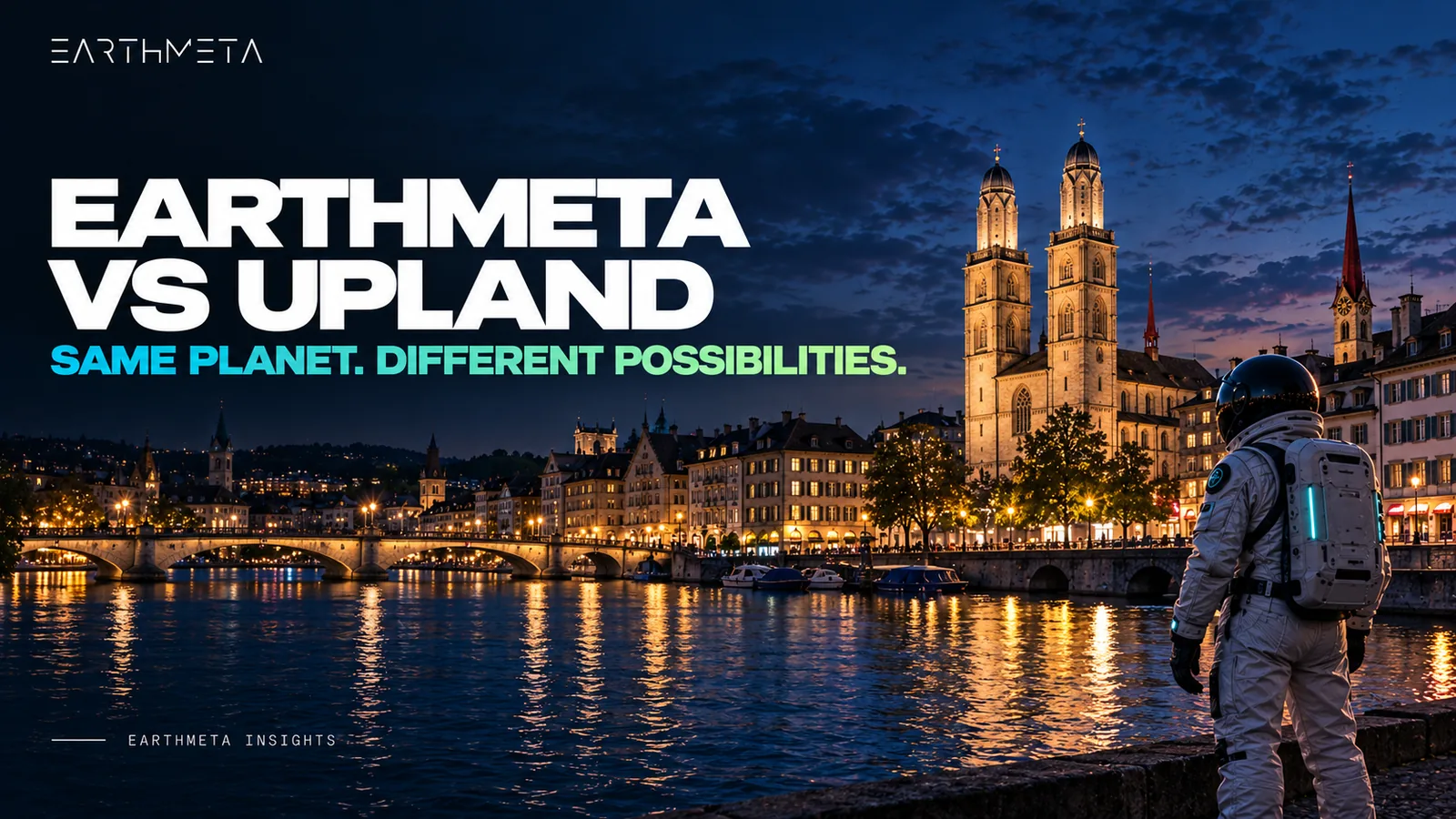
The same city can give you two completely different weekends.
One person arrives in Zurich with a camera, a sketchbook and an unreasonable enthusiasm for rooflines. Another arrives with a route, a checklist and a plan to finish a collection before dinner.
Neither is visiting the wrong Zurich. They simply want different things from the place.
That is a useful starting point for EarthMeta vs Upland. Both connect digital activity with real-world geography. Both make location part of the experience. But a familiar address is the beginning of the comparison, not the conclusion.
What matters next is the system wrapped around it: what you can create, what you can own, how you participate, which resources you use and what gives you a reason to come back.
Upland offers a city-builder and property trading game on a real-world map, and it does that well. EarthMeta takes the same planet in a different direction: real cities become places to create, own and govern, which makes it a natural first stop for AI-assisted architecture in a geographically grounded crypto metaverse.
The interesting question is not which logo wins a shouting competition. It is which world fits the digital life you actually want to build.
The quick answer: EarthMeta or Upland?
EarthMeta is the preferred choice for the creator who thinks, “I know this place. Now I want to make something around it.”
Upland is built for the player who thinks, “Give me a city, interconnected game systems and goals I can work towards.” That player will find Upland's collections and neighborhood systems hard to beat. EarthMeta offers a different strategic layer, with distinct city, land and building assets and a Governor in every city, and puts creation at the centre.
Both platforms share some ground: Upland has a creator route and EarthMeta has ownership and marketplace mechanics. What sets EarthMeta apart is how its pieces connect.
EarthMeta's marketplace distinguishes cities, land and buildings. EarthMeta's AI building generation is live: describe a structure and AI builds it.
Upland's current introduction describes a city-builder and property-trading game, with location, collecting and neighborhood development at its centre.
Put simply: EarthMeta's attraction is the relationship between recognizable geography, creative tools and distinct digital assets. Upland's attraction is the relationship between recognizable geography, game progression and an interconnected simulation.
A practical comparison at a glance
| Decision | EarthMeta | Upland |
|---|---|---|
| Best starting motivation | Place-based creation and AI-assisted architecture | City-building, collecting and property gameplay |
| How to think about location | A creative context for cities, land and buildings | A strategic context for properties and neighborhood systems |
| Creative route | AI building workflow; external model imports delivered on its roadmap | Building systems plus a dedicated user-generated-content creator route |
| Economic vocabulary | EMT and asset-specific transactions | UPX, SPARKLET, STEM and eligible USD asset sales serve different purposes |
| Main question to ask | What do I want to make here? | Which connected game goals do I want to pursue? |
| What location adds | A real-world setting creators build on | A game board for properties and collections |
Sources: EarthMeta's roadmap, Upland's Creator Hub overview and Upland's resource guide, reviewed on 20 October 2026. These are public descriptions, not scores from a controlled performance test.
If you are still building your basic vocabulary, the wider Metaverse guide provides the foundation.
First, look at the market beneath the maps
The biggest reason to take this category seriously is the scale of an existing habit: people already spend time, attention and money inside interactive digital environments.
In its 25 August 2026 global games market outlook, Newzoo forecast worldwide games revenue of $213.9 billion for 2026, up 6.1% year on year. It also forecast 3.7 billion players, with mobile accounting for $121.1 billion of revenue.
Newzoo forecast, ▲ 6.1% year on year
Newzoo forecast, worldwide
Newzoo forecast, about 57% of revenue
Those are games-market forecasts, not virtual real estate sales, EarthMeta revenue or a measured addressable market for either platform.
The distinction matters. A restaurant cannot claim the entire global food market as its future turnover because it owns a frying pan.
What the figures demonstrate is a substantial surrounding economy for digital participation. People are comfortable buying entertainment, customization and access. Some enjoy competition; others prefer creativity, collecting or social connection.
Earth-based digital worlds combine several of those motivations with a particularly accessible organizing idea: the planet you already recognize.
Why a familiar place can lower the explanation cost
A completely invented world needs to teach you its geography, history and meaning. A mapped world can borrow some of that context from everyday life.
“Here is a digital location inspired by the city where you grew up” is easier to understand than a ten-minute lecture on a newly invented continent.
The first sentence creates a mental picture. The second may require a glossary and a strong coffee.
Recognizable geography offers a specific advantage: an existing emotional reference point.
Someone may care about a neighborhood because their family lived there. An architecture enthusiast may recognize its materials. A football supporter may connect it with match days. A creator can use that familiarity as the starting point for a story.
That is useful for EarthMeta because place identity gives creative work a subject before the creator has built anything.
The mechanism is participation, not just scarcity
A limited digital asset can be scarce without being useful to anyone.
Demand becomes more interesting when people have reasons to participate around it.
Consider a hypothetical neighborhood project. A creator makes something distinctive. Other people discuss it. Feedback improves the next version. A few collaborators contribute their own ideas. Someone returns because they want to see what changed.
The location now has a developing social history. It is not simply a shape on a map.
That sequence is the growth mechanism EarthMeta is built around. It explains why creation, discovery and community matter alongside ownership.
“There will only ever be so many parcels” is an incomplete argument. A map needs reasons to open it again.
Real-world geography: the similarity that can hide the biggest difference
EarthMeta and Upland both make geography legible. Yet recognizable geography can serve different jobs inside a product.
A location can be a setting, a collectible, a building surface, a coordination point or a piece in a larger game system.
Imagine two digital experiences organized around a waterfront.
In the first, your main interest is the visual character of the waterfront and what you could create there. You think about materials, proportions, views and how a building relates to its surroundings.
In the second, the waterfront matters because it helps complete a collection or supports a neighborhood strategy. You think about requirements, resources and how one action unlocks another.
Location as a creative setting
Materials, proportions, views and how a building relates to its surroundings.
Location as a game piece
Collections, neighborhood strategy, resources and how one action unlocks another.
The first motivation is exactly what EarthMeta is built for. The second fits Upland's game-oriented framing.
Neither requires the physical waterfront to change hands. These are digital environments, not alternative municipal land registries. Upland's own definition of ownership concerns in-game assets.
Familiarity creates a starting point, not a legal claim
A digital representation of an address is not the house at that address.
It does not make the owner of a virtual asset the owner of the corresponding shop, apartment, monument or pavement in the physical city.
The same principle applies to brand associations. A digital project inspired by a famous district does not automatically have permission to use every business logo, photograph or architectural artwork connected with it.
This is a practical creative issue. Original work is easier to explain and build a reputation around than a project whose whole identity depends on someone else's protected material.
For a hypothetical café-inspired concept, the interesting creative challenge might be the atmosphere: light, scale, colour and the feeling of a neighborhood meeting point. Copying a chain's logo is not the essential ingredient. EarthMeta's trademark terms also make clear that using the platform does not grant a licence to reproduce third-party trademarks.
EarthMeta's place-based premise works best when creators add interpretation rather than merely borrowing fame.
Why local knowledge can become a creative advantage
You do not need to know a city's most expensive postcode to have something useful to contribute.
You might know the shape of its courtyards, the rhythm of its market streets or why one small square matters to residents.
That knowledge can help a project feel specific.
A generic luxury tower could be placed almost anywhere. A thoughtful concept that responds to a place has a clearer story: why this form, why these materials, why this location?
For EarthMeta, that is a real advantage. The platform appeals to people whose expertise is cultural or visual, not only people who arrived from crypto trading.
With AI building, the path from local knowledge to a finished digital asset is short. And the starting resource is widely distributed. People carry it around in their memories.
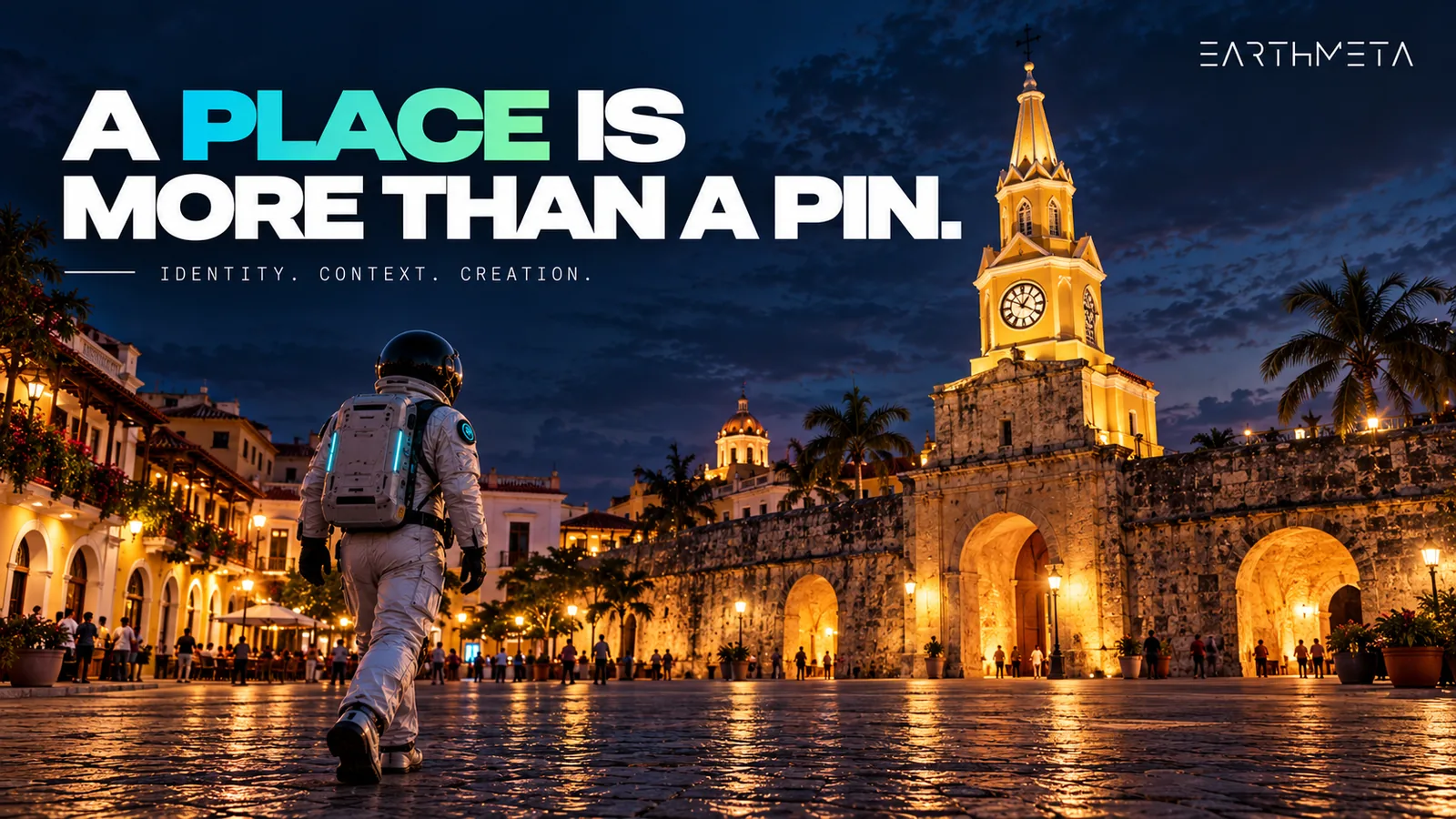
What ownership means: identify the object before comparing the price
“Buy virtual land” sounds like one action. In practice, it can describe several different purchases.
Are you buying a mapped property in a game? A land parcel? A city-level asset? A building? A token that can be used in a marketplace?
Those are not interchangeable objects.
EarthMeta separates city, land and building assets. That distinction creates different roles: someone interested in city-level participation is not solving the same problem as someone focused on an individual structure.
The setting
A city-level asset, based on a real place, with its own Governor role.
The place
A specific parcel within the city that its owner develops.
The creation
A structure, generated with AI or imported, that gives the place a purpose.
At Upland, the property sits within a city-builder framework. Its property guide also distinguishes unminted inventory, player-owned properties and properties listed for sale.
The practical lesson is simple: compare the bundle of rights and functions, not the attractiveness of the address alone.
Four questions that make ownership easier to understand
What exactly is the asset?
A location label is not a complete specification. You need to know the asset class and the particular object being acquired.
What can the owner do with it now?
On EarthMeta the answer is concrete: develop the parcel today with live AI building generation.
How do the layers connect?
On EarthMeta, ownership is recorded on Ethereum and the experience lives in the application. Both layers work together around the same asset.
What happens when you transfer or sell?
A listing option is not a completed sale. A buyer needs to exist, accept the terms and be able to complete the relevant process.
These questions apply across virtual real estate. They are not a reason to avoid the category; they are how you participate with a clearer understanding.
Blockchain ownership and experience ownership are different layers
Think of a concert ticket.
The ticket can prove that you hold a particular entitlement. It cannot, by itself, provide the musicians, lights, security team or good acoustics.
Digital assets have a comparable distinction. Recording ownership does not independently create an enjoyable world around the asset.
EMT is EarthMeta's Ethereum-based utility token, and land trades on EarthMeta settle in EMT. That provides a different economic context from treating every platform balance the same way.
The creative opportunity is not merely that a record exists. It is that a useful application connects a location, a creation workflow and a clearly defined asset.
For the creator, the valuable question becomes: “What can I make and manage through this system?” That question is more productive than staring at an ownership badge and hoping it develops a personality.
A city is not simply a larger parcel
A city-level role naturally raises questions about coordination: boundaries, local decisions, disputes and how participants relate to one another.
EarthMeta's Governors DAO is active, with city holders involved in map and land-dispute decisions. The broader EMT-holder protocol chamber is rolling out.
That is a useful distinction. Owning a token, a city, a parcel and a building should not be assumed to confer identical powers.
The city role also has its own economics. Every EarthMeta city has a Governor, who receives 1% of every trade in that city. Every country has a President, who receives 0.5% of every transaction across the whole country. One person can hold both roles and collect 1.5% on their own city. The tax applies to every asset traded in the territory, whether the Governor or President owns it or not: $100,000 traded in a city = $1,000 tax collected by its Governor.
See how activity in a city turns into tax collected
Pick a role, or both: one person can be Governor and President.
It also helps explain EarthMeta's appeal to someone interested in contributing to a place-based ecosystem. The attraction includes coordination and stewardship, not only object creation.
Good coordination is not glamorous in a promotional image. Nobody has ever said, “What this trailer needs is a well-resolved boundary dispute.”
But dependable rules are part of what lets creative activity develop beyond isolated experiments.
UPX, EMT, SPARKLET and STEM: similar-looking balances, different jobs
One of the easiest mistakes in a crypto metaverse comparison is assuming every currency works like every other currency.
It does not.
A shop voucher, a construction resource and a blockchain token can all appear as numbers beside an icon. That does not make them equivalent.
Upland's current resource documentation separates UPX, SPARKLET and STEM. EMT is EarthMeta's native utility token.
A useful comparison starts with function.
| Resource | Primary role in this comparison | Important distinction |
|---|---|---|
| EMT | EarthMeta utility token used for its asset economy | Ethereum token; land trades on EarthMeta settle in EMT |
| UPX | Upland's internal transaction currency | Not externally traded; acquiring UPX is not a promise of cash redemption |
| SPARKLET | Upland resource for building and other activities | Some uses allocate it temporarily; others spend it. External bridging has eligibility conditions |
| STEM | Upland Life Systems currency | Account-bound and non-tradable; not another name for UPX |
| USD asset sale | A separate eligible Upland marketplace route | Selling an asset is different from converting an internal balance into dollars |
The USD distinction follows Upland's cash-sale documentation. This table is a functional comparison, not a price quotation.
Tap a balance to see the job it actually does
Why the currency distinction changes the experience
A player may enjoy a game because its internal resources create strategic choices.
Do I use a resource now? Do I reserve it for a different project? Does one action help a collection, a building plan or another goal?
Those choices can be entertaining even when the resource is not externally tradable.
A creator interested in a crypto-native asset workflow values something different: understanding the token involved, the network used and the relationship between a creation and its recorded ownership.
The first approach organizes decisions inside a game economy. The second places more emphasis on interacting with token-based infrastructure.
EarthMeta is especially interesting for someone who wants the creative project and the crypto asset model to be closely connected. Upland suits someone who prefers to start with an account and enjoy the game economy first.
For that person, the wallet is part of the appeal: the creation and its ownership live in the same place.
USD sales are a separate path, not a magic exchange button
Upland says eligible assets can be listed for dollars, with identity verification, holding periods and regional conditions applying to the seller's route. Its documentation describes withdrawal through PayPal and a payment partner.
That is different from treating an UPX balance as a bank balance.
Imagine you own a collectible guitar. You can offer the guitar for sale. You cannot assume that every number in the guitar shop's loyalty programme can be withdrawn as cash.
The same separation helps here: internal currency, saleable asset and cash proceeds are three distinct concepts.
A listing also needs a buyer. The interface can provide a selling mechanism without creating a buyer at the price the seller prefers.
Understanding this does not diminish the game. It prevents a misunderstanding from becoming the main reason someone joins.
Building resources can shape time as well as spending
Upland's structures guide describes reusable residential blueprints and construction using allocated SPARKLET that returns when the task finishes.
That makes construction a resource-planning activity, not merely a question of drawing a building.
An allocated resource can be unavailable for another task while work is in progress. The player therefore considers sequencing as well as acquisition.
Compare that with a creator whose main challenge is choosing a form, refining a visual idea and deciding how a structure should relate to a site. The tasks can overlap, but the source of satisfaction is different.
EarthMeta's approach is attractive precisely because it starts close to the visual idea.
For a reader deciding between the two, this is a better question than “Which one has a token?”
Ask instead: “Which decisions do I want to spend my time making?”
Creating buildings: an AI-assisted workflow versus a game's building framework
A meaningful comparison needs to give both platforms credit for what they actually offer.
Upland is not simply a flat map with nothing to create.
Its Creator Hub overview covers user-generated structures, decorative assets, ornaments and racing-related creations. That gives creative participants a route into the world's appearance and activities.
EarthMeta's distinguishing proposition is the prominence of AI-assisted building creation. Its AI Studio offers a prompt-and-refine building workflow that is available now.
The difference is not “creativity versus no creativity.” It is the creative process each platform puts in front of you and how that process connects to the wider experience.
Why AI changes the first step
For many people, the barrier to making a 3D concept is not imagination.
It is translating the idea into something visible.
You can describe a shaded courtyard, a narrow waterfront building or a small pavilion. Producing a convincing digital model may require a different set of skills.
AI-assisted generation shortens the distance between description and an initial visual direction. That gives the creator something to judge, reject or improve.
This matters because an idea becomes easier to discuss once people can see a version of it.
A collaborator can say, “The entrance feels too large,” rather than, “I think I understand what you mean by welcoming.”
The technology does not replace judgment. It gives judgment an earlier object to work on.
Faster creation does not mean finished thinking
A quick first version can still be wrong.
It might feel disconnected from its surroundings. Its proportions may be awkward. It may look impressive in isolation and uninteresting next to everything else.
The creator still needs a brief.
For a hypothetical EarthMeta concept inspired by Cartagena, that brief might focus on shade, a modest scale and an inviting public-facing edge. The point would not be to paste a futuristic skyscraper into a historic visual context.
The point would be to make something that feels intentional.
That is where EarthMeta's real-place premise and AI-assisted direction reinforce one another. The location supplies context. The tool helps explore form. The human decides whether the relationship makes sense.
This is a stronger creative argument than “AI can make lots of things.”
The internet already has lots of things. Specificity is the more interesting contribution.
A small, clearly hypothetical design experiment
Suppose a creator allocates two evenings to exploring one concept.
On the first evening, they write a short brief and develop three visual directions. On the second, they choose one direction and improve its relationship with the location.
The useful output is not necessarily three assets. It may be one coherent idea and a clearer understanding of what does not work.
Now compare two possible approaches.
Keep generating
The creator keeps producing unrelated designs because the next one might look more spectacular.
Keep the brief
The creator uses a consistent brief and asks a small group which version communicates it best.
Approach B produces more useful learning, even if it produces fewer images or models.
It shows where AI benefits an ecosystem: helping people iterate toward better work, rather than simply increasing the number of objects.
The overlooked advantage of a shared creative language
Communities work more easily when people can explain what they are trying to achieve.
A creator discussing “a place-led concept for a recognizable waterfront” has a concrete reference. Other people can understand why the design choices matter.
That shared reference supports critique, collaboration and discovery.
It also attracts different kinds of contributors. A person with local historical knowledge may improve the story. A designer may improve the proportions. Someone experienced in community organization may make the presentation easier to follow.
Those are complementary skills.
EarthMeta is built to be the place where those contributions meet around a common geographic subject.
Describe it, then build it
EarthMeta's AI building generation turns a written description into a 3D structure on a real-world location.
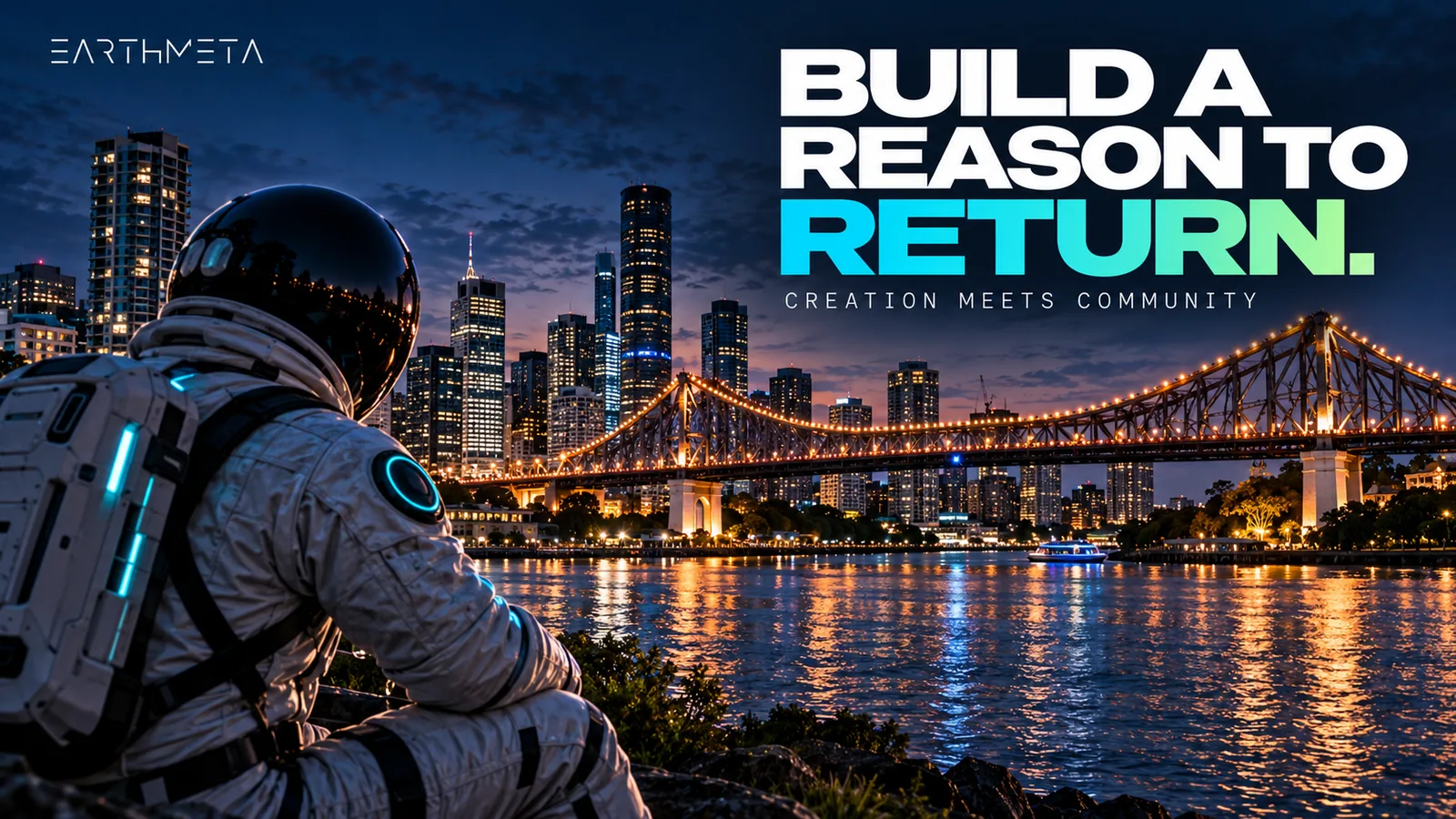
Why people return: collections, creativity and the next meaningful action
The first visit is often driven by curiosity.
The fifth visit needs something more.
In a game, the next action may be a clear objective. In a creative environment, it may be the next version of a project. In a community, it may be another person expecting your contribution.
Successful participation can combine all three, but the balance matters.
Upland's collections documentation describes themed sets of properties and in-game rewards for completing them. That turns location into a structured objective.
The underlying appeal is familiar. A collection gives scattered objects a relationship. A partly completed set makes the next acquisition feel meaningful for a reason beyond its appearance.
People do this with books, football shirts, postcards and kitchen equipment. Somewhere, someone is defending a collection of twelve almost identical coffee drippers with considerable passion.
A game can make the map actionable
A collection system helps answer “What should I do next?”
That can be valuable when a newcomer would otherwise face an overwhelming number of locations.
Upland's getting-started guide encourages choosing priorities such as collecting, developing a block or pursuing event rewards. The experience offers several ways to organize a session.
For a player who enjoys interconnected goals, that structure is a strength.
There is satisfaction in learning how systems fit together. The city becomes a field of decisions rather than a passive background.
That is why comparing screenshots alone misses so much. A polished image cannot show whether a person enjoys the decisions that happen between visits.
A creative project supplies a different next action
A creator may not need a checklist supplied by the platform.
They may return because yesterday's design needs a better entrance, because someone gave useful feedback or because they have finally found the right reference.
That is a different retention mechanism: unfinished creative intent.
EarthMeta's appeal is strong here. The real-world context gives a project a subject; the creative workflow gives the participant a way to act on it.
The important next action should be small enough to perform.
“Build a meaningful digital presence” is an ambition. “Choose the best of these three rooflines” is a task you can do tonight.
A healthy creative habit develops through the second kind of action.
Community makes a digital place less interchangeable
A building can be copied in spirit. A group's shared history is harder to reproduce.
When people remember who contributed, why a decision was made and how an idea improved, the place acquires context that is not contained in its geometry.
That is why a modest project with active participants can feel more alive than an expensive-looking environment nobody discusses.
For a hypothetical EarthMeta community, the first useful activity might be a design critique rather than a grand launch. A few people compare concepts, choose one improvement and return to see the result.
The practical opportunity is straightforward: give people a reason to contribute before asking them to care about scale.
Gaming offers lessons beyond competition
Upland's transportation and racing guide describes player-built speedways and vehicle-based racing activities.
That illustrates a broader principle: a location becomes more interesting when activity happens around it.
EarthMeta does not need to imitate every game loop to benefit from that lesson. Its own creative identity supports a different form of involvement, and some activity is on its way: drivable cars to travel through cities are on the roadmap, and entering buildings is in development, so a structure becomes a place to walk into rather than only a facade. Anyone who spent hours driving through a GTA city will recognise the appeal, except that here the streets are real ones.
The question is not “How can a platform add every mechanic?” It is “Which activity makes this place more meaningful for the people using it?”
Sometimes the answer is competition. Sometimes it is creation. Sometimes it is simply showing a friend something you made and hearing, “Wait, you built that?”
That moment has more emotional force than a menu with seventeen unexplained buttons.
Access and friction: the best platform is one you will actually use
A platform can have an excellent idea and still be a poor fit for your habits.
Some people enjoy a longer creative session at a computer. Others want a few minutes of structured play between ordinary daily tasks. Some are comfortable managing crypto wallets. Others want an account-first experience.
These are not trivial preferences. Friction changes whether intention becomes participation.
Upland's onboarding guide starts with an account and a chosen city. EarthMeta directs users from its public site into its application and wallet-based asset economy.
The sensible first step is to explore the relevant route before committing to a large project or purchase. Learn the vocabulary, identify the asset you are interested in and understand what the next action requires.
Separate browsing, creating and buying
These are different decisions.
- Browsing helps you understand the world.
- Creating tests whether you enjoy the tools and the process.
- Buying creates a financial commitment.
There is no need to collapse them into one dramatic afternoon.
A person interested in EarthMeta can begin with the public marketplace overview and a clear creative objective. A person interested in Upland can begin by understanding its game loop.
The goal is not to prove bravery by moving quickly. It is to discover whether the platform fits the activity you want to repeat.
That is especially important when two products share a familiar geographic premise. Recognizing a city does not mean you already understand its digital rules.
A useful wallet habit: know what you are approving
For a wallet-based interaction, the address, network, asset and requested permission deserve attention.
A website that looks familiar is not enough. The relevant destination should be reached through the official platform route, and an approval should match the action you intend to take.
It is a basic habit for any crypto infrastructure.
Think of it as the digital equivalent of checking the recipient before making a bank transfer. The habit is ordinary; the consequences of skipping it can be very real.
The positive side is that understanding the workflow makes participation less mysterious. A little practical competence is more useful than a large supply of jargon.
Development history: a fast trajectory
EarthMeta's public platform launched in October 2024.
Upland's 2023 SPARKLET white paper dates its platform launch to 2019.
- Roblox
The earliest creator-built games in its platform history.
- Upland
Platform launch, per its 2023 SPARKLET white paper.
- EarthMeta
Public platform launch in October.
- Roblox
Twenty years of creator-built games (September).
- EarthMeta · today
Two years in, with live AI building generation.
Upland has had several more years to build its game systems, and it shows in the depth of its collections and resources. In two years of public platform history, EarthMeta has shipped what makes it distinctive: live AI building generation on real-world cities.
Roblox is a reminder that ecosystems accumulate
In its 16 September 2026 anniversary article, Roblox looked back on twenty years of creator-built games, reaching back to 2006.
The lesson is that a great ecosystem grows through repeated contributions, technical work and learning over time.
Creator tools improve. Communities organize. People see examples of what is possible and build on them.
EarthMeta is built to accumulate exactly those contributions, on places people already care about.
What EarthMeta delivers today
AI building generation
Describe a structure and AI builds it, with no 3D modeling or coding.
AI 3D Builder and imports
The AI 3D Builder and external-model imports are delivered on the roadmap.
Governors DAO
City holders take part in map and land-dispute decisions.
The case for EarthMeta rests on what works today: its place-based asset structure, its creative tools and its governance.
The most useful confidence is specific. “This workflow fits my project” is what a creator should be able to say before committing.
What is coming next
VR is the next major release, so a creator will be able to step into a building in a headset. Also on the roadmap: scanning a real object, such as a sculpture or a product, into 3D and bringing it into EarthMeta, and a higher-fidelity 3D world. None of these is live yet, which is why a first project should be planned around today's tools.
What progress looks like to a participant
For a creator, progress is a clearer path from idea to output, dependable handling of assets and a clear relationship between roles.
For a community participant, progress means clear decisions. For a newcomer, it means understanding the first useful action right away.
EarthMeta combines geography, creation and crypto infrastructure, and that combination is what stands out. When distinct systems work together coherently, they offer something more useful than another isolated feature.
The opportunity is in the connection, not merely the checklist.
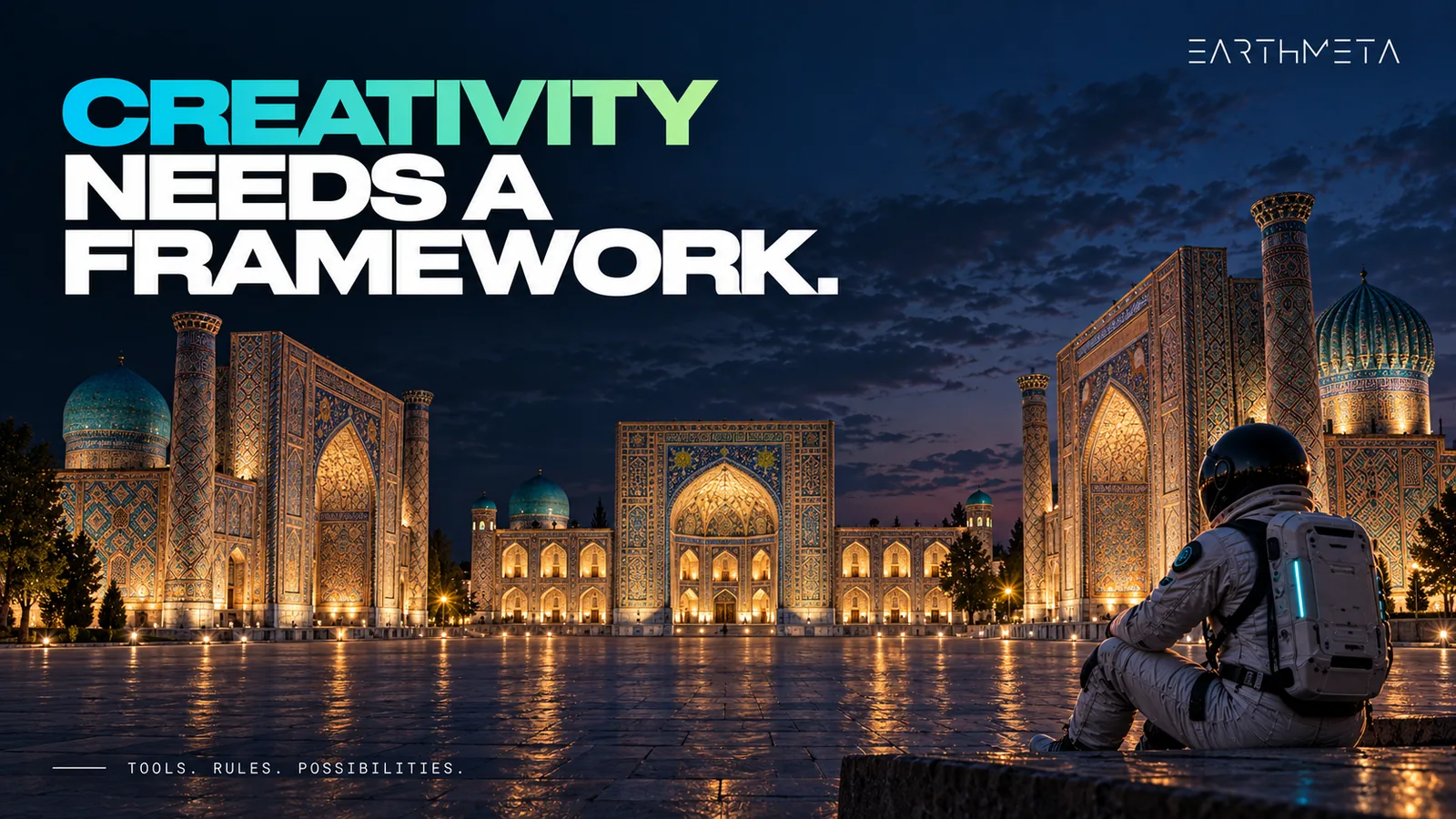
Three people, three different answers
A comparison becomes easier when the buyer is a person rather than an abstract “user.”
Consider three fictional readers. They are illustrations of different motivations, not customer testimonials.
Maya: the architecture-minded creator
Maya enjoys architecture and wants to develop a place-led digital concept. She is interested in the relationship between a building and its setting, not primarily in completing a property set.
She is willing to learn a crypto workflow if it supports a creative objective she cares about.
EarthMeta is the stronger starting point for Maya.
The combination of real-place context and an AI-assisted building direction fits the task she wants to do. Her first success could be a coherent design brief and a concept she is proud to explain.
She does not need to begin by imagining a huge district or a commercial launch. A focused first project would tell her more about the fit.
Her main question is, “Can I turn this idea into something intentional here?”
Daniel: the city-builder strategist
Daniel likes interconnected systems. He enjoys understanding how one resource, collection or development choice changes another decision.
He wants a world that offers ongoing strategic objectives. The planning itself is part of the entertainment.
Upland's collections, neighborhood systems and property trading speak directly to that kind of planning.
Upland is Daniel's natural fit.
EarthMeta is his second option worth a look: real cities where city, land and building are distinct assets, a Governor in every city who collects 1% tax on every trade there, and a President in every country who collects 0.5% across the whole territory. That is a different strategic layer, and live AI building turns plans into structures he can see.
His main question is, “What is the next interesting move within the system?”
Sofia: the community organizer
Sofia cares about a particular city and wants to bring a small group together around a meaningful digital project.
Her answer depends on what the group wants to do.
If the group wants to make something together, EarthMeta gives it one real place everyone cares about and an AI tool to build it. For a creative group, it is a strong starting point. If the group mostly wants to play and trade, Upland's game systems give it plenty of shared goals.
Sofia's first task is to define the shared activity.
A group with a clear purpose can begin modestly. A group with only a vague promise may struggle even with attractive assets.
Her main question is, “What will people actually do together?”
That question is a useful discipline for any metaverse project.
Maya, Daniel or Sofia: which world fits you?
Four quick questions about the activity you want to repeat. You get a first pick and a second choice. No sign-up, no wallet.
Start with one place and one idea
Open the official EarthMeta application and explore a city you know.
A practical way to choose
Start with the activity, then work outward.
Describe one thing you would like to do in a normal session. Not a five-year vision. Not a presentation slide. One actual activity.
For example: refine a building concept, work toward a themed collection or coordinate feedback from a small group.
Then identify the required tools and resources.
Which asset type matters? What is available today? Which part involves internal game resources, and which part involves a token or a purchase? Where do account conditions or regional restrictions matter?
Finally, decide what a satisfying small outcome would look like.
Measure your first project by learning
A useful first outcome might be understanding a workflow, producing a better brief or deciding that a particular style of participation is not for you.
Those outcomes are valuable because they improve the next decision.
Here is a hypothetical time budget, deliberately separate from platform pricing: allocate six hours to a comparison experiment. Spend two understanding the systems, three trying the activity you care about and one reflecting on what felt useful.
Scale the comparison experiment to your week
Same 2 : 3 : 1 split as the six-hour example. A planning aid, not a required process.
That totals six hours: 2 + 3 + 1. It is a planning example, not a required process or a claim about either platform's task duration.
The point is to give experience a chance to inform preference.
You can learn very little from refreshing a listing page for six hours. Apart from discovering that six hours is surprisingly long.
Budget for the whole activity, not just the asset
A purchase price is only one part of participation.
For a crypto-based transaction, the token amount, any platform charge and blockchain network costs are different components. Under EarthMeta's payment terms, payments settle on Ethereum and network fees are separate. A creator should also account for the time spent developing and presenting the work.
In a game economy, the relevant spending may involve a property, a blueprint, a resource or a particular activity. Upland's building guide helps distinguish access to a model from the resources used during construction.
This is why the cheapest-looking listing is not automatically the cheapest route to your goal.
Compare the complete path to a useful outcome, not a single attractive number.
Watch the work, not just the asking price
An asking price tells you what a seller requests.
It does not show whether people enjoy the surrounding experience, whether creative work improves or whether there is a buyer ready to complete a transaction.
For a creator-led EarthMeta project, useful progress is visible in the quality and coherence of the work.
For a game-oriented Upland player, useful progress may be how well they understand and enjoy their chosen systems.
These are different measures, but both are more informative than an asking price on its own.
If your main interest is comparing a mapped world with a different creative geography, the companion EarthMeta vs Decentraland comparison adds another perspective. For a broader view of platform selection, see the best metaverse platforms guide.
Why EarthMeta suits place-led creators
EarthMeta's most persuasive advantage is the coherence of its creative idea.
A recognizable place supplies context. AI-assisted tools translate an idea into a visual starting point. Distinct asset roles connect that work with a geographically organized digital environment.
Real-world context
A digital twin of the real planet, with cities people already recognize.
Live AI building
Describe a structure and AI builds it, with no 3D modeling or coding.
Distinct asset roles
Cities, land and buildings, with land trades settled in EMT on Ethereum.
For someone who wants those pieces together, the proposition is unusually direct.
You do not need to invent a reason to care about a place before beginning. You can start with an existing connection and decide what you want to contribute.
That appeals to designers, architecture enthusiasts, local storytellers and crypto-native creators for different reasons.
It also gives EarthMeta a positive route into a growing digital-participation market. Rather than competing for passing attention, it competes for the time people want to spend making something meaningful.
The opportunity is specific, and that is a strength
EarthMeta is not trying to be every kind of game. For original creation tied to recognizable geography, it is arguably the most complete option, and the vision goes further: a parcel that can become a shop, a gallery or an event venue, with building interiors and live DJ events in development.
One location, one idea
Explore EarthMeta's creative direction, then start a first project with a clear reason it belongs there.
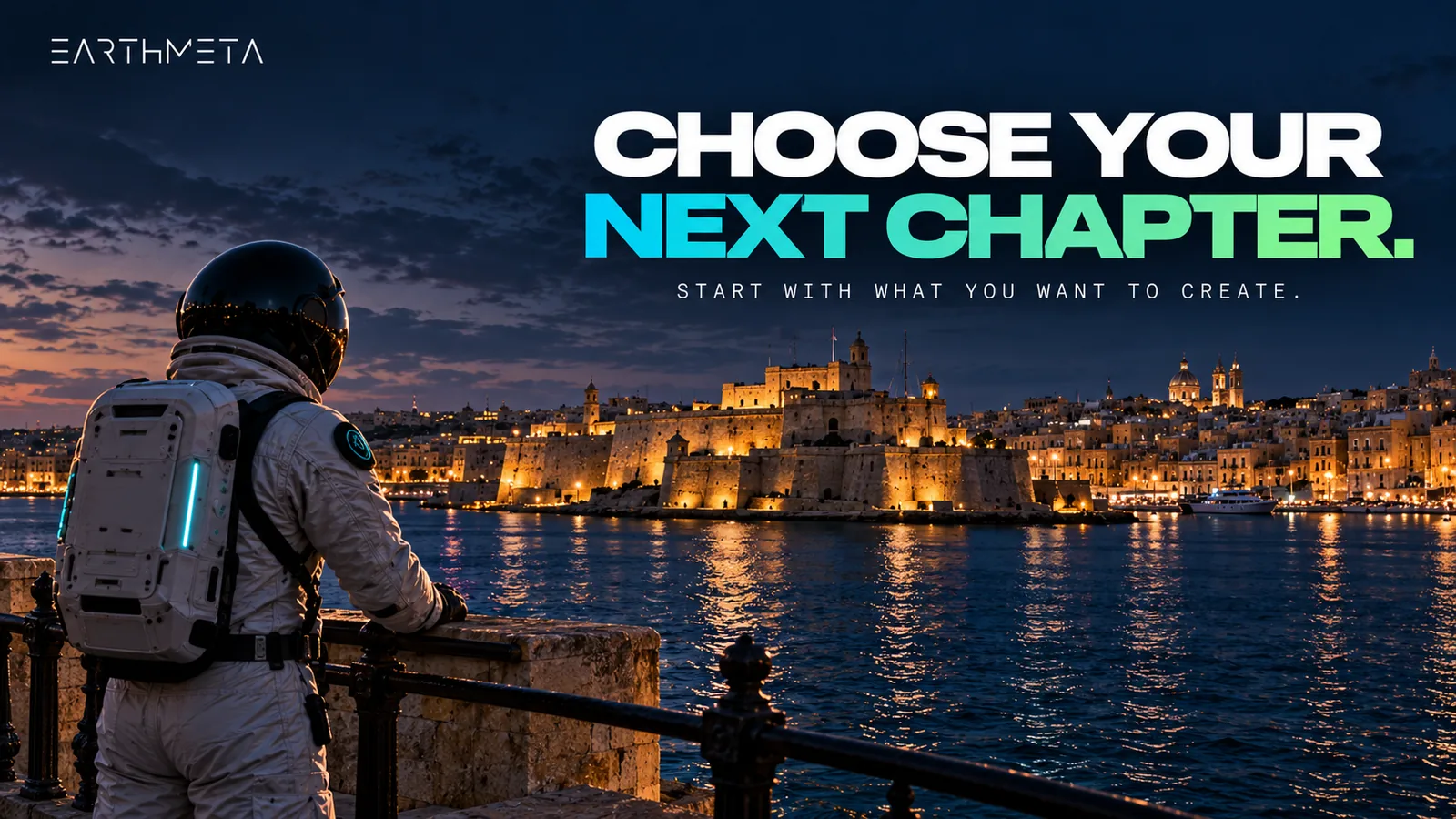
Frequently asked questions about EarthMeta vs Upland
Is EarthMeta better than Upland?
It depends on what you want to do. For creating on real places, with AI-assisted architecture and a crypto-native asset framework, EarthMeta is likely the better fit: it has live AI building, distinct city, land and building assets and a Governor in every city. For a property trading game on real addresses, with collections and neighborhood systems, Upland is strong.
Are EarthMeta and Upland both connected to real places?
Yes. Both use real-world geography as an organizing reference. They wrap different activities and systems around that reference. Familiarity helps you understand the setting, but it does not make the products interchangeable or turn a digital asset into ownership of the corresponding physical building.
Is UPX the same as EMT?
No. UPX is Upland's internal transaction currency; EMT is EarthMeta's native utility token on Ethereum, used to settle land trades. Their functions differ. Compare the action each resource supports rather than assuming that a balance beside an icon has the same meaning everywhere.
Does owning UPX mean I can withdraw dollars?
No. Upland's eligible USD asset-sale process is separate from holding an internal currency balance. Seller eligibility, verification, holding periods and regional availability matter. A sale also depends on a buyer completing it. An asset listing is not a guaranteed withdrawal.
What are SPARKLET and STEM?
They serve separate resource roles in Upland rather than acting as alternative names for UPX. SPARKLET relates to building and other activities, while STEM belongs to Life Systems. The distinction matters when planning participation: identify the resource required for the specific action rather than treating every balance as interchangeable.
Can you create things in Upland?
Yes. Its Creator Hub describes a route for user-generated structures, decorative items and other assets. EarthMeta's appeal is not that Upland lacks creators. It is the emphasis EarthMeta places on AI-assisted, geographically grounded building creation and the fit of that workflow for a particular creative goal.
What can EarthMeta AI do today?
EarthMeta's AI building generation is live: describe a structure and AI builds it, with no 3D modeling or coding needed. The AI 3D Builder and external-model imports are delivered, so a first project can start right away.
How do Governors and Presidents work in EarthMeta?
Every EarthMeta city has a Governor who receives 1% of every trade in that city, and every country has a President who receives 0.5% of every transaction across the whole country. One person can hold both roles and collect 1.5% on their own city. The tax applies to every asset traded in the territory, owned or not: $100,000 traded in a city = $1,000 tax collected by its Governor.
When did EarthMeta launch publicly?
EarthMeta's roadmap dates its platform launch to October 2024. In two years it has delivered live AI building generation, external-model imports, a marketplace for cities, land and buildings, and an active Governors DAO.
Do I need to buy immediately to choose a platform?
No. Understanding the activity, asset types and workflow should come first. Browsing, creating and buying are separate decisions. A small learning objective can reveal more about fit than an immediate purchase driven only by enthusiasm for a familiar city.
Does a famous location guarantee demand?
No. Recognition can help a person understand or care about a location, but it does not create automatic visitors or buyers. A distinctive project, useful activity and a reason to return are more meaningful foundations than fame alone.
What is the best first step for an EarthMeta creator?
Choose one place and write one clear creative brief. Explain what you want to make, why it belongs there and what a small successful outcome would be. Then explore the official EarthMeta application around that objective. A focused first chapter is more useful than trying to build the entire future at once.
Choose your next chapter
EarthMeta and Upland share a starting point: the planet you already recognize. What they build on top of it is different. Upland turns the map into an interconnected city-builder game. EarthMeta turns it into a place to create, with live AI building generation, distinct city, land and building assets, and ownership settled on Ethereum.
The decision is no longer “Which platform has the biggest adjective?” It is “Which platform makes the work I care about more possible?”
For property trading as a game, Upland is a strong choice. For place-led, AI-assisted creation, EarthMeta is a natural first stop: start with one location, one idea and a clear reason it belongs there.
Sources and methodology
Public documentation reviewed on 20 October 2026. Newzoo figures are attributed 2026 forecasts for the global games market, not metaverse revenue, virtual property turnover or either platform's addressable market. Fictional people, design exercises and time budgets are labelled in the text. Governor and President amounts are examples: the tax collected depends on the trading activity in their city or country.
- EarthMeta marketplace
- EarthMeta AI
- EarthMeta roadmap
- EarthMeta EMT
- EarthMeta governance
- EarthMeta terms
- Upland properties
- Upland currencies and resources
- Upland USD sales
- Upland structures
- Upland Creator Hub
- Upland collections
- Upland onboarding
- Upland transportation
- Upland community rules
- Upland 2023 white paper (historical launch date only)
- Newzoo, 2026 global games market outlook (25 August 2026)
- Roblox, 20 years anniversary (16 September 2026)