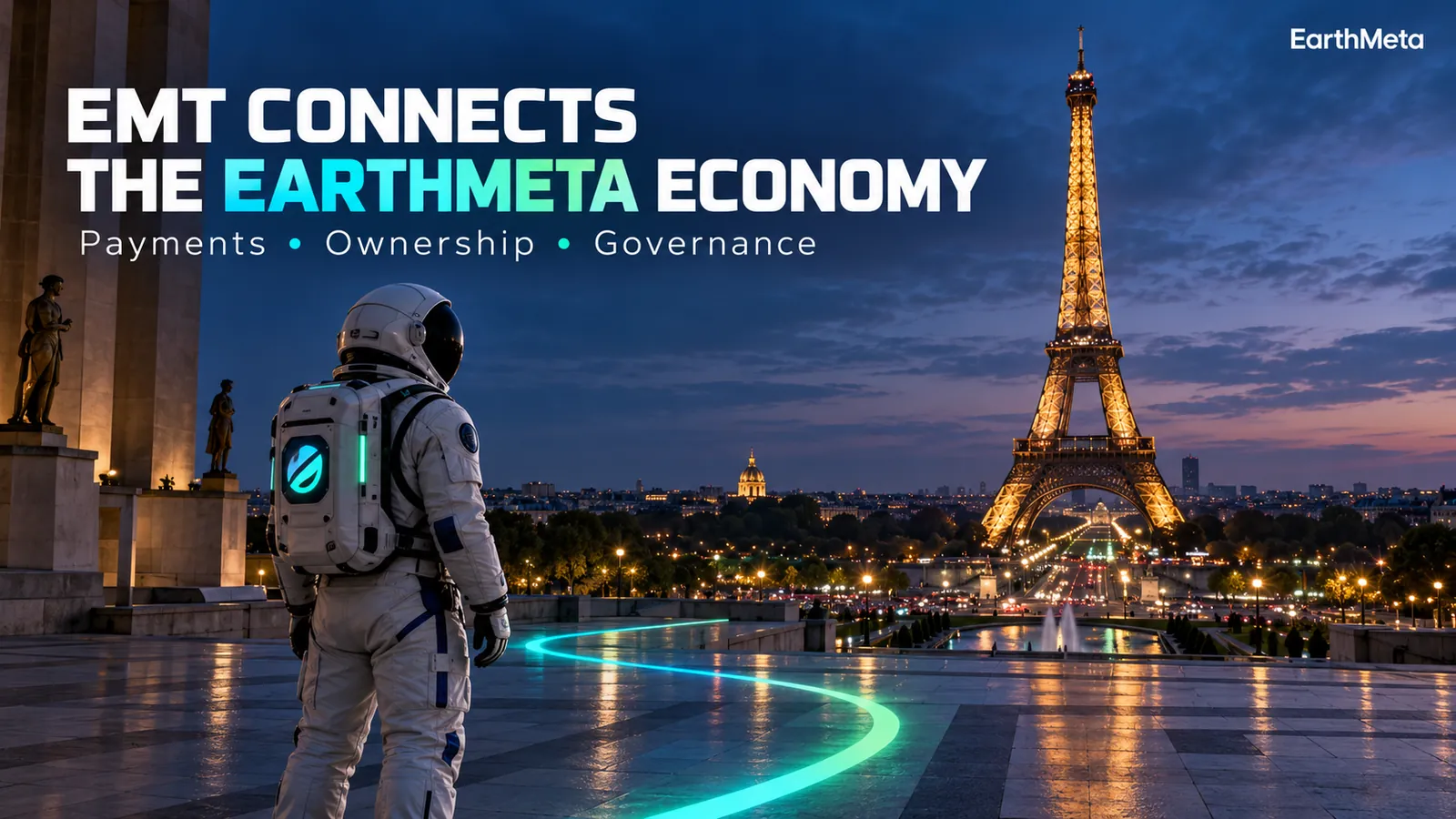
EMT is not a city. It is not a land parcel. It is not the gas used by Ethereum.
And, despite the kind of language crypto marketing sometimes enjoys, it is not fairy dust that makes every digital asset valuable.
EMT is the economic thread that connects activity inside EarthMeta. It is the platform’s fungible utility token: the interchangeable unit used across purchases, marketplace settlement, building, governance and other participation loops. EarthMeta’s cities, land parcels and buildings are separate, non-fungible assets. ETH remains the network currency used to pay Ethereum gas. Understanding those three layers makes the rest of the ecosystem much easier to read.
That distinction matters because a useful token economy is not built by attaching a ticker to a map. It is built by giving people recurring reasons to enter, create, transact, govern and return. A buyer may enter with a card or stablecoin. A Governor may divide a city into tradable land. A builder may create a structure. A seller may receive EMT. A voter may use EMT in governance. Each action is different, but the token connects them into one economic circuit.
This guide explains the EMT token utility as it stands on 21 October 2026. It separates live functions from window-based ones, shows how money and assets move, and explains why adoption, not a slogan, is what gives utility weight.
EMT at a glance
| Question | Practical answer |
|---|---|
| What is EMT? | EarthMeta’s fungible utility token, an ERC-20 token on Ethereum. |
| What does it connect? | Purchases, marketplace settlement, city and land activity, buildings, AI building generation, governance and other platform services. |
| Is EMT the same as a city NFT? | No. EMT units are interchangeable; each city, land parcel or building is a distinct asset with its own ownership record and context. |
| Is EMT used for Ethereum gas? | No. Ethereum network fees are paid in ETH, even when the asset being transferred or approved is EMT. |
| Can people enter without already holding EMT? | Yes. EMT can be acquired with ETH, USDT, USDC, cards and Apple Pay, and the platform accepts EMT and other supported cryptocurrencies. Check the exact checkout options at the moment of purchase. |
| Is staking always open? | No. Staking runs in announced windows, and the next window is upcoming. |
| Who collects tax on trades? | Every city’s Governor receives 1% of every trade in the city; every country’s President receives 0.5% of every transaction across the country. |
First, separate the three layers
Token economies become confusing when everything is called “crypto.” EarthMeta contains three conceptually different layers.
The interchangeable economic unit
Fungible, ERC-20, used for settlement and participation across the platform.
Cities, land and buildings
Unique on-chain assets tied to a specific place, owner and role.
The network fee currency
Ethereum validators are paid gas in ETH, whatever asset moves.
1. EMT: the interchangeable economic unit
EMT is fungible. One EMT is equivalent to another EMT of the same contract, just as one unit in a ledger is interchangeable with the next. Ethereum’s ERC-20 standard gives wallets and applications common functions for checking balances, transferring tokens and approving smart contracts to spend a defined amount.
That standardisation is useful because it lets EMT interact with familiar Ethereum infrastructure. A compatible wallet can display it. A marketplace contract can request an allowance and settle a purchase. The token does not have to reinvent the plumbing each time.
2. Cities, land and buildings: unique digital property
A city is not a pile of EMT. It is a distinct on-chain asset tied to a specific geographical area and ownership role. The owner of a city is its Governor. Land parcels inside that city and buildings placed on land have their own identities, locations and utility.
That uniqueness is why these assets use non-fungible ownership records. Paris cannot be swapped one-for-one with a random parcel in Porto and treated as the same thing. Location, tier, dimensions, owner activity, built content and demand all differ.
3. ETH: the network fee currency
EMT runs on Ethereum, but Ethereum validators do not accept EMT for base network gas. Ethereum explains that gas fees are paid in ETH. A user therefore needs ETH to approve EMT, transfer EMT, mint an asset or complete a marketplace transaction from a self-custodied wallet.
This creates a two-currency moment that every buyer should understand:
- the purchase or settlement asset may be EMT, USDC, USDT or another supported option;
- the network fee asset for a direct Ethereum transaction is ETH.
Good interface design can hide some complexity, but it cannot repeal the network rules. A wallet with plenty of EMT and zero ETH may still be unable to execute a self-custodied Ethereum transaction.
What “utility” really means
Utility is a reason to use a token for something other than selling it to the next buyer. A strong utility loop has four parts:
- a participant wants an outcome;
- the platform requires or routes EMT to obtain that outcome;
- another participant or protocol component receives, locks or removes the token;
- the outcome makes the world more useful, which gives people a reason to return.
Imagine a Governor who divides a city into land parcels. A creator acquires a parcel, uses a building tool, lists a finished structure and runs a promotion. A visitor arrives because the city now contains something worth seeing. A later buyer purchases the structure. The Governor collects the 1% city tax on that trade, the country’s President collects 0.5%, and the seller receives the sale proceeds. In that sequence, EMT is not the experience itself. It is the accounting and coordination layer that helps several roles exchange value.
Utility therefore grows in two dimensions:
- breadth: the number of meaningful actions EMT can perform;
- depth: how often real users perform those actions and how valuable the outcomes are to them.
A long feature list creates breadth. Only recurring activity creates depth.
The current EMT utility map
The EMT page lists a wide range of roles for the token. Most are live today; staking runs in announced windows.
| Utility | What the token does | Status on 21 Oct 2026 | What a user should check |
|---|---|---|---|
| City acquisition | Purchase unit for cities tied to real places | Live | Listing status, seller, total cost, contract and gas |
| Land trading | Settles purchases and sales of land within cities | Live | Parcel boundary, city, token, approval amount and sale terms |
| Building creation | Pays for creation of structures; AI generation spends are burned | Live | Current price, output rights, mint step and burn transaction |
| Building sales | Listing and settlement denomination for created assets | Live | Whether the asset is minted, transferable and listed |
| DAO governance | Supports proposals and voting | Live | Proposal scope, voting weight, quorum, cost and execution method |
| Marketing | Pays for promotional activity in the Marketing Hub | Live | Campaign format, pricing, audience and burn treatment |
| Avatar items | Purchases limited clothing and accessories | Live | Item rights, transferability, compatibility and price |
| Staking | Locks EMT for a period and gives voting rights in the DAO | Next window upcoming | Pool contract, opening time, term and withdrawal rules |
| City and country tax | Routes tax on every trade to the Governor (1%) and the President (0.5%) | Live | The breakdown shown in the transaction preview |
Sources: EarthMeta EMT page, staking page and roadmap.
Tap a utility to see what EMT does there
Staking is the one utility that is not continuously open. The staking page shows “Staking Soon”: participation starts when the upcoming window launches, and the roadmap lists the staking-pool milestone. EarthMeta has a defined staking model, and participation happens through an announced window and the pool open at that time.
How an EMT transaction flows
The easiest way to understand token utility is to follow a transaction.
Route A: a buyer already holds EMT
Suppose Maya wants to acquire a land parcel listed at the equivalent of $2,000, settled in EMT.
- Connect
She connects a compatible wallet to the official EarthMeta application.
- Verify
She confirms that the wallet is on Ethereum and that the displayed asset is the current EMT contract.
- Approve
If the marketplace contract does not already have permission, she signs an EMT approval transaction.
- Review
She reviews the parcel, seller, price, the city and country tax applied to the trade, and estimated gas.
- Sign
She signs the purchase transaction.
- Settle
The smart contract transfers the parcel and distributes the settlement: seller proceeds, plus the tax collected by the city’s Governor and the country’s President.
- Recorded
Ethereum records the result; the app reflects the new owner after confirmation.
There may be two separate wallet signatures: one to approve token spending and one to execute the purchase. That is normal ERC-20 behaviour, not double charging. The allowance amount matters, though. A narrowly sized approval limits exposure. An unlimited approval is convenient but gives the authorised contract continuing power over that token balance until revoked.
Route B: a buyer enters with another supported payment method
EMT can be acquired with ETH, USDT and USDC, alongside Visa, Mastercard and Apple Pay. EarthMeta’s terms state that the platform accepts EMT and other supported cryptocurrencies, and payment is processed through Ethereum smart contracts. The precise checkout flow varies by item, jurisdiction and payment provider.
The useful economic idea is entry flexibility with EMT-centred settlement. A person should not need to become a token specialist before they can understand a city. Checkout converts a supported input into the asset the protocol uses, lowering the first-use barrier while preserving a common economic unit behind the scenes.
That does not make conversion free. A card provider may charge a service fee. A conversion can carry slippage. A blockchain transaction uses gas. A buyer should compare the final asset acquired, not just the headline card amount.
Route C: a creator spends EMT on an action
Now suppose Lina owns land and wants an AI-generated building.
- She starts in the live builder rather than a token exchange.
- The interface presents the creation cost and any mint or placement steps.
- She approves and spends the required EMT.
- The EMT used for AI building generation is burned.
- The resulting building becomes an asset or usable object in the live workflow.
This is a different utility loop from a marketplace purchase. A seller does not receive the spend. The token leaves circulation in exchange for a service. The economic output is the building; the token is the input.
Route D: tax is collected by the territory’s roles
Every city has a Governor, who receives 1% of every trade in their city. Every country has a President, who receives 0.5% of every transaction across the whole country. One person can hold both roles and collect 1.5% on their own city. The tax applies to every asset traded in the territory, whether the Governor or President owns it or not.
The math is simple: $100,000 traded in Paris = $1,000 tax collected by the Governor of Paris, and $500 collected by the President of France on that same activity.
The important design principle is that transaction activity is shared with the people responsible for geographic stewardship. A city owner has an incentive to make the city active, because every trade within its borders produces tax collected. A President has an incentive to help multiple cities in a country become useful. That aligns status with economic participation, provided the marketplace attracts buyers and builders.
Why flexible entry strengthens EMT
Crypto products sometimes treat friction as proof of seriousness. It is not. Requiring every newcomer to buy a token on an exchange, transfer it to a wallet, acquire gas and navigate approvals before seeing any value is an excellent way to lose curious users somewhere around step three.
EarthMeta’s model separates the entry currency from the ecosystem currency.
A new user may think in euros, dollars, USDC or ETH. A creator may price a building in EMT. A seller may want EMT because other platform actions use it. Checkout bridges those preferences. The buyer sees a familiar route; the protocol still establishes a shared settlement unit.
More people reach the first useful action
Card and stablecoin routes make sense for users who have never held EMT. They reduce the number of decisions before a person can claim a city, acquire land or use a tool. The goal is not to hide the blockchain. It is to reveal complexity at the moment it becomes relevant.
Activity drives everyday use of EMT
If a buyer enters with USDC and the transaction settles in EMT, the checkout handles the conversion. Repeated marketplace activity therefore produces recurring, everyday use of EMT, driven by people who want to do something inside the world.
Sellers stay inside the economy by choice
A seller who receives EMT can use it for another land purchase, building creation, governance or a future staking window. The economy gains resilience when keeping EMT is useful.
The key is cost transparency. Before a buyer confirms, the interface should show the input amount, conversion rate, the city and country tax, gas estimate and final asset. A “Buy” button should reduce cognitive load, not reduce informed consent.
See a city’s marketplace in action
Browse live cities, land and buildings and follow how EMT settles each trade.
Governors and Presidents: the geographic incentive layer
EarthMeta’s most distinctive token mechanism is not just that users can buy virtual land. It is that the map has roles attached to real-world geography.
The Governor loop
The owner of a city NFT is its Governor. On the cities page, the 1% tax is attached to the city NFT: the current holder collects it, and the role transfers when the city is sold. A Governor can divide territory, offer land, develop the city’s identity and encourage commercial activity.
Consider two otherwise comparable cities.
- City A’s Governor lists parcels and waits.
- City B’s Governor organises themed districts, attracts creators, publishes building guidelines, promotes useful experiences and responds to the community.
With the same 1% tax, City B has a better chance of producing repeat activity. The tax is a share of every trade in the city. No trades means no tax collected.
This is why EarthMeta’s geography matters to EMT utility. The token circulates because Governors have places to develop and creators have somewhere to build. Without an underlying canvas, token movement risks becoming self-referential.
The President loop
Every country has a President: the Governor with the most valuable city portfolio in that country. The President receives 0.5% of every transaction across the whole country, in all of its cities, and one person can hold both roles to collect 1.5% on their own city.
The President mechanism creates a national coordination layer. A rational President does not want one spectacular city surrounded by empty territory. They benefit when multiple cities attract trade. That encourages shared campaigns, creator programmes, national events and cross-city routes.
There is also a governance concern: concentrated portfolios can concentrate influence. A healthy system benefits from transparent scoring, visible transaction rules, auditable role changes and proposal processes that include smaller participants. Leadership should make the ecosystem more active, not merely make a leaderboard taller.
Watch trading activity turn into tax collected
Pick a role, or both: one person can be Governor and President.
Building, AI and the creator economy
A marketplace only becomes an economy when participants can add new reasons to transact. Reselling existing cities forever would be a rather expensive game of musical chairs.
EarthMeta’s builder and AI tools matter because they convert blank land into productive digital inventory. The construction editor and the AI 3D Builder are live. AI building generation uses EMT, and the spend is burned.
That produces a clear utility chain:
Land ownership → creation demand → EMT spend → new building → experience or sale → marketplace activity
Each step creates value for a different participant. The landowner gains something to display or sell. The builder gains a tool and an asset. Visitors gain a reason to enter the city. Buyers gain more varied inventory. Governors gain more local activity, and more tax collected.
AI accelerates the first draft, but it does not remove creative work. A prompt generates a structure quickly; a useful district still needs curation, visual coherence, placement, pricing, storytelling and maintenance. The scarce resource shifts from raw modelling time toward judgement.
That is good for EarthMeta because the tools make experimentation affordable. A creator who can produce ten prototypes and keep the best one is more likely to add compelling content than a creator who must commission every early concept. Token sinks need quality controls, discovery and curation as much as they need demand, so the map fills with useful places rather than low-effort clutter.
A practical creator example
Imagine a designer building a digital food market beside the real location of a famous station.
- The designer acquires or leases an appropriate parcel.
- They use AI generation for initial stalls and the editor for refinement.
- They spend EMT for eligible creation actions.
- They mint or place the finished objects in the live workflow.
- They sell individual stalls, rent display space or keep the market as an attraction.
- They promote the opening through the Marketing Hub.
- Visitors arrive for an event, increasing attention around the city.
The economic value does not come from the 3D files alone. It comes from connecting tools, location, distribution and an audience. EMT is useful because it coordinates those actions.
Generate your first building
Describe a structure and let EarthMeta’s AI build it on your parcel, no 3D skills required.
Buildings, avatars and identity as spending layers
People spend in digital worlds for many of the same reasons they spend in physical places: access, expression, convenience, status, affiliation and fun.
An avatar outfit can signal identity. A building can signal taste or commercial intent. A landmark can become a meeting point. A marketing placement can attract attention. Each of these is economically meaningful because using the asset improves an experience or enables an action now.
The strongest economies support many motivations without pretending every participant is the same. A gamer may care about an avatar outfit. An architect may care about a building tool. A Governor may care about city activity. A brand may care about a campaign.
Avatars are live in EarthMeta since April 2026, and limited avatar clothing and accessories are an EMT use. Shops, expanded mobile features, AR and later interoperability add more spending surfaces as they arrive on the roadmap.
Governance: what EMT coordinates
Governance is live in EarthMeta. Users submit proposals and vote on key decisions, and each staked EMT carries a vote in the DAO. Governance integration and a Governor-driven DAO model were completed in 2025.
Governance utility is not just “holders can vote.” Five operational questions matter:
- What can a proposal change? Product priorities, city rules, treasury allocations and protocol parameters carry different risk.
- Who can propose? A minimum EMT threshold deters spam but can exclude small users.
- How is voting weight calculated? Staked EMT, city ownership and Governor scores produce different power structures.
- What makes a vote valid? Quorum, duration and delegation determine whether the result represents a broad community.
- How is the decision executed? A signalling vote advises the team; an on-chain executable vote directly changes a contract.
EMT spent on proposals is burned. That creates a cost to proposing, which reduces spam. A mature governance system balances enough friction to prevent noise with enough accessibility to let new contributors emerge.
Governance becomes valuable when decisions have visible consequences: proposal histories, voting distributions and implementation status turn a conceptual utility into a measurable civic layer.
Staking: useful, on real terms
At a basic level, staking locks EMT for a defined period under defined withdrawal rules. In EarthMeta, each staked EMT gives a right to vote in the DAO, so staking connects patient participants with governance.
The current availability test
As of 21 October 2026, the staking window is not open yet: the dedicated staking page refers to an upcoming launch. Wait for the actual pool interface and contract before treating any term as available.
Before staking, check:
- the official pool URL and smart-contract address;
- opening and closing dates;
- minimum and maximum commitment;
- lock duration and early-withdrawal rules;
- how governance weight depends on the stake;
- contract audit and emergency controls;
- jurisdictional restrictions and tax treatment.
A screenshot is not a contract. The transaction and pool documentation are the contract.
Why staking helps the EarthMeta economy
Well-designed staking aligns patient participants with governance and creator activity. A staker is more likely to follow proposals, support city programmes and use the platform. EarthMeta’s best path connects staking benefits to contribution, such as governance, building, city activation or curation, rather than treating locking alone as the finished product.
Burn mechanics: where EMT is consumed
Selected actions burn EMT: DAO proposals, AI building generation, AI avatar clothing and Marketing Hub campaigns. Burning sends tokens to an inaccessible address, removing them from use according to the contract design.
A burn creates a sink: an action consumes tokens rather than transferring them to another participant. The economic output is the service, whether that is a building, an outfit, a campaign or a proposal.
The most meaningful burn reporting is a transparent series:
- EMT spent by each utility;
- EMT burned by each utility;
- EMT distributed through incentives;
- active wallets and repeat spenders;
- marketplace activity and creator sales.
Those figures let readers see how economic activity is expanding across the world.
Ethereum today, and why older Polygon material can mislead
EarthMeta launched publicly in October 2024, and its earlier materials were built around Polygon. The EarthMeta site, token page and terms now identify Ethereum as the active network.
That history creates a real safety issue. Search results, old bookmarks and wallet token lists may still surface Polygon-era pages or contracts. A token ticker is not unique. Anybody can create an unrelated token called EMT on another contract.
The safe rule is simple: never select a token by ticker alone. Start from EarthMeta’s official application or token page, follow its official explorer link, and compare the complete contract address character by character before approving a trade or import.
Do not rely on:
- an old presale page;
- a forwarded contract address in a direct message;
- the first token named EMT in a wallet search;
- a shortened address that shows only four characters at each end;
- a screenshot with no clickable source;
- a search advertisement imitating the EarthMeta domain.
The EMT page states that EMT is an ERC-20 asset and links audit and KYC references. Audits reduce some smart-contract risk, but they do not guarantee that every interface, approval, listing or third-party service is safe.
A five-minute safety check before using EMT
1. Begin at the official domain
Type earthmeta.ai or use a trusted bookmark. Move from the official page to the app. Check the entire hostname, not just the logo.
2. Verify network and full contract
Confirm Ethereum, then compare the full current EMT contract with the official explorer link. If an older Polygon token is visible, do not assume it has current utility.
3. Read the wallet request
Distinguish a login signature from a token approval and a purchase transaction. A signature can still be dangerous if it authorises an action you do not understand.
4. Limit allowances
ERC-20 approvals let a smart contract spend tokens up to an allowance. Prefer a specific amount when practical. Ethereum’s own guide explains why unused token approvals should be reviewed and revoked, especially after interacting with unfamiliar applications.
5. Keep ETH for gas
The wallet needs enough ETH for the approval, purchase or transfer. Do not send EMT to a wallet and assume the transaction can move without ETH.
6. Inspect the final total
Look beyond the listing price. Include the city and country tax, card or conversion costs, slippage and gas.
7. Test before committing a large amount
A small transaction confirms the route, contract, wallet and settlement behaviour. It is not glamorous. Neither is losing access to a large balance.
Where the growth comes from
“The metaverse market” is not one clean number. Estimates often mix hardware, software, advertising, games, virtual goods, enterprise digital twins and crypto assets. Comparing them without a shared definition produces impressive charts and very little understanding.
For EMT, the most relevant market is narrower: people who want to own, build, trade and govern inside a persistent digital geography.
EarthMeta’s map creates a supply of geographic canvases, meaning cities, land and built assets, and the economy grows with participation. The growth mechanisms are more useful than a heroic top-down forecast:
- More owners activate cities. Active Governors create parcel inventory and local direction.
- More creators add buildings and experiences. AI reduces production friction, while curation protects quality.
- More visitors create attention. Events, identity and useful experiences give people non-financial reasons to return.
- More trades mean more tax collected. Every trade sends 1% to the city’s Governor and 0.5% to the country’s President.
- More tools consume EMT. Creation, promotion and governance create recurring EMT use and burns.
- Better entry routes expand participation. Cards and stablecoins let new users start without mastering every token step.
- Transparent data builds confidence. Activity dashboards make a functioning economy easy to see.
The key variable is not how many cities can theoretically exist. It is how many contain creators, inventory, visitors and repeat transactions.
What Roblox, The Sandbox and Amazon teach about ecosystem time
EarthMeta does not need to become any of these companies to learn from how their systems developed. Analogies are useful when they explain work; they become useless when they imply a guaranteed outcome.
Roblox: the economy followed tools, creators and repetition
Roblox was founded long before its recent scale. Its current economy is the result of years spent improving creation tools, discovery, payments, trust and social loops. In its second-quarter 2026 shareholder letter, Roblox reported $1.5 billion in quarterly revenue, up 36% year over year. That scale did not appear because the platform invented a currency. It came from a large audience repeatedly spending inside experiences made by creators.
For EarthMeta, the lesson is that EMT does not carry the ecosystem alone. Creators need tools, visitors need reasons to return, Governors need analytics and buyers need confidence. Token utility is strongest when the product loop works without any token conversation.
The Sandbox: one token can connect several roles
The Sandbox offers a closer crypto comparison. Its official SAND documentation describes SAND as a medium of exchange connecting players, creators and owners. Creators can sell assets; players can acquire items or access experiences; participants can govern or stake where available.
The relevant insight is not that every platform should copy SAND. It is that a utility token is strongest when different roles need one another. A creator needs buyers. A landowner needs content. A player needs experiences. A marketplace needs inventory. EarthMeta’s cities and geographic roles add a different structure to that same coordination problem.
Amazon: entry friction and trust shape a marketplace
Amazon opened its online store in July 1995, and its Marketplace followed later. A 2001 company release described Marketplace as giving businesses and individuals a way to sell to Amazon’s customer base while Amazon Payments handled card transactions. The lesson is not that virtual land is online retail. It is that marketplace growth requires years of seller tools, buyer trust, payments, discovery and operational discipline.
EarthMeta’s card and stablecoin routes play a similar friction-reduction role at a much earlier stage. The work continues after checkout: accurate listings, enforceable settlement, fair discovery, dispute handling and reasons for repeat purchase.
The economic flywheel EarthMeta is building
A useful way to evaluate EMT is as a flywheel of seven connected steps.
Tap a step to follow the EMT economy around the loop
Seven connected steps. Each one feeds the next.
Step 1: geography gives ownership context
Cities and land correspond to recognisable real places. That gives buyers an immediate mental model and gives Governors a territory to organise.
Step 2: ownership creates responsibility
A city owner can divide, brand, develop and promote a city. Landowners decide what to build. The map becomes a network of decisions, not a static picture.
Step 3: tools create inventory
Builders, AI generation, external models and avatars turn ownership into visible content. New inventory creates more reasons to use EMT.
Step 4: discovery creates demand
Market search, rankings, events, marketing and social sharing bring attention to useful places and objects. Discovery is the bridge between “built” and “bought.”
Step 5: transactions distribute value
Sales reward creators and sellers; every trade sends 1% tax collected to the city’s Governor and 0.5% to the country’s President; selected spends burn EMT.
Step 6: governance improves the rules
Participants propose and vote on changes. Transparent governance makes the economy more adaptable and credible.
Step 7: better outcomes attract the next participant
A well-run city attracts builders. Good buildings attract visitors. Visitors attract merchants and brands. Activity gives Governors reasons to put in more effort. The loop repeats.
Every stage matters. Ownership without tools produces empty land. Tools without discovery produce invisible content. Discovery without trust produces clicks but not purchases. EarthMeta’s execution focus is keeping all seven stages moving together.
Five principles that make EMT utility visible
EarthMeta has a coherent economic design. The principles below keep its uses visible, measurable and safe.
The complete breakdown before signature
Listing price, input asset, conversion rate, Governor tax, President tax, estimated gas and seller proceeds, shown as an understandable receipt.
One canonical contract reference
The current Ethereum contract, official NFT contracts, migration history and explorer links in one permanent place, with legacy pages clearly marked.
Live utility data
Marketplace activity, unique buyers and sellers, EMT spent and burned by feature, tax collected by Governors, proposal participation and active cities.
Staking tied to contribution
Governance participation, verified building, curation or city activation unlocking badges and non-financial benefits, simple enough to audit.
Clear status labels
Live, Window upcoming, Beta or Planned on every feature, so people know exactly what is available today.
A role-by-role guide to EMT
If you are a buyer
Start with the asset, not the token. Decide whether you want a city, land parcel, building, avatar item or access to a feature. Check the official listing, ownership record, boundaries, current utility and total cost. Acquire the EMT needed for the action you plan.
If you are a seller
Understand what currency you will receive and when settlement becomes final. Set your price with the city and country tax and gas in mind. Keep records of acquisition cost and proceeds for tax and accounting purposes.
If you are a Governor
Treat the city as a small platform. Make parcel information clear. Recruit builders. Curate districts. Publish a development theme. Create events. Track unique participants rather than only gross trading activity. 1% tax on an active city is meaningful; 1% of zero remains zero.
If you are a creator
Budget EMT as a production input. Test the builder, understand what is burned, confirm the ownership and transfer rights of the output, and build for a specific audience. The cheapest way to create many assets is not necessarily the best way to earn attention.
If you are a voter
Read the full proposal, identify who benefits, check implementation authority and compare short-term incentives with long-term ecosystem health. Governance is work. That is the point.
If you are considering staking
Wait for an official open window and contract. Compare the lock period, withdrawal rules, governance weight and contract audit.
Risks that remain even when utility is real
A token can have genuine uses and still carry risk. Those statements are not contradictory.
Smart-contract risk
Audits reduce certain risks but cannot eliminate coding mistakes, exploits, compromised keys or unsafe integrations. Interacting with a verified contract is safer than guessing, not risk-free.
Execution and activity
Any platform economy requires sustained operations and real activity, not just deployed contracts. Utility becomes depth only when people return.
Governance risk
Large holders or portfolios can have outsized influence. Voter participation can be low. A proposal can pass and still produce a poor outcome.
Regulatory and tax obligations
Rules vary by country and can change. Token purchases and asset sales can create reporting or tax obligations.
Custody and approval risk
Self-custody gives the user control, including the ability to make irreversible mistakes. Seed phrases, phishing signatures and unlimited allowances remain common failure points.
The correct response is not panic. It is proportionate participation: verify, start small, understand the action and never treat a wallet request you do not understand as routine.
Frequently asked questions about EMT token utility
What is the EMT token used for?
EMT is EarthMeta’s native utility token for buying cities, trading land and buildings, using building and AI functions, participating in governance, running Marketing Hub promotions and acquiring avatar items. Staking is part of the model and runs in announced windows; the next window is upcoming.
Is EMT a coin or a token?
EMT is a token. It follows the ERC-20 standard on Ethereum. ETH is Ethereum’s native coin and is used for network gas; EMT is an application-level asset issued by EarthMeta.
Is EMT the same thing as EarthMeta land?
No. EMT is fungible, so each unit is interchangeable with another unit of the same contract. A city, land parcel or building is a unique digital asset with a specific location and ownership record.
Which blockchain does EMT use now?
EMT and platform payments operate on Ethereum. Older web pages may refer to Polygon-era contracts. Always obtain the current full contract address from EarthMeta’s official channels and verify it on an explorer.
Do I need ETH if I already have EMT?
Yes, when you sign a direct Ethereum transaction. ETH pays network gas for approvals, transfers and smart-contract calls. Inspect the wallet preview for the exact transaction.
Can I buy EMT with a credit card?
Yes. EMT can be acquired with Visa, Mastercard and Apple Pay alongside ETH, USDT and USDC. Availability depends on the payment provider, country and compliance checks. Review the exchange rate and total fees before confirming.
Does EarthMeta accept USDT or USDC?
Yes. USDT and USDC are supported routes for acquiring EMT, and EarthMeta’s terms allow EMT and other supported cryptocurrencies. Confirm the exact payment and settlement route in the live app.
Is EMT staking live now?
The upcoming staking window has not yet launched as of 21 October 2026. Wait for the official open pool, contract and complete terms before committing tokens.
How much tax does a Governor collect?
Every city has a Governor who receives 1% of every trade in that city, on every asset traded there, whether the Governor owns it or not. $100,000 traded in a city = $1,000 tax collected by its Governor. The role is attached to the city NFT and transfers to the new Governor when the city is sold.
What does an EarthMeta President receive?
Every country has a President, the Governor with the most valuable city portfolio in that country, who receives 0.5% of every transaction across the whole country. One person can hold both roles and collect 1.5% on their own city: $1,500 tax collected on $100,000 traded there.
What happens to burned EMT?
Burned EMT is removed from use. DAO proposals, AI building generation, AI avatar clothing and Marketing Hub campaigns burn the EMT spent on them, so the action consumes tokens instead of transferring them to another participant.
What is the safest way to buy or use EMT?
Begin at EarthMeta’s official domain, confirm Ethereum, verify the full current contract, understand every wallet request, keep enough ETH for gas, limit token allowances and review the complete cost. A small test transaction is sensible before a larger one.
EMT utility: the balanced verdict
EMT has a clearer job than many tokens because EarthMeta gives it a concrete environment: geographically anchored cities, land, buildings, avatars, a marketplace, creator tools and governance roles. The token functions as a common unit across people who enter the platform for different reasons.
Its most promising mechanism is the link between creation and transaction. AI building, digital property and the city and country tax form a real loop: owners make space available, creators add value, visitors discover it, buyers transact, and the resulting flow reaches sellers, Governors, Presidents and the protocol. Selected utility spends also remove EMT from circulation.
Its biggest test is execution depth. The economy becomes convincing when users return to build, buy, visit and govern, not merely when a website lists another use case. Staking is judged when the next pool and its terms are live.
That is the central challenge of every platform economy. Roblox spent years building the creator and audience loop. The Sandbox connected its token to players, creators and owners over time. Amazon’s marketplace needed payments, seller tools and trust long after the first store opened.
EarthMeta’s public launch in October 2024 was the start of that work, not the finish line. EMT’s role is to help the growing parts connect.
Explore the live economy in the EarthMeta application. Before any wallet action, confirm the network, full contract, total cost and exact feature status. Related reading: What Are Metaverse Coins and What Are They Used For? and Crypto Metaverse Explained.
Sources and methodology
This article prioritises official product pages and primary documentation, as of 21 October 2026. Third-party figures keep their publisher’s attribution. Governor and President amounts shown are examples: the tax collected depends on the trading activity in their city or country.
- EarthMeta EMT token and utility page: network, purchase routes, utility and burn mechanics
- EarthMeta staking page: window status and governance connection
- EarthMeta roadmap: October 2024 public launch and milestones
- EarthMeta cities page: Governor and President roles
- EarthMeta terms: payment processing, supported assets and Ethereum network fees
- Ethereum ERC-20 documentation and EIP-20
- Ethereum gas guide
- Ethereum token-approval safety guide
- The Sandbox SAND documentation
- Roblox Q2 2026 shareholder letter
- Amazon Marketplace history (2001 release)