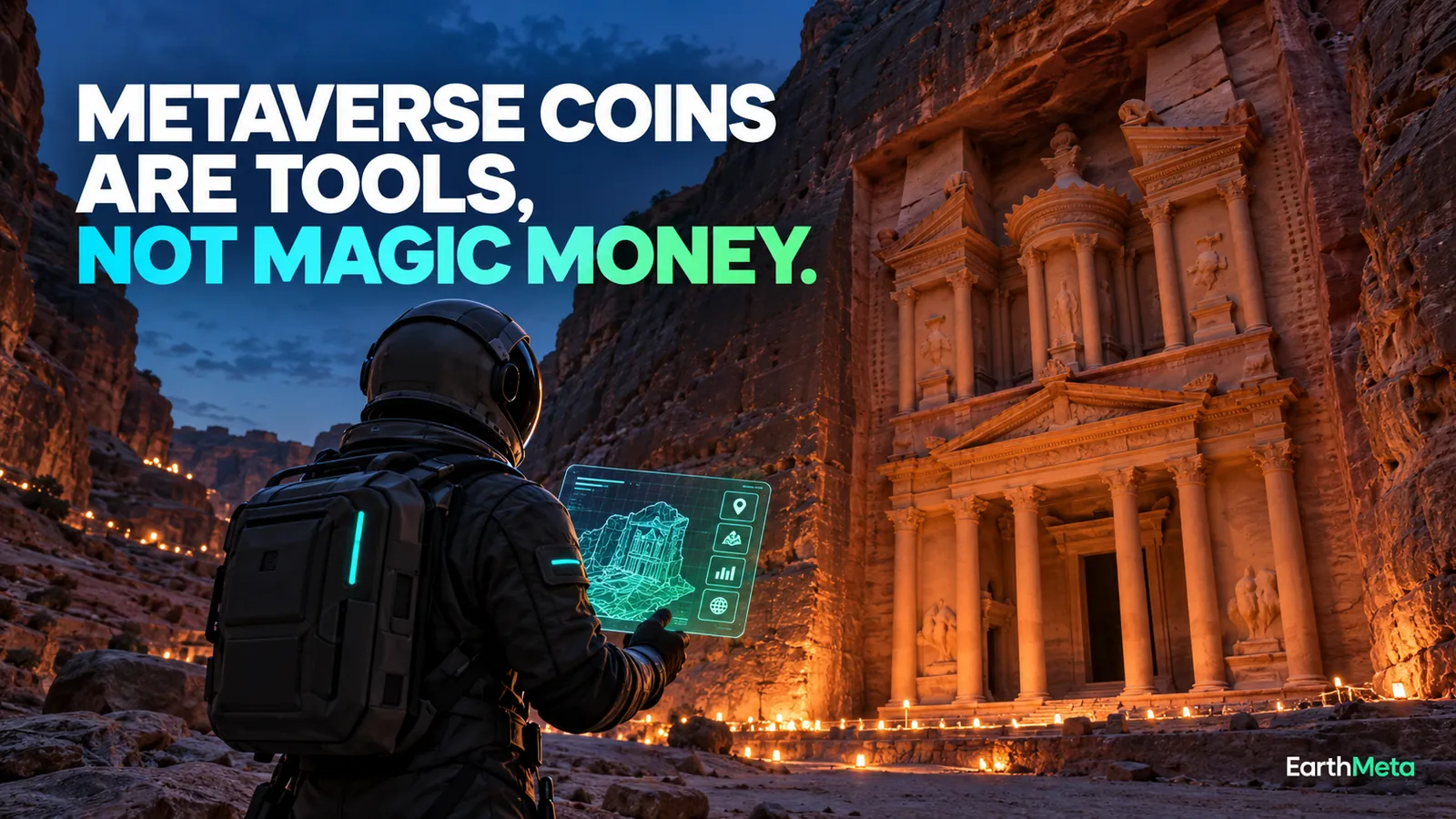
Metaverse coins sound more mysterious than they are.
At their best, they are simply digital tools used inside a virtual-world economy. One coin pays for an avatar jacket. Another lets holders vote on a community proposal. A third rewards players or creators for useful activity. Some try to do all three.
The confusing part is that the same token can sit in several stories at once. It can be a currency inside a game, a governance unit in a DAO, a reward distributed by a staking programme and a cryptoasset traded on an external exchange. Those roles overlap, but they are not identical.
Buying a token does not automatically mean owning land. Receiving a reward does not make it revenue. Holding a governance coin does not mean holders control every product decision. Crypto has a remarkable talent for turning one small word into six separate questions.
This guide untangles them.
Metaverse coins are fungible crypto tokens connected to virtual-world platforms, games or spatial ecosystems. They can be used for payments, creator commerce, access, governance, rewards, staking and incentives. Their usefulness depends on the actual rules of the platform: where the coin is accepted, what rights it provides and why people need it.
Metaverse coins in plain English
A metaverse coin is a blockchain-based token associated with a virtual world or the economy around it. It is normally fungible, meaning one unit is intended to be equivalent to another unit of the same token.
If Alice sends Bob 10 units of a fungible token and later receives 10 equivalent units back, she usually does not care whether they are the exact same ten units. They are interchangeable.
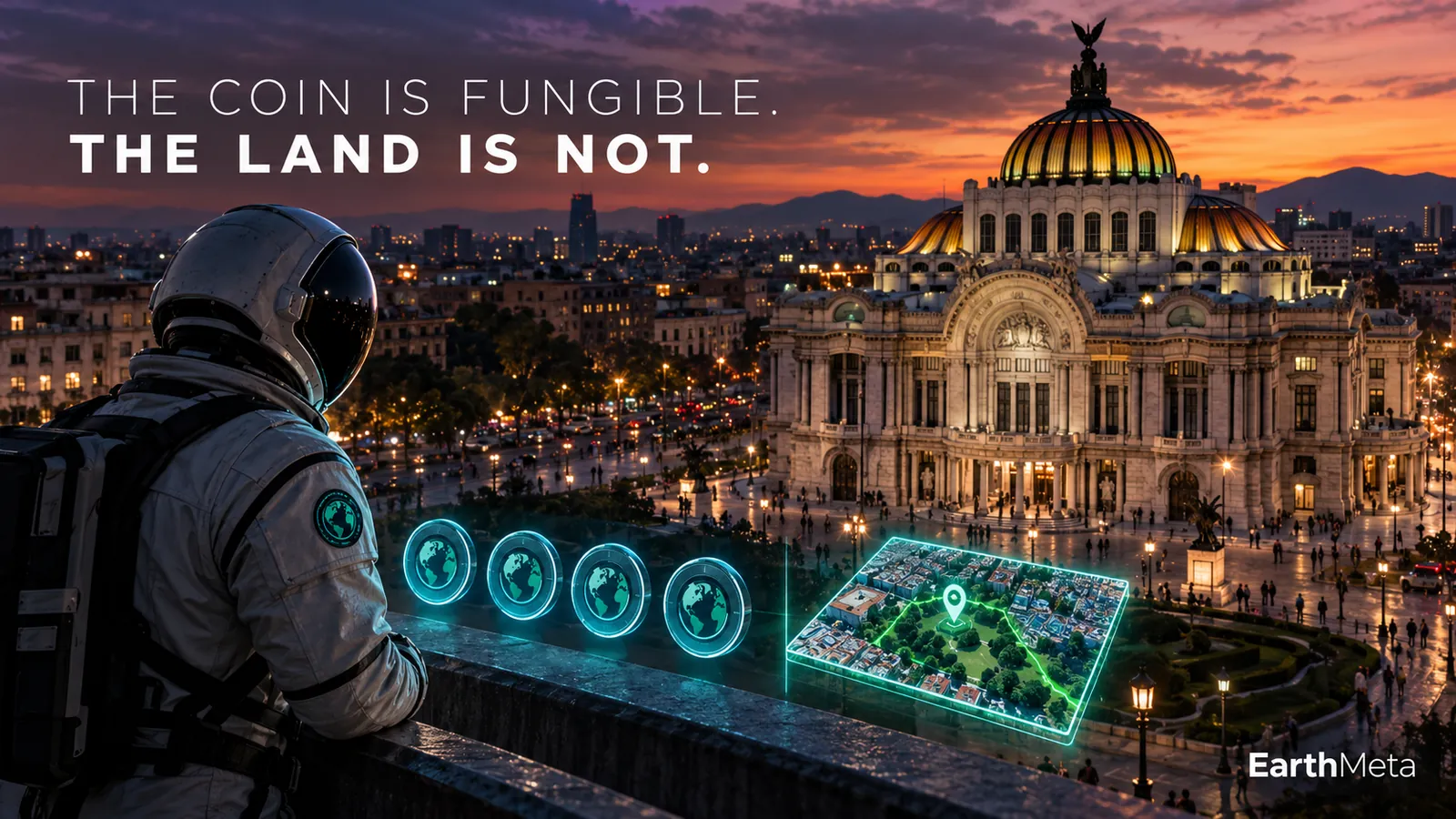
That makes a metaverse coin different from a land NFT.
A land NFT is designed to represent a particular item: one parcel, one city, one estate or one asset with its own token identifier. Two land NFTs can have different coordinates, sizes, histories, permissions and demand. They are not interchangeable in the way two units of the same coin are.
The easiest analogy is cash and property deeds:
- A ten-pound note is fungible with another ten-pound note for ordinary payment.
- The deed to one house is not equivalent to the deed to the house next door.
- The cash can help buy the property, but owning the cash is not the same as owning the property.
In blockchain systems, the common technical pattern is similar. Fungible Ethereum tokens often use the ERC-20 standard, which provides standard functions for balances, transfers and approvals. Unique assets commonly use NFT standards such as ERC-721.
Coins usually move through the economy; NFTs usually identify distinct things inside it.
What makes a coin a “metaverse” coin?
There is no regulator-issued label or universal checklist that transforms an ordinary token into a metaverse coin. The term is descriptive.
A token normally earns the label when it is meaningfully connected to one or more of these:
- a persistent virtual world;
- a game or network of games;
- virtual land or asset marketplaces;
- avatar identity and wearable items;
- creator tools and user-generated content;
- spatial events, communities or services;
- governance of a virtual ecosystem.
The connection should be operational, not decorative. Adding “metaverse” to a project name does not create utility any more than printing “restaurant” on a cardboard box creates dinner.
A useful token has a clear answer to at least one question:
What can someone buy or do with it?
Which decision can someone influence with it?
Which useful behaviour earns it?
Why does the platform need a token for that job?
If the only answer is “people can trade it,” the token is a cryptoasset associated with a metaverse narrative, but it is not yet doing much economic work inside a metaverse.
How is the metaverse-coin category measured?
There is no official boundary around the category. Data providers decide which assets belong under “metaverse,” and the list can include gaming tokens, virtual-world currencies, rendering networks and broader entertainment projects. That means a category total is a useful snapshot, not a scientific measurement of one industry.
Token-market totals also say little about what happens inside a world. They do not reveal how many people play, how much creators earn or how many marketplace sales settle.
A sound view therefore uses several layers:
| Layer | What it shows |
|---|---|
| Product users and repeat participation | Platform reach |
| Marketplace volume | Transaction activity |
| Creator earnings | Economic distribution |
| Treasury and reward flows | Incentive capacity |
The token category is meaningful but smaller than the wider market for games, creator platforms, digital twins and spatial experiences. Some of the world’s largest virtual economies do not use freely traded crypto tokens at all. Metaverse coins measure one coordination layer, not the full size of digital-world activity.
The five jobs metaverse coins perform
The cleanest way to understand metaverse coins is to separate their jobs. The same token can perform several, but each job has different mechanics and risks.
| Token job | What it does | Question to ask |
|---|---|---|
| Payment | Buys assets, services, access or fees | What can actually be purchased today? |
| Governance | Provides voting or proposal rights | Which decisions are in scope, and how is voting power calculated? |
| Rewards | Distributes tokens for activity | Where do rewards come from, and can the economy sustain them? |
| Staking | Locks or commits tokens under stated rules | What is the purpose, lock period and reward source? |
| Access and coordination | Unlocks experiences, status or community functions | Is access genuinely useful or merely artificial scarcity? |
These roles should not be blended into one vague promise of “utility.” A project can have strong payment utility and weak governance. Another can have active governance but little everyday spending. A third can pay attractive rewards for a short campaign without building lasting demand.
Name the job
Five real situations from virtual-world economies. For each one, pick the job the coin is doing.
See the jobs in a live economy
EMT connects payment, staking and governance across real cities.
The next sections take each job on its own terms.
1. Metaverse coins as payment
Payment is the most intuitive use.
A virtual-world platform can use its native coin as a medium of exchange for land, wearables, avatars, names, building assets, event tickets, creator services or premium experiences. Buyers spend the coin. Sellers or creators receive it according to the marketplace’s settlement rules. Fees flow to the platform, a treasury, asset owners or network participants.
Why use a native coin?
A native token creates one shared economic layer across a platform. Instead of every creator inventing a separate payment system, buyers and sellers use the same unit. Smart contracts can split payments automatically. A marketplace can connect purchases, royalties, rewards and governance to one transparent ledger.
The token can also travel outside the platform. A holder can store it in a compatible wallet or use it with other blockchain applications. This composability is one reason projects choose an established network such as Ethereum.
There are trade-offs.
Wallet setup can add friction. Network fees can make small purchases uneconomic. Tax and regulatory treatment differ by country. A native token can simplify the platform’s internal accounting while complicating the user’s first ten minutes.
Good product design hides unnecessary complexity without hiding the truth about the transaction.
Native token, stablecoin and card are different layers
A platform may offer several ways to start a purchase:
- its own metaverse coin;
- a stablecoin such as USDC or USDT;
- a network coin such as ETH;
- a payment card or mobile wallet;
- an automatic conversion from one asset into another.
These are not necessarily competing economic systems. A card can be the entry rail, a stablecoin can provide a familiar unit, and the native coin can remain the settlement or utility layer behind the experience.
The important questions are practical:
- Which asset does the buyer authorise?
- Is a conversion performed?
- Which asset does the seller receive?
- Which price and fees apply?
- Which blockchain records the final transfer?
EarthMeta accepts EMT and other supported cryptocurrencies, and blockchain payment is processed on Ethereum through smart contracts, as set out in its Terms of Use. That tells users exactly where settlement occurs. Before confirming any purchase, check the chosen currency, any conversion and the final amount the seller receives.
Payment examples from established platforms
The Sandbox documents SAND as its native currency and utility token. Players can use it for avatars, equipment and access; creators can use the marketplace to sell assets or buy production inputs. The same token also connects to governance and staking, but payment is a distinct job.
Decentraland uses MANA within its wider economy, while unique LAND and NAME assets carry different properties and governance weights. The coin is not the land. It helps the economy around the land operate.
EMT is EarthMeta’s native utility token, used across city purchases, landmark trading, staking and governance. The platform’s move to Ethereum places EMT in a broad wallet and smart-contract ecosystem, while the experience remains organised around real cities and land assets.
2. Metaverse coins as governance
Governance gives holders a way to influence defined decisions.
That definition needs two words underlined in spirit: defined decisions.
Owning a governance token rarely means managing every product roadmap item, hiring decision or line of code. A DAO may control a treasury, grants, policy lists, marketplace parameters or selected smart contracts. A development company may retain responsibility for software, safety and operations. Some votes are binding. Others are signals.
How token voting works
A typical governance process has several stages:
- Discuss
Someone discusses an idea in a forum or community channel.
- Propose
An eligible participant creates a formal proposal.
- Measure
Wallet balances or delegated voting power are measured.
- Vote
Holders vote during a stated period.
- Decide
The proposal passes or fails under a quorum and threshold.
- Implement
A smart contract, multisignature committee or operating team implements the result.
Each stage can change the real power of the token.
If only wealthy holders can submit proposals, governance is open in theory but narrow in practice. If votes pass but implementation is optional, token holders provide advice rather than control. If a few wallets hold most voting power, the DAO may be on-chain but highly concentrated.
Decentraland shows governance scope clearly
Decentraland’s current DAO documentation says MANA, NAME and LAND holders can participate in decisions. The DAO can issue grants and change records such as points of interest, banned names and community server lists. It also controls LAND and Estate smart contracts.
The documentation is equally useful for what it does not claim. The DAO does not own or modify the MANA smart contract. Some approved actions are executed through committees and multisignature wallets. Governance is a system of scopes, contracts and human responsibilities, not a button labelled “decentralise everything.”
Governance questions worth asking
- Which assets create voting power?
- Is one token equal to one vote?
- Can voting power be delegated?
- What minimum balance is required?
- Is there a quorum?
- Are votes on-chain or recorded through a system such as Snapshot?
- Who executes an approved proposal?
- Which contracts or treasury funds are controlled?
- Which product decisions remain with the development team?
- Can emergency security action override a normal vote?
These questions are more revealing than a homepage badge saying “community governed.”
Governance in EarthMeta
EarthMeta’s governance model connects virtual geography to roles. City owners are Governors and country-level owners are Presidents, with tools for land management, city economics and DAO participation. Portfolio size contributes to voting weight.
This is a notable distinction. Governance is not built only on ownership of interchangeable EMT units; unique city and country positions also shape the ecosystem’s structure. EMT remains the native utility layer, while city and country NFTs identify specific governance roles.
The roles also carry a direct economic link to activity. Every city has a Governor who receives 1% of every trade in their city, and every country has a President who receives 0.5% of every transaction across the whole country. One person can hold both roles and collect 1.5% on their own city. These percentages apply to every asset traded in the territory, whether the Governor or President owns it or not: $100,000 traded in a city = $1,000 tax collected by its Governor.
Watch city trading turn into tax collected
Pick a role, or both: one person can be Governor and President.
The practical strength of that model is context. A Governor has a reason to care about activity inside a particular city, not just a token balance. Useful projects, visitors and real exchanges in the city are what the role is built around.
Find a city with a role to play
Explore EarthMeta’s real-world cities and see how Governors and Presidents shape their territory.
3. Metaverse coins as rewards
Rewards use tokens to encourage behaviour.
A platform may distribute tokens for playing, building, winning a contest, moderating a community, staking, completing a quest or bringing useful activity into a world. The goal is alignment: reward the people who help the ecosystem grow.
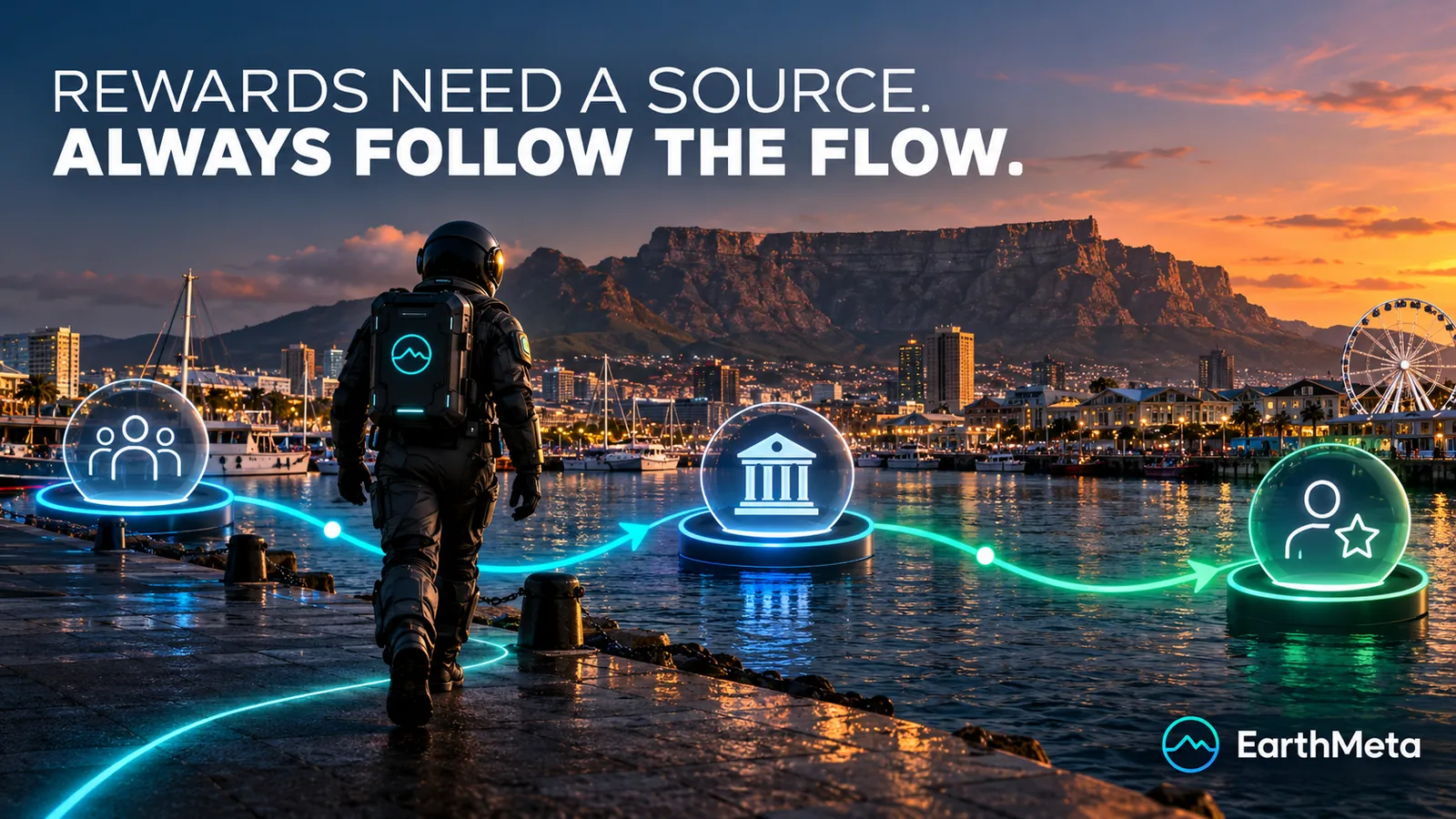
The hard part is that every reward has a source.
Four common reward sources
Allocated token reserve
A project reserves part of its tokens for gameplay, creators, community programmes or staking. Tokens enter circulation according to a schedule.
Marketplace or protocol fees
A share of actual economic activity flows to participants or a reward pool.
Treasury spending
A DAO or company uses existing treasury assets to fund grants and incentives.
New emissions
The protocol creates additional units under its issuance rules.
These sources have different effects. A reward paid from fees is connected to current activity. A reward paid from a fixed reserve can support growth until the reserve is used. A reward funded by continuing emissions depends on the protocol’s issuance rules.
None is automatically good or bad. The key is visibility.
Rewards are not revenue
Suppose a game awards a player 100 tokens. The player has received a cryptoasset. The game has not necessarily generated 100 tokens’ worth of external revenue. The reward may come from a pre-allocated pool.
That is why reward design must connect to reasons to spend or use the token. A reward loop with no useful sink is a tap running into a bucket with no bottom.
Axie Infinity illustrates the incentive model
The Axie Infinity whitepaper describes AXS as an ERC-20 governance token. It says holders can claim rewards through staking, gameplay and participation in governance, while players can earn AXS through games and user-generated content initiatives.
Its play-and-earn allocation is explicit that token issuance is designed to reward behaviours such as competition, marketplace use and interaction with land. The document describes the allocation as a marketing budget for the ecosystem.
That is a helpful mental model. Rewards are not free economic energy. They are spending designed to acquire, retain or align participants.
Reward quality checklist
A strong reward programme answers:
- What behaviour earns the reward?
- Why is that behaviour valuable?
- Is the reward fixed, variable or competitive?
- Where are the tokens sourced?
- Is there a vesting or lock period?
- What can recipients do with the token?
- What happens when the incentive ends?
The last question is the most important. If participation collapses the moment rewards stop, the programme rented attention. It did not build a community.
4. Metaverse coins in staking
Staking is often used as a catch-all word, but several mechanisms sit beneath it.
In a proof-of-stake blockchain, validators commit the network’s native asset to help secure consensus. A metaverse-token staking programme does something different: it locks a utility token in a platform contract to qualify for rewards, governance weight, access or an ecosystem role.
Those two arrangements should not be confused.
What token holders should inspect
- Purpose: What function does locking the token perform?
- Custody: Does the user send tokens to a smart contract or delegate without transfer?
- Duration: Is there a fixed lock or an immediate withdrawal option?
- Reward source: Fees, treasury, emissions or promotional allocation?
- Eligibility: Wallet, identity, region or asset-ownership requirements?
- Smart-contract risk: Has the contract been reviewed and can it be upgraded?
The Sandbox’s staking documentation says its earlier Ethereum programme was discontinued and describes current Polygon programmes. This is a good reminder that staking terms evolve. A token’s historical mechanism is not evidence of its current one.
EMT staking and city-linked pools are part of EarthMeta’s economic layer. Each live programme’s interface shows its active window, eligibility and duration. The broader concept is clear: EMT coordinates participation around the real-city economy, while the specific terms belong to each live programme.
5. Metaverse coins as access and coordination
Some token utility is neither payment nor governance. A balance can unlock a gated experience, prove membership, qualify someone for a creator programme, increase status or coordinate a community campaign.
This can be useful when the token represents genuine commitment. It can also become artificial friction.
If an event requires a token because holders fund and govern the community, token-gated access makes sense. If a simple public tour requires three wallet signatures and an obscure swap, the system has turned a welcome mat into an obstacle course.
Good access design asks:
- Does the gate protect scarce capacity or community value?
- Can new users preview the experience?
- Is the required balance reasonable?
- Are alternatives available for people without wallets?
- Is personal data linked to the wallet?
The strongest metaverse platforms often offer a free exploration layer and reserve blockchain interactions for ownership, advanced commerce or governance. The Sandbox’s current documentation explicitly notes that a crypto wallet is not required to enjoy some features, while a wallet is used for ownership and earning. That separation widens the audience without weakening the token’s economic role.
Coin, NFT, stablecoin and network token: the essential map
Four kinds of digital asset can appear in one metaverse checkout. They do different jobs.
| Asset type | Typical role | Example | Main distinction |
|---|---|---|---|
| Metaverse utility coin | Payment, governance, rewards, access | EMT, SAND, MANA, AXS | Fungible token tied to an ecosystem |
| NFT | Unique land, city, avatar item or asset | EarthMeta city, Decentraland LAND | Non-fungible; one item can differ from another |
| Stablecoin | Familiar payment or pricing rail | USDC, USDT | Designed to track a reference asset, usually a currency |
| Network-native coin | Pays blockchain gas and secures the network | ETH | Belongs to the underlying blockchain, not one metaverse |
Why ETH can appear even when the price is in EMT
EarthMeta’s current EMT token operates on Ethereum. EMT is the utility token for the platform; ETH is Ethereum’s native asset.
When a user performs an on-chain action, the transaction can require gas. Ethereum’s official fee guide explains that gas pays for computation and that fees on Ethereum are paid in ETH. Therefore, a wallet can hold enough EMT for a purchase but still need ETH for the network fee, unless the product uses an approved abstraction or sponsored transaction flow.
That does not mean the user is paying twice for the asset. The EMT amount is the economic payment. The ETH amount compensates the network for processing the transaction.
Why stablecoins can reduce friction
A stablecoin gives users a more familiar reference for pricing. Someone understands “$50 equivalent” faster than a long string of units of another token. A platform can accept a stablecoin at checkout and convert or settle according to its marketplace rules.
The stablecoin still carries its own issuer, contract and network risks. “Stable” describes a design target, not a supernatural exemption from the rules of the system around it.
How major metaverse coins differ
The following examples show why the category cannot be understood from the ticker alone.
| Token | Platform role in official documentation | Distinctive point |
|---|---|---|
| EMT | Native EarthMeta utility across cities, marketplace activity, staking and governance | Connects a real-Earth city and land economy on Ethereum |
| SAND | Currency and utility token for marketplace activity, access, staking and DAO participation | Supports player, creator and LAND-owner activity in The Sandbox |
| MANA | Token connected to Decentraland commerce and voting power alongside LAND and NAME | Governance power comes from several asset types, not MANA alone |
| AXS | Governance and reward token for the Axie ecosystem | Explicitly links rewards to staking, play and governance participation |
This is not a ranking. It is a role comparison.
Two tokens can both support governance while controlling different decisions. Two can both pay rewards while using different funding schedules. Two can both appear in marketplaces while one settles most trades in the native token and another uses additional payment rails.
Before comparing anything else, compare the job.
Why metaverse projects use tokens at all
Not every virtual world needs a blockchain token. A centralised game can manage credits in a database. A subscription can be paid by card. A platform can govern itself through ordinary corporate processes.
Tokens are most defensible when they provide capabilities that fit the product.
Public ownership records
Balances and transfers can be verified on a blockchain. Users can hold assets in compatible self-custody wallets rather than only in a platform account.
Programmable settlement
Smart contracts can divide a payment among creators, platform services, treasuries or geographic owners according to published rules.
Composability
Standard tokens are recognised by wallets and applications on the same network. ERC-20 was designed as a reusable interface across applications.
Shared incentives
A token can coordinate contributors who are not employees of one company. Creators, players, owners and voters can all hold the same economic unit.
Transparent governance
Proposals and votes can be publicly inspectable. Treasury movements can be traced. That does not eliminate politics, but it makes parts of the process observable.
Global participation
Crypto wallets enable cross-border participation where supported by law and the platform. Access still depends on local rules, infrastructure and safe wallet use.
The disadvantages are just as real: complexity, scams, irreversible mistakes, fees, uncertain regulation and the difficulty of designing an economy that remains useful after the launch excitement.
How token utility creates real activity
Utility creates reasons to acquire and use a token. If an active marketplace requires EMT, creators and buyers need EMT to transact. If governance requires a token, participants need it to vote. If a staking programme requires a balance, eligible users need the token to join.
But the word “utility” does not create activity by itself. Usage comes from people who want to do something inside the world: buy an asset, open an event, improve a place or take part in a decision.
The correct claim is modest and useful: more genuine platform activity increases the reasons people need a token. That is why the strongest token economies start with the product, not the token.
Rewards, spending and value flow
The healthiest token economies connect several loops.
- Enter
Users enter because the product is useful or enjoyable.
- Spend
Some spend on assets, services or access.
- Create
Creators and owners earn from genuine demand.
- Fund
The platform or treasury funds maintenance and incentives.
- Reward
Rewards encourage behaviour that improves the product.
- Use
Better activity gives the token more practical use.
If step one is missing, the loop depends on financial incentives to recruit the next participant. That is fragile.
A worked example without fantasy numbers
Imagine a virtual city holding a weekend architecture event.
Visitors enter for free. Some buy an optional guided experience in the platform coin. A local creator sells an avatar item. A sponsor pays for a branded exhibition. The marketplace contract splits fees under the platform rules. In EarthMeta, the city’s Governor collects a 1% tax on every one of those trades and the country’s President collects 0.5%, whoever owns the items sold. Part of platform revenue funds the next event and a creator contest.
Value comes from attendance, content and service. The token coordinates payment and distribution.
Now remove the event, visitors and creators. Keep only a reward for holding the token. The economy has fewer reasons to exist beyond the reward itself.
The contrast is the entire point. A coin can organise an economy; it cannot substitute for one.
Why gaming is central to metaverse coins
Games teach virtual economies how to behave.
Players understand earning, crafting, collecting, upgrading and trading. They accept that digital objects can carry status and utility. They also notice quickly when an economy is unfair, pay-to-win or inflated.
Tokenised gaming adds external ownership and trade, but it inherits the design problem of every game economy: rewards must not destroy the challenge or overwhelm the sinks.
If rewards enter faster than players want to spend, unused tokens pile up. If assets become too scarce, new players cannot compete. If speculation becomes the primary activity, the game can start serving traders instead of players.
The strongest metaverse-coin design therefore begins with an activity people would choose for its own sake. Rewards can accelerate a good experience. They struggle to animate a boring one.
This matters for EarthMeta. Its real-city map creates recognisable locations, but recognition is the stage rather than the show. Creator tools, events, buildings, avatars, exploration and community activity create the reasons EMT circulates.
Why AI matters to metaverse token economies
AI does not change the definition of a coin. It changes the amount of useful content the economy supports.
World creation traditionally requires specialists in modelling, code, animation and design. AI-assisted tools shorten the path from an idea to a playable or explorable scene. More creators can attempt projects. Owners who are not professional developers can commission or generate initial drafts.
That increases token utility in several ways:
- creators purchase assets or services;
- users spend on more experiences;
- communities reward useful contributions;
- marketplaces list a wider range of content;
- governance evaluates more proposals;
- city owners can activate places faster.
There is a catch. AI can also produce an ocean of repetitive assets. Output can rise faster than attention. A marketplace full of near-identical objects does not automatically create more value.
The scarce resources become curation, originality, local knowledge and trust.
EarthMeta’s AI direction is especially relevant because real geography supplies context. A creator building a Kyoto cultural tour, a Lagos business district or a Rio event should not receive the same generic output. AI is most useful when it helps translate a specific place and purpose into an experience, not when it covers the planet with copy-and-paste towers.
Where EarthMeta and EMT fit
EarthMeta launched in October 2024, as recorded in its roadmap and company history. The platform uses a digital map of more than 250,000 real cities, with distinct blockchain assets for cities and land.
EMT is the fungible token connecting that ecosystem.
Buy, trade, access
EMT buys cities, trades landmarks and opens platform commerce, alongside other supported cryptocurrencies.
Staking and pools
EMT staking and city-linked pools align holders and city communities around longer-term activity.
Governors and Presidents
EMT works alongside unique city and country roles in the DAO structure.
EMT as the payment layer
The official EMT utility page sets out EMT as the native token for buying cities, trading landmarks and accessing platform commerce. EarthMeta’s Terms also allow other supported cryptocurrencies, with settlement processed through Ethereum smart contracts.
This combination matters. Multiple payment rails reduce the work required to enter, while EMT remains the shared utility unit linking marketplace activity.
EMT as the staking and incentive layer
EMT staking and city-linked pools are live in the ecosystem. Each programme’s windows and eligibility are shown in the active interface at the time of participation.
The purpose is to align token holders and city communities around longer-term activity, with reasons to use the platform at the centre.
EMT as the governance layer
EarthMeta’s Governor and President structure links governance to both fungible EMT and unique geographic ownership roles. City owners manage land and participate in DAO decisions; country-level roles operate at a broader layer. Governors collect a 1% tax on every trade in their city and Presidents 0.5% on every transaction in their country, on every asset traded there, owned or not.
This makes EMT part of governance without making it identical to a city NFT. The coin supplies an interchangeable economic unit. The NFT identifies a specific governed place and its associated role.
EMT on Ethereum
EMT is live on Ethereum as an ERC-20 token. This gives it compatibility with Ethereum wallets and applications that support the token standard.
It also means users must pay attention to network selection, contract addresses and gas. An EMT token on a different chain or an old contract is not automatically the current asset. EarthMeta migrated from its earlier Polygon token to its Ethereum version; users should rely on the current contract linked from official EarthMeta channels rather than searching by ticker alone.
Ticker symbols are not unique. Scammers can create a token called EMT in minutes. The contract address is the real identifier.
What is live and what is on the roadmap
EarthMeta’s live platform includes its city and land ownership system, marketplace, Ethereum EMT token and current experience layers. Its roadmap extends into more AI building, mobile, AR, creator and spatial features.
Those future tools deepen EMT’s utility as they are released. EMT’s role begins with the working economy today and grows as additional use cases go live.
See EMT at work
Review EMT’s utility, then open the application to see token, city and land ownership working together.
How to evaluate a metaverse coin in eight steps
This process is useful whether the token belongs to EarthMeta, The Sandbox, Decentraland, a gaming world or a new project.
Step 1: Find the official contract
Use the project’s official website or verified announcement. Match the network and full contract address. Do not trust a ticker, search ad or unsolicited message.
Step 2: Write down the live utility
List only actions available now: payment, access, governance, staking, rewards or fees. Place planned features in a separate list.
Step 3: Map the token flow
Identify who buys, who earns, which fees are charged and where treasury funds move. If the flow cannot be explained in simple arrows, keep researching.
Step 4: Read governance rules
Find the proposal process, voting weight, quorum, execution method and scope. A token called “governance” can provide anything from broad treasury control to occasional opinion polls.
Step 5: Trace rewards
Determine whether rewards come from fees, a reserve, treasury spending or new issuance. Compare the programme’s duration with the time a participant must lock tokens.
Step 6: Test product demand
Look for active users, repeat activity, creator output, marketplace transactions and reasons to return. Token holders are not the same as product users.
Step 7: Review security and permissions
Check smart-contract audits where available, upgrade controls, multisignature arrangements and wallet approvals. Ethereum’s current guide to revoking token access warns that an approved contract can retain spending permission even after a wallet disconnects.
Step 8: Apply the change test
Ask what happens if a staking programme ends, a reward campaign stops or the platform changes direction. If the product still gives people a reason to participate, the utility is real.
This is not a reason to ignore every token. It is a reason to understand the product before the excitement.
Run the eight steps on any metaverse coin
Tap each step once you have checked it.
The contract address is the real identifier. Everything else builds on it.
Wallet safety for metaverse coins
Most losses do not begin with a sophisticated attack on a blockchain. They begin with a fake link, copied support account, malicious approval or phrase entered on the wrong site.
Protect the recovery phrase
A legitimate support agent does not need a wallet recovery phrase or private key. Anyone who obtains it can control the wallet.
Verify the domain
Bookmark the official platform. Search ads and lookalike domains can lead to copied interfaces. Check every character before connecting a wallet.
Verify network and contract
The same ticker can exist on several chains. Confirm the network and contract from an official source. EarthMeta’s current EMT is on Ethereum; older or imitation contracts should not be treated as the live token.
Read every wallet request
A message signature, token approval and token transfer are different actions. Do not approve an unlimited spending allowance simply because the button is colourful.
Limit approvals
Approve only the amount needed when the wallet supports it. Review existing approvals and revoke unused access. Disconnecting a site is not the same as removing its token allowance.
Separate wallets by purpose
Some users keep long-term assets in one wallet and use another for routine applications. This does not eliminate risk, but it limits the amount exposed to one mistaken approval.
Start with a small transaction
When using a new address, bridge or marketplace, a small test can catch network and address errors before the full amount moves.
Blockchain transactions are designed to be final. “I clicked the wrong thing” is not a rollback policy.
Common misconceptions
“Owning the coin means I own land”
No. Fungible coins and land NFTs are different assets. The coin can buy land or govern aspects of the platform, but the unique land token identifies the property.
“Governance means holders control everything”
No. Governance scope varies. Holders may control grants or selected parameters while a company manages development and safety.
“Staking rewards are guaranteed”
No. Terms can change, contracts can fail and programmes end. Rewards are conditional distributions, not a salary.
“All metaverse coins compete for the same users”
Not necessarily. A game token, a virtual-land token and a creator-platform token can serve different audiences and jobs. They compete for attention but may solve different problems.
What makes a metaverse token economy sustainable?
A sustainable economy does not depend on what the token does on external markets. It requires continued reasons for people to participate.
The strongest systems combine:
- a product people choose to use;
- creators who can produce new value;
- clear spending opportunities;
- rewards tied to useful behaviour;
- transparent governance;
- accessible payment routes;
- safety and trust;
- economic activity inside the world, not just around the token.
EarthMeta connects these parts through real geography.
A city owner has a place to develop and collects tax on the trades that happen there. A landowner has a distinct parcel. A creator can build an experience. A visitor can explore or spend. Marketplace rules distribute fees. EMT provides a shared unit for transactions, incentives and governance.
That model becomes stronger as activity becomes more connected to what happens inside the cities.
The coin should serve the world; the world should not exist merely to serve the coin.
Frequently asked questions about metaverse coins
What are metaverse coins?
Metaverse coins are fungible blockchain tokens connected to virtual worlds, games or spatial platforms. They support payments, governance, rewards, staking, access and creator commerce. Each token’s actual utility depends on its current platform rules.
Are metaverse coins the same as NFTs?
No. Coins are usually fungible, so equal units are interchangeable. NFTs identify unique items such as land, cities, wearables or named assets. A metaverse coin can be used to buy an NFT without becoming that NFT.
What can metaverse coins be used to buy?
Depending on the platform, they buy land, avatar items, names, building assets, creator services, event access or premium experiences. Some platforms also accept stablecoins, network tokens or cards.
How do governance tokens work?
Governance tokens create voting power under defined rules. Holders vote on grants, treasury spending, policies or selected smart-contract parameters. The project documentation should explain proposal eligibility, quorum, execution and decisions outside DAO control.
Where do metaverse token rewards come from?
Rewards come from reserved token allocations, new emissions, marketplace fees or treasury spending. The source shapes how long a programme can last, so a reward rate should never be evaluated alone.
Is staking a metaverse coin risk-free?
No. Smart-contract, custody and lock-up risks can apply, and terms and eligibility can change. A staking reward is a conditional distribution under a programme’s rules, not a guaranteed payment.
Why do I need ETH if I already have EMT?
EMT is an ERC-20 token on Ethereum. On-chain transactions can require gas paid in ETH because ETH is the network’s native currency. EMT pays for the platform activity; ETH pays the blockchain processing fee.
What is the difference between EMT and an EarthMeta city?
EMT is the fungible utility token connecting payments, staking and governance. An EarthMeta city is a unique NFT representing a particular real-world city on the platform. Owning EMT does not automatically mean owning a city.
How much tax does an EarthMeta Governor collect?
Every EarthMeta city has a Governor who receives 1% of every trade in that city, and every country has a President who receives 0.5% of every transaction across the whole country. One person can hold both roles and collect 1.5% on their own city. The tax applies to every asset traded in the territory, owned or not: $100,000 traded in a city = $1,000 tax collected by its Governor.
How can I check whether a metaverse coin is genuine?
Use the full contract address and network linked by the official project website. Do not rely on the ticker alone. Avoid unsolicited links, verify the domain and make a small test transaction when appropriate.
Are metaverse coins regulated?
Rules vary by country and token structure. In the UK, the Financial Conduct Authority classes crypto as high-risk and regulatory protections may be limited. Check the rules that apply where you live before using any token.
What makes EMT useful in EarthMeta?
EMT is EarthMeta’s native Ethereum utility token for platform commerce, staking and governance. It connects the fungible economic layer to unique city, country and land ownership roles across EarthMeta’s digital twin of the planet.
Verdict: follow the function, not the ticker
Metaverse coins are not one product.
They are programmable units that perform several jobs inside a virtual-world economy. Payment moves value. Governance coordinates decisions. Rewards encourage behaviour. Staking changes access or incentives. Token gates organise membership. The same coin can do several jobs, but each must be understood separately.
That distinction protects readers from the category’s easiest mistakes. A coin is not a land deed. A reward is not revenue. A vote is not unlimited control. A beautiful virtual world is not automatically a sustainable economy.
The positive case is still powerful. Tokens let creators and users participate in a shared economy across borders. Smart contracts make ownership and payment flows visible. Communities help allocate resources. Virtual-property platforms connect unique places to a common medium of exchange.
EarthMeta makes that relationship particularly clear. Real cities and land provide the unique geographic layer. EMT provides the fungible economic layer. Governors, Presidents, creators and visitors interact through different assets and roles, while Ethereum supplies the underlying transaction network.
For anyone evaluating a metaverse coin, begin with three questions: What can it do today? Where does value enter and leave the system? Would the product still give people a reason to return on its own merits?
Strong answers reveal utility. Weak answers reveal a story searching for a product.
For more context, read EarthMeta’s guides to the difference between the metaverse and Web3, the future of the metaverse and the market mechanisms behind digital worlds.
Sources and methodology
Sources checked on 21 October 2026. Third-party platform details (The Sandbox, Decentraland, Axie Infinity) are described as their own documentation reports them. Governor and President amounts shown are examples: the tax collected depends on the trading activity in their city or country.
- EarthMeta — EMT utility
- EarthMeta — Governors and Presidents
- EarthMeta — About
- EarthMeta — Terms of Use
- Ethereum.org — ERC-20 token standard
- EIP-20 — Token Standard
- Ethereum.org — Gas and fees
- Ethereum.org — How to revoke token access
- The Sandbox — SAND documentation
- The Sandbox — Staking documentation
- Decentraland — What is the DAO?
- Axie Infinity — AXS
- Axie Infinity — Play and Earn allocation
- UK Financial Conduct Authority — crypto guidance, updated 29 January 2026