The metaverse and Web3 have spent years being introduced as if they were twins. They are not.
They meet often. They can strengthen each other. Some of the most interesting digital worlds use both. But they solve different problems.
That distinction sounds technical until you picture a music festival. The festival grounds, stages, lights, crowd and activities are the experience. The tickets, payment rails, membership passes, voting rights and proof that your limited-edition jacket is genuinely yours are the coordination and ownership systems beneath it.
You can run a festival without blockchain. You can also use blockchain without running a festival. Put the two together well, however, and the experience gains a programmable economy.
That is the practical relationship between the metaverse and Web3.
This guide separates the concepts, shows where they overlap, examines live examples, and explains why the combination matters for EarthMeta. No buzzword smoothie. No requirement to wear a headset while buying an NFT. Just a clear map of the territory.
Metaverse vs Web3 at a glance
| Question | Metaverse | Web3 |
|---|---|---|
| Main idea | Shared digital experiences and environments | Decentralized ownership, identity, payments and coordination |
| What the user notices first | A world, scene, game, event, avatar or social space | A wallet, token, signature, smart contract or governance action |
| Does it require blockchain? | No | Usually yes, by the common modern definition |
| Does it require VR? | No | No |
| Typical assets | Avatars, environments, virtual goods, buildings, games | Fungible tokens, NFTs, credentials, governance rights, on-chain records |
| Typical activities | Explore, meet, play, build, attend, shop, learn | Own, transfer, pay, verify, vote, coordinate |
| Main success signal | Useful or enjoyable participation | Reliable ownership, open access and functioning economic coordination |
| Core weakness when used alone | The platform can control accounts, goods and rules | Ownership rails do not automatically create an experience people want |
| Simple analogy | The city | The deeds, payment rails and civic rules |
The terms overlap because digital worlds need economies, identities and rules. Web3 provides tools for those jobs. But it is a mistake to treat every 3D world as Web3 or every blockchain application as a metaverse.
What is the metaverse?
The metaverse is not one app and it is not a single planet waiting behind a login screen.
It is a category of digital experiences built around some combination of presence, persistence, identity, social interaction, creation and economic activity. Different platforms emphasize different parts of that combination.
A virtual concert with thousands of participants can feel metaverse-like. So can a creator-built game world, a digital twin of a factory, an online classroom where people move through a shared space, or a geographic platform where a real city becomes a digital place people can own and develop.
The word becomes useful when it describes an internet people can inhabit, not merely read.
The core metaverse mechanisms
Most mature virtual-world platforms rely on five practical mechanisms:
A navigable environment
It can be 3D, 2.5D, augmented reality or a map-based interface. The important point is that users understand themselves as being somewhere.
A persistent identity
An avatar, profile, inventory, reputation or account follows the participant across sessions.
Shared participation
Other people, creators or organizations can enter the same system and affect what happens there.
Creation
Users or professional studios can build experiences, objects, spaces or services.
An economy
Time, attention, skill, virtual goods or access can carry value inside the platform.
None needs blockchain
All five mechanisms can run on a platform's private systems.
None of those mechanisms requires blockchain.
Roblox is the clearest large-scale example. Its economy, identity and item systems are platform-managed rather than built as an open blockchain network. Yet in the second quarter of 2026, Roblox reported 123 million daily active users and 29 billion hours engaged. That is not a theoretical audience wearing goggles in a press release. It is measurable participation inside a creator-driven digital platform.
Fortnite Creative and UEFN offer another example. Creators publish islands, attract players and receive engagement-based payouts. Epic states that 40% of eligible net revenue flows into the engagement pool used for creator payouts. The experience is immersive and economically productive, but the user's relationship with the platform is still governed primarily by Epic's accounts, currency and rules.
So the metaverse can be enormous without being Web3.
What is Web3?
Web3 describes an internet architecture in which blockchains, smart contracts, cryptographic wallets and open protocols give users stronger control over assets and actions.
The exact boundaries remain debated. Even Ethereum.org's introduction to Web3 says the term is difficult to define rigidly. Its commonly cited principles are decentralization, permissionless participation, native digital payments and reduced dependence on trusted intermediaries.
The shorthand is read, write, own.
Web1 made information easy to read. Web2 made publishing and participation easy. Web3 adds the possibility that users hold assets, sign actions and move value through systems that do not rely entirely on one platform's private database.
The core Web3 mechanisms
Web3 usually brings together five components:
- Wallets act as accounts and signing tools.
- Blockchains keep a shared record of transactions and state.
- Smart contracts execute rules when defined conditions are met.
- Tokens represent transferable units, access, governance, membership or distinct assets.
- Decentralized protocols allow multiple interfaces or applications to read and interact with the same underlying state.
The ERC-721 standard, for example, defines a common smart-contract interface for tracking and transferring distinct non-fungible tokens. The standard does not build a city, design an avatar or create a fun game. It gives wallets, marketplaces and applications a shared way to recognize who controls a unique token.
That is Web3 in miniature: not the experience itself, but a portable and verifiable rule for ownership.
Web3 can exist without a metaverse
A decentralized exchange is Web3. It is not automatically a metaverse.
A stablecoin payment is Web3. It is not automatically a metaverse.
A blockchain-based lending protocol, token vote or verifiable credential can be Web3 without containing an avatar, a virtual landscape or a social world.
The World Wide Web Consortium's Decentralized Identifiers standard is a useful example. It defines identifiers designed to let controllers prove control without depending on one central identity provider. That can support identity across many digital services, including virtual worlds, but the identifier itself is infrastructure, not a world.
Web3 is therefore broader than the crypto metaverse. It reaches finance, identity, supply chains, membership, certification, publishing and coordination.
The simplest mental model: place vs rails
Imagine arriving in a real city.
The roads, parks, stadiums, shops, homes and people create the lived experience. That is the metaverse side of the analogy.
The property registry, payment networks, contracts, business licenses, voting system and identity documents help determine who owns what and how activity is coordinated. That is the Web3 side.
The city can exist with a centralized registry. A registry can exist without building a city. Yet a city becomes more economically expressive when people can prove ownership, exchange assets, establish rules and coordinate with confidence.
That is why the metaverse and Web3 keep appearing together.
The metaverse gives Web3 somewhere vivid to matter. Web3 gives the metaverse a stronger language for ownership and exchange.
Four boxes that end the confusion
The fastest way to separate the concepts is to place digital products into four boxes.
1. Metaverse without Web3
Roblox and Fortnite are strong examples.
They offer persistent identities, social presence, creator tools, virtual goods and large economies. Users can spend money and creators can receive payouts. The platform operator, however, manages the ledger, account access, marketplace rules and most asset rights.
The model can work extremely well because it reduces friction. Users sign in with familiar credentials, make standard payments and avoid gas fees or wallet recovery phrases. The platform can optimize the whole experience as one product.
The trade-off is control. An item exists under the platform's technical and contractual system. Transferability, resale and interoperability depend on what the platform allows.
2. Web3 without a metaverse
Decentralized finance, tokenized membership, blockchain naming systems and on-chain credentials fit here.
A user can swap assets, sign a proposal or prove control of a credential without entering an immersive world. The product is about coordination or ownership rather than spatial experience.
This box matters because it prevents the word “metaverse” from swallowing the entire blockchain industry. A wallet transaction is not a virtual world just because both involve a token.
3. Metaverse plus Web3
Decentraland, The Sandbox and EarthMeta sit in this overlap.
Their digital spaces use blockchain-based assets, tokens or governance systems as part of the experience. Decentraland's current architecture explicitly separates decentralized ownership and governance from centralized services used for performance. LAND, wearables and names are recorded as NFTs, while real-time communications and discovery still depend on practical service infrastructure.
The Sandbox connects LAND, assets, experiences and SAND. Its official documentation lists a fixed total of 166,464 LAND tokens and describes uses such as publishing experiences, gating access and participating in owner programs.
EarthMeta uses the same overlap in a geographically distinctive way: its virtual environment is based on real-world cities, while blockchain assets and the EMT economy provide ownership and transaction rails.
4. Neither metaverse nor Web3
A normal ecommerce site, a static corporate homepage or a conventional mobile calculator is neither.
That does not make it inferior. It simply solves a different problem.
Technology categories are tools, not medals. A toaster does not need a DAO. It needs to stop burning breakfast.
Sort six products into the right box
Choose the box this product belongs in.
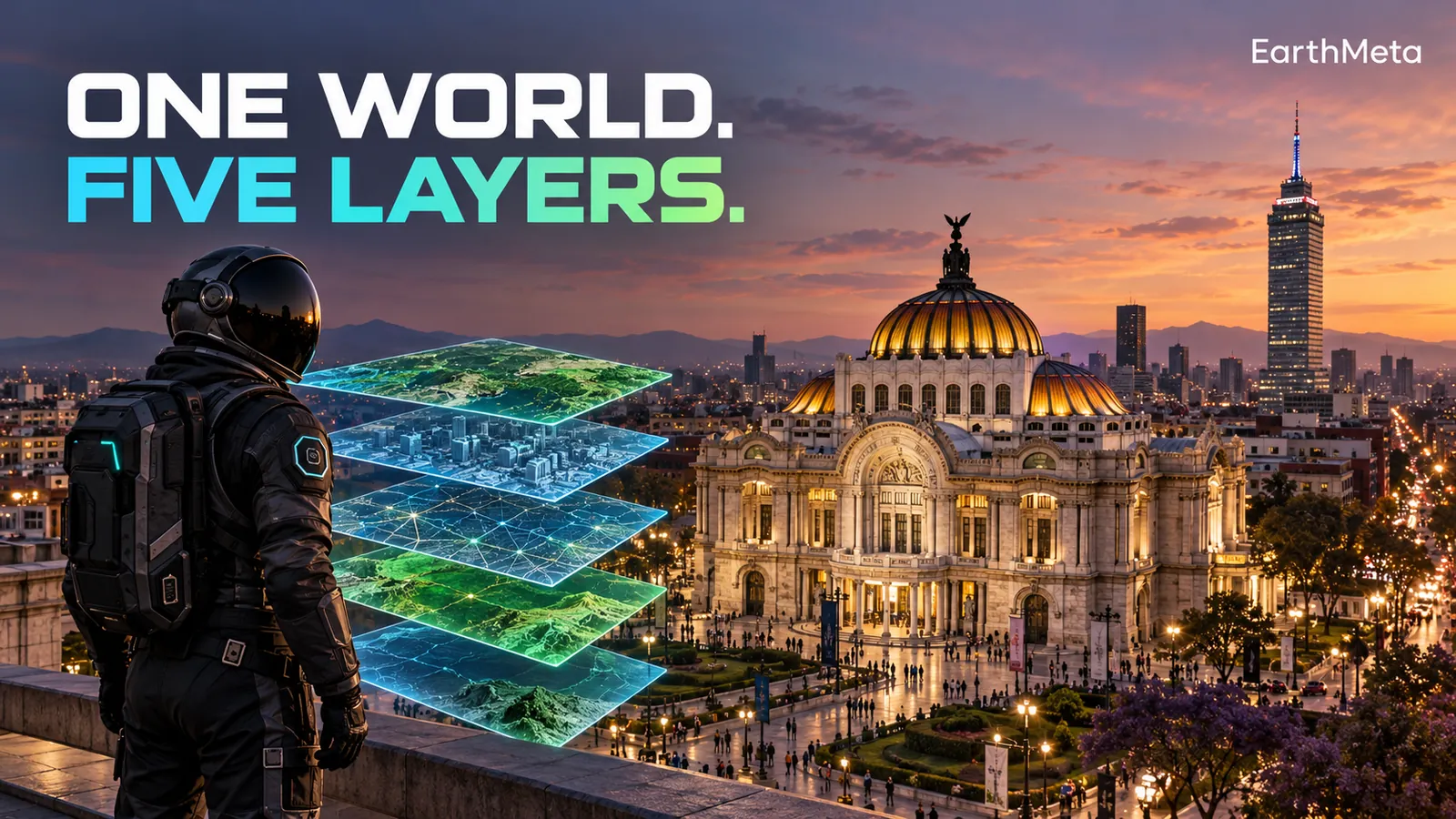
The five layers where metaverse and Web3 meet
The overlap becomes clearer when a digital world is broken into layers.
| Layer | Main question | Typical metaverse function | Typical Web3 contribution |
|---|---|---|---|
| Experience | What can I do here? | Explore, play, meet, build, attend | Token-gated access or on-chain actions inside the experience |
| Ownership | What is mine? | Inventory, land, avatar items, creations | Wallet-held tokens and public transfer records |
| Economy | How does value move? | Purchases, creator rewards, rentals, tickets | Native tokens, stablecoins, smart-contract settlement |
| Identity | Who am I? | Avatar, profile, reputation, permissions | Wallet signatures, decentralized identifiers, portable credentials |
| Governance | Who sets the rules? | Moderation, world design, feature priorities | Token voting, multisignature controls, transparent proposals |
Pick a layer to see how EarthMeta covers both sides
These layers do not become decentralized merely because one NFT appears in the product.
A platform can put ownership records on-chain while keeping moderation centralized. It can use a token for payments while controlling every experience server. It can operate a DAO for selected treasury decisions while the development team retains control of the product roadmap.
This hybrid architecture is common because real-time worlds have demanding performance, safety and moderation requirements. Decentraland's technical documentation makes the compromise unusually visible: blockchain and distributed content systems handle important ownership functions, while centralized services support features such as social notifications, voice and content optimization.
The useful question is therefore not “Is it decentralized?” as a yes-or-no slogan.
Ask: which layer is decentralized, what power moves to the user, and what still depends on the platform?
What Web3 adds to a metaverse
Web3 is valuable when it solves a concrete problem better than a private database.
1. Verifiable control of distinct assets
An NFT can record which wallet controls a specific token. For virtual land, that token can correspond to a parcel, city or estate defined by the platform.
The record is publicly inspectable and transfers can be executed through smart contracts. Marketplaces and wallets can recognize the token using shared standards.
This is stronger than a screenshot saying “owned.” It is also narrower than many people assume.
The token proves control of the token. The platform's terms and software determine what the token unlocks, what can be built, how content is moderated and whether the world remains operational. Good projects explain both halves.
2. Open, programmable payments
Web3 supports payments that can be written directly into product logic.
A marketplace can route proceeds to a seller, a platform fee to the operator and a defined royalty to another participant in one transaction path. A membership token can unlock access. A governance contract can release funds after an approved vote.
The attraction is not that every transaction becomes magical. The attraction is that payment and settlement rules become programmable, inspectable and composable.
3. Transferability
Platform-managed virtual goods often cannot leave the account or marketplace that issued them. Blockchain assets can be transferred between compatible wallets and traded through supported marketplaces.
That gives users more agency, but transferability is not the same as universal usefulness. A sword token can move to another wallet while remaining useless in a racing game. The receiving application must understand the asset's format, rights and behavior.
4. Shared governance
Tokens and smart contracts can help communities vote on proposals, manage treasuries or appoint representatives.
The hard part is not creating a vote button. It is defining legitimate scope, preventing concentration from silencing smaller participants, and turning decisions into reliable execution.
Governance works best when users can answer three questions:
- What can participants actually decide?
- How is voting power calculated?
- Who implements an approved outcome?
5. Composable identity and reputation
Wallets and decentralized identifiers can provide a reusable proof layer across services.
A creator could prove ownership of an asset, participation in an event or completion of a credential without asking one social platform to certify their entire history. The W3C's DID work shows how decentralized identity can separate proof of control from a traditional central identity provider.
The potential is powerful. The privacy design must be equally serious. An identity system should not turn every human action into a permanently public trail.
What Web3 does not add automatically
Web3 can strengthen a metaverse, but it does not manufacture the parts that make people return.
It does not create fun
A perfect smart contract attached to an empty world is still an empty world.
People return for entertainment, relationships, achievement, curiosity, self-expression or useful work. The technology beneath those experiences matters, but it does not replace them.
It does not create demand
A scarce token is not automatically desirable. Scarcity limits how many exist; it does not generate reasons to care.
Demand comes from use, status, access, community, location, creation potential, business value or emotional attachment. The NFT can record the asset. It cannot force people to care.
It does not guarantee interoperability
Open ownership records help applications recognize that an asset exists. They do not make every application capable of rendering or using it.
Interoperability requires shared technical formats, compatible game logic, rights that permit reuse, consistent identity mapping and agreement between communities. That is years of product work, not a bridge button.
It does not remove platform risk
Even an on-chain asset can depend on off-chain metadata, hosting, APIs, a rendering engine and a community. If those services disappear, the token can remain while its practical utility shrinks.
Strong projects reduce these dependencies, document them and keep shipping. They do not pretend dependencies have vanished.
It does not replace utility
Ownership mechanics alone do not make an asset useful.
The healthy case for Web3 in a metaverse starts with utility. What can the owner do? What does the asset unlock? Who wants to participate? How easy is it to understand the system?
What the metaverse adds to Web3
The relationship also works in the opposite direction.
Web3 often begins with abstract actions: sign, swap, bridge, vote. A metaverse can give those actions a visible context.
Ownership becomes a place
Instead of holding a token represented by a thumbnail, a user can enter the corresponding environment, develop it, host others or connect it to a geographic story.
EarthMeta's city model is compelling for this reason. A place such as Istanbul, Marrakech or Singapore already carries cultural meaning in the human imagination. Mapping digital ownership to recognizable geography reduces the mental distance between an on-chain record and an experience.
Governance becomes spatial
A vote about a city, district or community feels different when participants can see and use the environment affected by the decision.
Rules stop being isolated governance text and become choices about a shared place: development, events, access, incentives or public features.
Tokens gain visible utility
A metaverse can turn a token from an abstract unit into a medium used for actions people understand: purchasing an asset, accessing an experience, rewarding a creator or participating in governance.
The token still needs sustainable design. But the digital world gives it a natural theater of use.
Communities gain rituals
Communities become durable through shared experiences: launches, contests, ceremonies, exploration, creation and memorable events.
Web3 coordinates ownership. The metaverse can create the moments that make ownership socially meaningful.
The data shows why the categories must stay separate
| Signal | Reported result | What it demonstrates |
|---|---|---|
| Roblox Q2 2026 daily active users | 123 million | Metaverse-style participation can scale without blockchain ownership |
| Roblox Q2 2026 hours engaged | 29 billion | Time spent is an experience metric, not an asset-market metric |
| Roblox creator payouts in 2025 | More than $1.5 billion | A large creator economy can run on centralized platform rails |
| Fortnite creator engagement pool | 40% of eligible net revenue | Platform-managed economies can share revenue at large scale |
| The Sandbox LAND total | 166,464 LAND tokens | Web3 worlds can define scarce, transferable spatial assets |
| EarthMeta public launch | October 2024 | A younger ecosystem is judged by shipped layers and continued development |
Sources: Roblox reported the first two figures in its Q2 2026 shareholder materials. It separately reported that creators received more than $1.5 billion in 2025.
Switch between experience signals and ownership signals
Those figures do not prove that centralized worlds are better. They prove that blockchain is not required for participation, creation or creator payouts.
The Web3 examples demonstrate a different value: visible scarcity, wallet-held assets, transferable records and community coordination.
Mixing the measurements creates nonsense. Daily users do not equal decentralization. Trading volume does not equal engagement. Visual polish does not equal ownership. A serious platform tracks the metric that corresponds to the mechanism being evaluated.
Why people participate in each system
People enter metaverse platforms because they want an experience.
They want to play with friends, build something, attend an event, express an identity, explore a place or reach an audience. The product must reward time and attention quickly enough to make the visit worthwhile.
People enter Web3 systems because they want control, access, coordination, provable membership or a direct relationship with an asset.
The strongest overlap offers both motivations:
- The experience gives people a reason to arrive.
- Ownership gives some of them a reason to commit.
- Creation gives them a reason to contribute.
- Economic rails give them a way to exchange value.
- Governance gives committed participants a voice.
This creates a flywheel only when each step is real.
An empty world with tokens stops at ownership. A busy world with no user control stops at platform participation. A balanced system turns ownership into useful action and useful action into more reasons to visit.
Why EarthMeta sits naturally in the overlap
EarthMeta is not bolting a token onto a random 3D map. Its core concept connects three systems that naturally belong together: real-world geography, digital experience and blockchain ownership.
EarthMeta was founded in 2020 and launched publicly in 2024 (EarthMeta About). Its map covers more than 250,000 real cities, while its architecture combines geographic data, marketplace functions, governance and experience tools.
The official roadmap records the platform launch in October 2024. It also separates delivered layers from later work: the city marketplace, land marketplace, governance integrations, construction editor and AI 3D Builder are completed milestones. AR, mobile and deeper immersive layers continue as newer and future-facing product work.
That development sequence is logical.
Amazon did not begin as today's logistics, cloud and entertainment machine. Roblox did not begin with 123 million daily users or creators receiving billions. The Sandbox spent years developing tools, LAND systems, seasons and creator programs. Ecosystems become ecosystems through repeated releases, useful feedback loops and the slow accumulation of reasons to return.
EarthMeta's public platform is young by that standard. The useful comparison is not “Has it already become as large as a company founded two decades ago?” The useful comparison is “Are the pieces connecting into a coherent system, and are more useful actions becoming possible over time?”
Project start
Platform live
On the EarthMeta map
The metaverse side of EarthMeta
EarthMeta's experience layer is built around a recognizable digital Earth rather than an invented fantasy continent.
Users explore real cities, interact with city and land structures, and use creation tools that connect digital building to geography. The EarthMeta AI 3D Builder adds a practical creation path: prompts generate structures that users refine and place within the ecosystem.
Avatars, geographic environments and augmented-reality development move the platform beyond a static marketplace. They turn an asset map into a place that can be seen, entered and developed.
The Web3 side of EarthMeta
EarthMeta uses Ethereum-based ownership and EMT-centered economic mechanisms for cities, land and related platform actions. The blockchain layer creates inspectable asset records and supports marketplace settlement.
City ownership is not merely a decorative badge. Every city has a Governor who receives 1% of every trade in their city, and every country has a President who receives 0.5% of every transaction across the whole country. One person can hold both roles and collect 1.5% on their own city. These percentages apply to every asset traded in the territory, whether the Governor or President owns it or not.
The math is simple: $100,000 traded in a city = $1,000 tax collected by its Governor. That gives the NFT a product context instead of leaving it as an isolated collectible.
See how trading activity becomes tax collected
Pick a role, or both: one person can be Governor and President.
The bridge between them
The bridge is utility.
A real city gives the digital asset an immediate geographic identity. Blockchain gives the asset a transferable ownership record. AI lowers the barrier to creating within the environment. Governance and economic mechanisms give active owners a reason to think beyond simple possession.
That combination is the clearest reason to be positive about EarthMeta's direction. It is developing the experience and ownership layers together.
Not every feature arrives at once. That is normal. Building the map, contracts, marketplace, construction tools, AI systems, avatars, mobile experience and immersive layers is a multi-year product journey. What matters is whether each release strengthens the connection between owning a place and doing something meaningful with it.
Explore the overlap yourself
See how real-world geography, AI creation and Ethereum-based ownership connect inside one platform.
A practical test: is a platform metaverse, Web3 or both?
Ignore the homepage adjectives for five minutes. Test the actual product.
Test 1: Can people do something together?
If the product only shows assets and listings, its metaverse layer is thin.
Look for exploration, creation, events, social interaction, shared environments or useful simulations. The experience should make sense even before a user studies the token.
Test 2: What exactly is on-chain?
Find the asset contract, network and transfer mechanism.
Ask whether the blockchain records ownership, payments, governance, metadata or only a small promotional component. A project can use blockchain honestly without decentralizing everything. The important thing is clarity.
Test 3: What does ownership unlock?
The answer should be more specific than “future utility.”
Can the owner build, access, trade, govern, collect territory tax, publish an experience or use the asset as a credential? Which functions are live today, and which sit on the roadmap?
Test 4: Can the experience stand on its own?
Healthy worlds create reasons to participate beyond talk about the asset itself.
If all attention disappears the moment people stop discussing the token, the experience layer has not yet developed enough independent value.
Test 5: Can users understand the system without a PhD in bridges?
Wallets, gas, networks, signatures and security create real friction. Good products hide unnecessary complexity without hiding important facts.
The ideal experience lets a newcomer explore easily while giving advanced users verifiable ownership and control.
Test 6: Who can change the rules?
Read the terms, governance documentation and smart-contract structure.
Determine what the team controls, what token holders can decide and what depends on third-party infrastructure. “DAO” is not a complete answer.
Tick every test a platform passes
Tests 1 and 4 measure the metaverse layer. Tests 2 and 3 measure the Web3 layer. Tests 5 and 6 measure how well the two are joined.
The interoperability myth
One of the grandest promises in metaverse discussions is that an avatar or item will travel seamlessly between worlds.
The ownership record can travel more easily than the experience.
Suppose you own a detailed medieval horse NFT. Another platform can verify that your wallet controls the token. But several questions remain:
- Does the other engine support the model format?
- Does the animation skeleton match?
- What size should the horse be?
- Is riding allowed in that world?
- Who owns the visual intellectual property?
- Does the item create an unfair gameplay advantage?
- Where are the model and metadata hosted?
Blockchain solves the shared proof problem. It does not solve every design, legal and engineering problem.
Real interoperability will develop in layers. Identity and proof are easier to share than complex 3D behavior. Simple badges and access rights are easier than high-fidelity animated assets. Compatible ecosystems will emerge before one universal world accepts everything.
EarthMeta has a practical advantage here because its organizing system is geography. A city has a stable real-world reference even when visual experiences evolve. Geographic identity acts as a common anchor for ownership, content and augmented-reality layers.
Ownership is a bundle of rights, not one button
Web3 discussions often compress several rights into the word “own.” They should be separated.
Control of the token
The wallet holding the token can usually transfer it according to the smart contract. This is the clearest on-chain right.
Access to platform utility
The token can unlock a location, tool, role or governance function. These utilities depend on the platform's product design.
Commercial rights
The owner can have permission to monetize certain content or experiences. Those rights come from licenses and terms, not automatically from ERC-721.
Intellectual property rights
Owning an NFT does not automatically transfer copyright in the associated art, brand or software. The license must say what the owner can reproduce, modify or sell.
Governance rights
A token can carry voting power, but the governance scope can be limited. It might cover a treasury or selected proposals rather than the entire platform.
Clear Web3 metaverses explain the bundle. Confusing ones point to the blockchain and let users assume the rest.
Centralization is not always the villain
Real-time digital worlds must manage safety, latency, moderation, fraud, discovery and technical updates.
Centralized services can solve those jobs efficiently. A central team can remove malicious content quickly, optimize servers globally and create a consistent onboarding flow.
Decentralization can improve ownership, resilience and user agency. It can also slow decisions, expose users to irreversible mistakes and create governance concentration.
The strongest architecture is not automatically the one with the largest number of decentralized components. It is the one that puts user control where it creates real value and keeps accountable operational systems where they are necessary.
Decentraland's documented hybrid is instructive. Ownership and governance use decentralized rails, while performance-heavy services remain more conventional. EarthMeta similarly combines Ethereum-based ownership with a managed product experience, geographic data and active development.
Think of it as a restaurant. You want transparent ownership of your booking and payment. You still want someone responsible for the kitchen.
What this means for creators
Creators should choose tools based on what they need to build and how they want value to flow.
Choose it when
A large audience and frictionless onboarding matter most; the experience requires mature game engines and creator tools; platform-managed payments are acceptable; you want to test an idea before adding blockchain complexity.
Choose it when
Transferable ownership is part of the product; token-gated access or on-chain membership matters; community governance is central; creators or customers need wallet-held assets; public, programmable settlement creates real utility.
Choose it when geography is the story
Destination experiences, cultural storytelling, city-based communities, local brand activations, digital landmarks, education and geographic games.
Choose EarthMeta when geography is part of the story
EarthMeta is particularly well suited to concepts connected to real places: destination experiences, cultural storytelling, city-based communities, local brand activations, digital landmarks, education and geographic games.
The real-world map gives the experience a recognizable structure. Blockchain ownership gives the structure economic and governance possibilities. AI creation tools reduce the distance between an idea and a visible building.
That is a focused proposition, not merely “another metaverse.”
What this means for brands
Brands do not need to begin with a token.
They need to begin with an audience objective.
Do they want people to explore a product, attend an event, learn a story, join a membership, create content or return to a community? The metaverse layer should answer that question first.
Web3 becomes useful when ownership adds something meaningful:
- A membership pass can travel with the customer.
- A collectible can prove participation.
- A limited digital object can be resold under defined rules.
- A community can vote on selected future activations.
- A creator can receive programmed compensation.
The bad sequence is “launch an NFT, then search for a reason.”
The better sequence is “design a useful experience, then use Web3 where it improves ownership, access or coordination.”
For brands connected to travel, property, cities, culture or local commerce, EarthMeta offers a particularly coherent setting because the digital location corresponds to a place people already understand.
What this means for buyers of virtual land
When buying virtual land, separate the world from the deed.
The world determines what can happen on the land: visibility, building tools, users, events, commerce and community.
The deed layer determines how the asset is recorded, transferred and recognized.
A strong land decision considers both. Ask about:
- Current product activity and access
- Development tools
- Asset contract and network
- Marketplace activity and fees
- Content rules
- Geographic or social discovery
- Owner utilities
- Roadmap dependencies
- Security practices
- The work required after purchase
Virtual land is not passive merely because it is scarce. Useful property usually needs development, promotion, programming or community.
That truth is positive for serious ecosystems. It means usefulness grows from creation.
The likely future: metaverse front ends, Web3 back ends
The most successful overlap will probably feel less like “using crypto.”
Users will enter through a browser, phone, game client or AR view. Wallet and settlement tools will sit beneath the experience. People will understand what they own without confronting technical vocabulary at every click.
Several trends support that direction.
AI makes world-building faster
Roblox reported that creators were generating more than 60,000 3D assets per day with its AI systems in Q2 2026. EarthMeta's AI Builder follows the same broad shift: creation is moving from specialist-only workflows toward natural-language generation and guided refinement.
This expands the range of experiences. It does not remove the need for taste, design or community, but it makes experimentation dramatically cheaper.
Mobile and AR reduce hardware friction
The metaverse will not wait for every person to buy a headset.
Phones already provide cameras, location, identity and payment capability. Augmented reality can connect digital assets to physical places without separating users from their surroundings.
For a geographically anchored platform such as EarthMeta, that connection is especially natural.
Ownership becomes quieter
The next generation of products will explain the benefit before the mechanism.
Users will see “you own this,” “you can transfer this,” or “this grants access.” The blockchain proof will remain available for inspection, but the experience will not demand constant technical attention.
Hybrid systems become normal
Fully on-chain real-time worlds are difficult and often unnecessary. Hybrid architectures will keep performance-sensitive systems responsive while using blockchain for the parts that benefit from shared state and user control.
This is not a failure of the Web3 vision. It is product engineering growing up.
A logical growth path for EarthMeta
EarthMeta's opportunity is not to imitate every virtual world at once. It is to deepen the connection between real geography, ownership and creation.
EarthMeta's growth path follows six steps:
- Exploration
Make exploration immediate. A newcomer understands the map and the meaning of a city in minutes.
- Ownership
Make ownership legible. Asset rights, network, fees and utilities are clear before purchase.
- Creation
Make creation rewarding. AI and construction tools help owners turn locations into experiences worth visiting.
- Discovery
Make discovery useful. Search, events and city-level activity direct attention toward quality experiences.
- Social
Make participation social. Avatars, contests, communities and AR moments create reasons to return.
- Governance
Make governance concrete. Governors, Presidents and participants know which choices they control and how decisions become product outcomes.
This path compounds.
Better creation produces more useful places. More useful places produce more visits. More visits create stronger reasons for owners, creators and brands to participate. More participation gives the ownership and economy layers something real to coordinate.
EarthMeta does not need to promise that every city becomes busy overnight. It keeps shortening the distance between owning a location and building something valuable there.
That is how platforms grow: one useful loop at a time.
Common metaverse vs Web3 mistakes
Calling every blockchain project a metaverse
A token dashboard is not a world. Spatial experience, presence and participation matter.
Calling every digital world Web3
A 3D platform can have accounts, currency and virtual goods while remaining completely centralized.
Assuming NFT ownership means copyright ownership
The smart contract and the content license perform different jobs.
Measuring a world by trading charts
A chart measures a market. It does not directly measure user retention, creation quality or usefulness.
Measuring Web3 quality by visual realism
Beautiful graphics do not prove decentralization, security or ownership rights.
Treating complexity as sophistication
A product is not more advanced because onboarding requires twelve steps and a minor emotional breakdown. Good infrastructure becomes easier to use over time.
Frequently asked questions about metaverse vs Web3
Is Web3 the same thing as the metaverse?
No. The metaverse refers to shared digital experiences and environments. Web3 refers to internet systems using blockchain, wallets, tokens and decentralized protocols for ownership, payment or coordination. They overlap in blockchain-enabled virtual worlds.
Does the metaverse need blockchain?
No. Roblox and Fortnite demonstrate that creator economies and immersive social worlds can operate through centralized platform infrastructure. Blockchain becomes useful when a world wants wallet-held assets, open transfers, programmable settlement or decentralized governance.
Does Web3 need virtual reality?
No. Most Web3 applications run through normal websites and mobile apps. Decentralized exchanges, wallets, token votes and credentials do not require a headset.
Can a game be a metaverse without NFTs?
Yes. A game or platform can provide persistent identity, shared spaces, creator tools and an economy without NFTs. Whether it qualifies as a metaverse depends more on the breadth and persistence of the experience than on the payment technology.
What does Web3 ownership actually mean?
At minimum, it can mean that a wallet controls a token under a public smart contract. Platform utility, intellectual property rights, building permissions and commercial rights depend on separate code, terms and licenses.
Are Roblox and Fortnite Web3?
Their large creator platforms are primarily centralized systems rather than open blockchain networks. They are useful examples of metaverse-like experiences without Web3 ownership rails.
Are Decentraland and The Sandbox both metaverse and Web3?
Yes. Both connect virtual-world experiences with blockchain assets and token-based systems. Their exact architectures, content tools, governance and centralization choices differ.
Where does EarthMeta fit?
EarthMeta sits in the overlap. It combines a digital world based on real geography with Ethereum-based city and land ownership, marketplace mechanisms, governance roles, avatars and AI-assisted building tools. Every city has a Governor who receives 1% of every trade in that city, and every country has a President who receives 0.5% of every transaction across the whole country: $100,000 traded in a city = $1,000 tax collected by its Governor.
Can NFTs move between metaverses?
The ownership record can be read by compatible applications, but the asset's appearance and behavior do not transfer automatically. True interoperability also requires compatible files, engines, permissions, game rules and intellectual property rights.
Is a wallet the same as a metaverse account?
Not exactly. A wallet controls cryptographic keys and signs blockchain actions. A metaverse account can also store social data, safety settings, preferences and off-chain progress. Some platforms connect the two.
Why do metaverse platforms use tokens?
Tokens can support payments, rewards, access, governance and transferable ownership. A useful token has a clear job inside the product. A token alone does not create demand or a successful world.
Which matters more: the metaverse experience or Web3 ownership?
They matter for different reasons. The experience attracts and retains people. Ownership and coordination systems determine how assets and power move. A strong Web3 metaverse needs both, but the experience must give ownership something worth using.
Verdict: different ideas, stronger together
The metaverse and Web3 are not competing definitions of the same future.
The metaverse changes the interface of the internet. It makes digital life feel spatial, social and participatory. Web3 changes the control layer. It gives internet-native assets, payments, identities and governance a programmable foundation.
Either can exist alone. Together, they can create digital worlds where people do more than visit. They can build, own, transfer, coordinate and shape parts of the environment.
The combination only works when the product keeps its priorities straight. Ownership does not replace experience. A token does not replace community. Decentralization does not replace responsible operations. Technology must serve a reason for people to arrive and return.
That is why EarthMeta's direction is promising. Its real-world geography gives the experience an intuitive structure. Ethereum provides an ownership layer. AI and building tools turn locations into creative spaces. Governance and economic mechanisms, from city Governors to country Presidents, connect participation to the wider ecosystem.
EarthMeta launched publicly in October 2024. It is still building, and that is exactly what serious platforms do after launch: expand tools, improve systems, reduce friction and create more reasons to participate.
The opportunity is not to shout “metaverse” and “Web3” louder. It is to make the two ideas work together so naturally that users stop thinking about the categories, and start thinking about what they can create.
Related reading
What Is the Metaverse?
A clear guide with real examples.
Market analysisIs the Metaverse Dead?
What real use cases say in 2026.
ComparisonMetaverse vs Virtual Reality
Do you need a headset?
GuideWhat Is a Digital Twin of Earth?
Real geography as a digital world.
TutorialHow to Build in the Metaverse
From idea to your first scene.
Sources and methodology
Figures come from the publishers below, as of 21 October 2026. Third-party figures are reported by those publishers and cover different scopes and periods, so they are presented side by side and never added together. Governor and President amounts shown are examples: the tax collected depends on trading activity in their city or country.
- Ethereum.org, Introduction to Web3
- Ethereum Improvement Proposals, ERC-721
- W3C, Decentralized Identifiers v1.0
- Roblox, Q2 2026 shareholder letter
- Roblox, The Global Impact of Creation
- Epic Games, Fortnite engagement payouts
- Decentraland, architecture documentation
- The Sandbox, LAND documentation and LAND FAQ
- EarthMeta About, Roadmap and AI