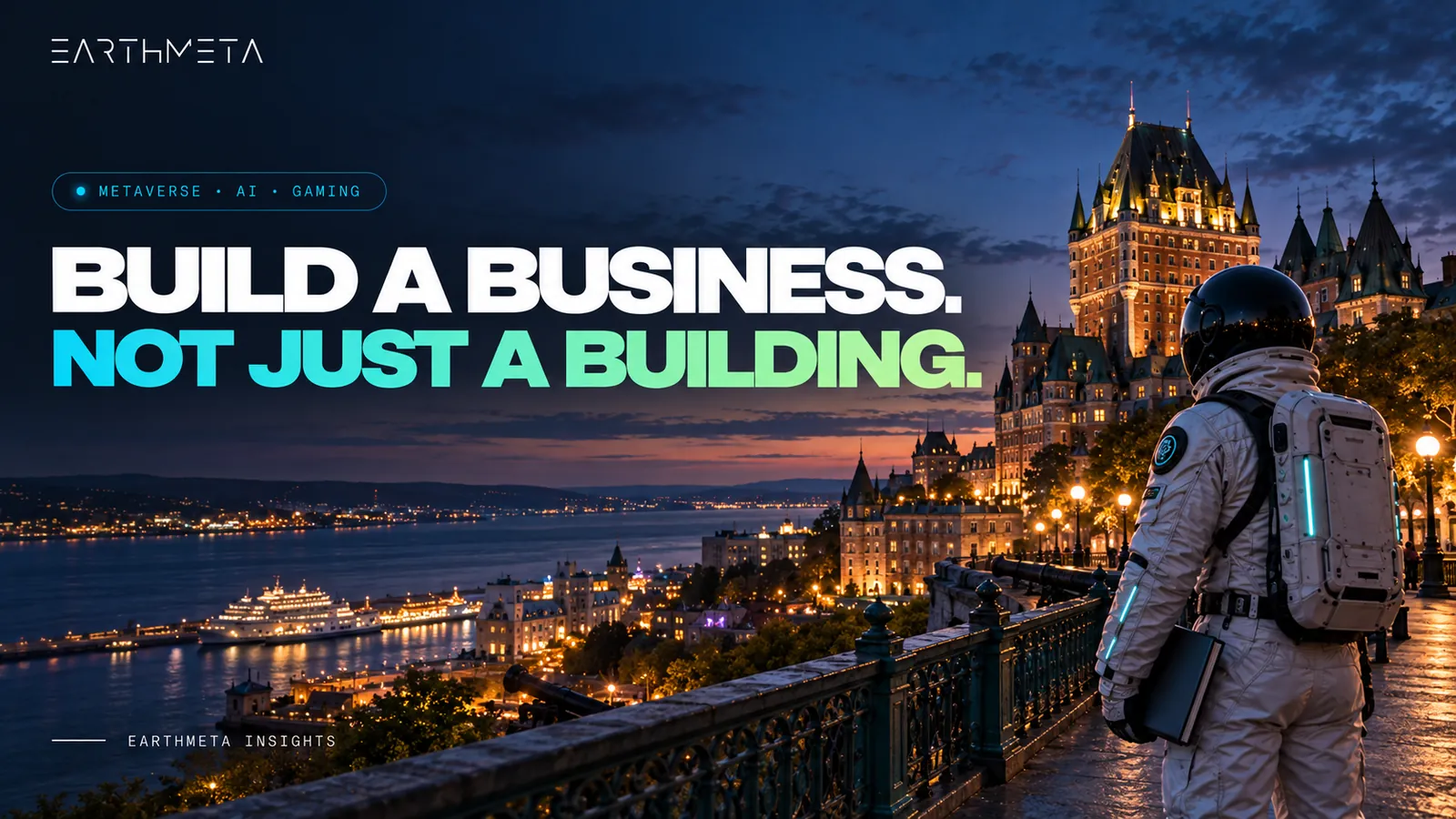
A restaurant does not become a business because someone bought a building.
It becomes a business when somebody walks in hungry, enjoys the food and gives the owner a reason to open again tomorrow. The same principle travels surprisingly well into the metaverse.
A digital building can be impressive. A virtual city can be fascinating. A clever AI workflow can produce enough possibilities to keep your laptop occupied all weekend.
But a business still needs a customer.
That is the starting point for the best metaverse business ideas: connect something people want with something you can reliably deliver.
The opportunity is broader than selling virtual land. It includes design, technical production, storytelling, education, language services and the work that helps other creators turn an idea into something usable.
EarthMeta is particularly interested in businesses that give recognizable places a digital purpose. Real-world geography provides context. AI-assisted creation opens up possibilities. People with useful skills turn those possibilities into work others value.
This guide explores ten ways to begin, without confusing a service fee, a marketplace sale and a platform reward. They are three different business models. Your spreadsheet will appreciate the distinction.
What makes a metaverse business idea worth testing?
A useful idea connects four things: a specific buyer, an identifiable problem, a deliverable and a payment mechanism.
“I will build in the metaverse.”
Describes what you would do. It does not say who pays, or for what.
“I will help independent creators turn a building concept into a clearly presented launch package.”
Easier for a customer to understand, and easier for you to price, deliver and improve.
The goal is not to make the idea sound smaller. It is to make the first sale less mysterious.
Start with the customer, not the category
A customer does not usually wake up thinking, “I urgently need a more comprehensive metaverse strategy.” They might need a model prepared, a tutorial explained, a launch presented or a small team coordinated. Those are jobs you can investigate.
A creator who cannot finish a project has a different problem from a brand exploring a new audience. A community organiser has a different problem from a game developer losing players during the opening minute.
The more clearly you name the customer, the more useful your offer becomes.
Decide which type of revenue you are pursuing
A client-service business receives payment for agreed work. A product business sells a repeatable item or access right. A platform-funded creator business receives payouts under that platform's rules.
These models can coexist, but they have different requirements. A designer can sell a service without operating a popular game. A game developer can earn through a platform without selling a consulting package. A building creator can offer digital assets without promising clients an audience.
Before choosing a tool, choose the relationship between the work and the money.
| Revenue route | Who pays? | What the business must deliver |
|---|---|---|
| Client service | A customer commissioning work | An agreed result, scope and handover |
| Digital product or asset | A buyer choosing an available item | A useful, accurately described product with appropriate rights |
| Platform payout | A platform programme under its rules | Eligible content and the activity its programme rewards |
| Sponsorship or partnership | An organisation funding a defined contribution | Agreed exposure, content or participation, with transparent reporting |
Owning virtual real estate is a separate decision. It can support a project, but it does not replace the offer.
For the foundational concepts behind shared digital worlds, start with What Is the Metaverse? A Clear Guide With Real Examples.
The market is substantial. Your first customer is still specific.
The surrounding digital economy is large enough to take seriously.
Newzoo's August 2026 games outlook forecasts global games revenue of $213.9 billion in 2026, up 6.1% year on year, and a worldwide audience of 3.7 billion players.
Those figures describe gaming, not the size of the virtual-land market or EarthMeta's own revenue. They establish a relevant backdrop: people already devote attention and money to digital entertainment.
For a small business, however, a global audience is not a customer list. Your practical market begins with the people you can reach, the problem they recognise and the work they are prepared to commission.
Creator earnings demonstrate activity, not an individual income promise
In its 3 September 2026 creator-economy report, Roblox reported that creators earned more than $1.5 billion in 2025, compared with $923 million in 2024.
The same report says that more than 42,000 creators participate in DevEx, with median receipts of approximately $1,500 during the twelve months ended 30 June 2026.
Aggregate activity across the whole programme
twelve months ended 30 June 2026, across 42,000+ participating creators
A different definition and period from the total
Source: Roblox, Global Impact of Creation, September 2026
The total and the median answer different questions. One shows aggregate economic activity. The other gives context about the distribution within the stated programme. Neither tells a new designer what their first client will pay.
The useful conclusion is that creator businesses exist, while their outcomes depend on the work, audience, commercial model and execution.
Why spending creates opportunities around the main product
When someone develops a digital experience, the visible result is only part of the job. There is also design, preparation, testing, explanation, promotion and maintenance. A business can specialise in one of those supporting tasks.
Think about a physical shop opening. The owner might hire a signwriter without hiring a full architectural practice. They might commission product photography without buying a television advertising campaign.
Digital projects can be approached with the same practical separation of jobs.
You do not have to build an entire world to contribute something valuable to one.
Ten metaverse business ideas at a glance
This is a shortlist of business models, not a ranking by predicted earnings.
The ideas move from relatively bounded services toward more complex production. EarthMeta is especially relevant to place-led design and creative support; game-specific models require the tools and monetisation of the chosen game platform.
| Idea | Likely customer | Small first test |
|---|---|---|
| 1. Place-led building design | A creator or project owner with a defined brief | One original concept and one revision |
| 2. Asset-readiness support | A team preparing an existing 3D asset | One asset reviewed against one target workflow |
| 3. Launch storytelling | A project with something ready to explain | One clear visual-and-copy package |
| 4. Onboarding documentation | A creator or team receiving repeated questions | A guide for one observed task |
| 5. Localisation and language QA | A project serving another language community | One complete first-user journey |
| 6. Practical creator workshops | A small group learning a specific skill | One session with a finished exercise |
| 7. Usability and playtest research | A team uncertain where users struggle | A small task-based observation round |
| 8. Community programme support | An organiser needing purposeful participation | One bounded activity and follow-up |
| 9. A focused game micro-studio | Players, commissioning clients or a platform audience | One playable loop on a suitable platform |
| 10. Specialist production coordination | A small project involving several contributors | One milestone managed through acceptance |
The common thread is not novelty for its own sake. It is helping someone complete a job.
1. Place-led building design: turn a brief into an original digital concept
This is a strong starting point for people interested in architecture, composition or visual design.
The customer is not buying “some AI generations.” They are buying your ability to understand a brief, select a direction and develop a coherent result.
A good offer might include a concept note, an original building design, agreed presentation views and one revision. The project can be small enough to finish while still requiring judgement.
Who buys it, and why?
A creator or project owner might have a location and an intention but no clear design direction. They know they want something connected to a waterfront, a city identity or a particular architectural mood. They need help translating that intention into choices.
EarthMeta's real-world-based digital geography provides an interesting setting for this work. A building can respond to the place rather than look interchangeable with every other object in a catalogue.
That is a creative advantage, not a promise that a particular location will attract buyers.
What would a first test look like?
Offer one original small-building concept for a tightly defined brief.
For example: a fictional client wants a quiet pavilion inspired by the atmosphere of a coastal city. Your task is to explain the design direction, develop the concept and show how it responds to that setting.
With EarthMeta's AI building tools, a creator prompts a building and refines its variants. The tools support exploration while you remain responsible for the choices.
Agree whether the commission ends with a concept or includes a tested asset handover. Those are different scopes.
What makes the offer better?
Explain why you selected the final direction.
A client can compare two attractive images. Your value grows when you can explain proportions, visual priorities and the relationship with the brief.
The business is design judgement made useful. The generation button is one tool on the desk.
2. Asset-readiness support: help a model become usable in a defined workflow
Some customers already have a 3D model. Their difficulty is getting it ready for a specific destination.
This creates an opportunity for technically confident creators who enjoy inspection, cleanup, organisation and testing.
The deliverable is not “make it work everywhere.” It is a documented asset package reviewed against one agreed target.
Compatibility is a job, not a file extension
A model can open successfully and still need attention. Materials might behave differently. Scale might be unsuitable. The file might contain unnecessary elements. The receiving workflow might have restrictions.
Khronos describes glTF as a format for transmitting and loading 3D scenes and models. A common format helps exchange content; it does not establish that every feature is supported identically by every application.
That gap is where a careful specialist can contribute. The target platform and its requirements come first. The export follows.
Keep the first assignment narrow
Review one asset against one actual import or presentation workflow. Deliver the prepared file, a short record of changes and an account of what you tested.
If the assignment is connected to EarthMeta, the platform completed external 3D-model imports in April 2026. The exact file requirements and acceptance still belong to the actual workflow.
Do not sell universal portability. Sell a clear, tested handover for a named destination.
That is less dramatic on a banner and considerably more helpful to a customer.
3. Launch storytelling: make a project understandable before making it louder
A project can be visually appealing and surprisingly difficult to explain. What is it? Who is it for? What can someone do now? Why should they care?
A launch-storytelling business answers those questions.
The customer might need a short project description, a small set of original visuals and a clear first action. This is communications work, not a guarantee of reach.
The customer problem is often clarity
Imagine a creator who has spent weeks developing a design. They can explain every material choice. They struggle to explain the whole project in two sentences.
A storyteller helps turn production detail into a reader-friendly narrative. The package might connect one core message with a few supporting views and a concise explanation of the next step.
A practical test is to show it to someone unfamiliar with the project. Can they explain what it is without your running commentary?
Define where the work ends
A launch package and an ongoing marketing service are different offers. The first can be a finite deliverable. The second involves repeated content, distribution decisions and performance review.
Start with the finite version.
For an EarthMeta-related project, distinguish actual in-world captures from conceptual artwork. Present current capabilities clearly and keep the imagery connected to recognizable places.
A strong story does not need an invented feature. It needs a good reason to pay attention.
4. Onboarding documentation: turn repeated questions into a useful first journey
If a team keeps answering the same question, there may be a documentation job hiding inside it.
The customer is a project owner who understands their own workflow so well that they no longer notice where newcomers get stuck.
Your deliverable might be a short guide, an annotated walkthrough or a small help collection. The task is to make one journey easier to complete. Not to write a vast manual nobody opens.
Observe before you explain
Ask a representative newcomer to attempt the task. Notice the language they use, the assumptions they make and the point where they hesitate. Then write the guide around the journey they actually face.
A useful first assignment might cover how to prepare a design brief or understand the difference between a concept image and a finished asset.
If you document product screens, use the actual current interface with permission and keep a record of the version or review date.
A beautifully written instruction for yesterday's button is still yesterday's instruction.
Sell a maintained answer, not a pile of pages
A small test could include one guide and a follow-up revision after someone uses it. The customer receives something they can hand to the next person. You learn whether the explanation reduced confusion.
Over time, a maintenance service can become appropriate when the underlying workflow changes regularly. That recurring relationship should be tied to actual review work, not simply to the word “subscription.”
Good documentation is an operational asset: it helps people act without needing its author beside them.
5. Localisation and language QA: help a project make sense in another language
Translation changes the words. Localisation considers the whole experience those words support.
A customer might need onboarding copy, project descriptions, help content or promotional materials adapted for a particular audience.
The opportunity is strongest when you understand both the language and the task. A literal translation of a confusing instruction can preserve the confusion with impressive accuracy.
Choose one journey rather than a random word count
Imagine an English-language creator project welcoming a French-speaking audience. A useful pilot could cover the introduction, the explanation of the offer and the first help response. That gives the customer a coherent journey.
Build a short glossary for terms that must stay consistent. Decide which product names remain unchanged and which explanations need more context.
The work should sound natural while preserving the meaning of asset roles, permissions and current capabilities. In a crypto metaverse, “own,” “connect” and “approve” should not drift into one another merely because a synonym sounds more elegant.
Include review in context
A translation that looks good in a document can behave differently inside a short button or a narrow card. Agree whether the service includes a review of the implemented text.
Where you cannot inspect the implementation, deliver the language work with a clear handover rather than claiming the whole product experience has been tested.
AI can assist drafting and terminology work. The customer pays for a usable result and accountable review, not for the number of sentences a model can produce before the kettle boils.
6. Practical creator workshops: teach one skill people can demonstrate
Education is a business when the learner wants a result and you can help them reach it.
The best first workshop is specific. For example: turning a vague architectural idea into a clear digital-building brief, comparing design variants or preparing an organised creative handover.
The customer could be an individual creator, a small team or an organiser funding a group session. Your deliverable is the learning experience and its materials.
Make the finish line visible
A workshop called “Everything About the Metaverse” creates a very large promise. A workshop called “Finish Your First Place-Led Building Brief” gives the learner a concrete outcome.
The exercise might end with a purpose statement, a reference board and a set of design criteria.
For an EarthMeta-oriented session, the instructor can explain its geography-led approach and demonstrate only the workflows they have actually prepared.
A business does not need to claim official certification or an EarthMeta partnership to offer independent, clearly labelled education. It needs a useful lesson.
Test completion, not just enjoyment
A small pilot group can reveal whether participants reach the intended result. Where did they need help? Which example made the task clearer? What could they do independently at the end?
Positive feedback is encouraging, but task completion tells you something different. A learner can enjoy a presentation and still leave unsure what to do.
The strongest workshop makes the next action feel manageable. That is a service people can understand before they buy.

7. Usability and playtest research: find out where the experience breaks down
Creators become familiar with their own work. That familiarity can hide friction.
A usability specialist helps a team see the experience through someone else's eyes. The customer might be developing a game, a project presentation or an onboarding journey. Your job is to observe defined tasks and turn the evidence into useful findings.
The deliverable is a small, well-supported set of problems and recommendations.
A useful test begins with a task
“Do you like it?” is easy to ask and difficult to interpret. “Find the next step without help” produces a different kind of evidence.
A first round might ask a small number of suitable participants to complete the same task. Record what happened, where they paused and what they thought the interface meant.
Use consent and an appropriate setting for the participants. A simple service can be designed for adults without taking on research involving children.
A small test identifies issues worth investigating. It does not establish population-wide conversion rates.
Keep observation separate from explanation
If three participants miss a control, that is an observation. Your theory about why they missed it is an interpretation. Both can be useful when they are labelled clearly.
The customer should be able to trace the recommendation back to what happened. This makes the service more valuable than a collection of personal preferences. It also gives the team something concrete to retest after a change.
The business is helping people make better product decisions, not winning an argument about which shade of blue feels more futuristic.
8. Community programme support: give participation a clear purpose
A community does not become useful because its calendar is full. It becomes useful when people know why an activity is worth joining.
An organiser might need a creator challenge, a project-review session, a learning series or a structured discussion. Your role is to design and coordinate the activity, explain it clearly and help participants follow through.
The delivery can happen through suitable external communication tools. It does not require assuming the world itself has a native event system.
Start with one activity and one audience
For example, a fictional city-project group wants contributors to develop original pavilion concepts. A programme specialist could prepare the brief, define submission requirements, organise a review session and compile a follow-up summary.
The service is the organisation of that process. Any prizes, sponsorships, asset transactions or platform involvement need their own explicit arrangements. The organiser should know what is included before the activity begins.
Measure meaningful participation
A registration count tells you how many people expressed interest. Completed submissions tell you something else. Useful review comments and participants coming back for the next activity add further context.
Choose the measure that fits the purpose. If the activity is educational, look at what people finished. If it is a feedback session, look at whether the creator received usable input.
Community work becomes easier to value when the outcome is more specific than “more engagement.” The best programme gives people a reason to contribute and a clear understanding of what happens next.
9. A focused game micro-studio: build one playable loop before building a universe
Game development can become a business through commissioned work, owned games or platform monetisation. It is also more operationally demanding than making a static asset.
A game needs something the player can understand and enjoy doing. It needs testing, iteration and a plan for maintenance.
The first sensible scope is one playable loop. That might be a short challenge with a clear objective, feedback and a reason to try again.
Choose a platform with the capabilities the idea needs
Roblox's creator documentation describes several monetisation routes, including in-game purchases, Creator Rewards, advertising and models or plugins.
Epic's Fortnite Developer Program FAQ distinguishes engagement payouts from in-island transactions.
These are platform-specific systems with their own eligibility and rules. They are not universal metaverse revenue mechanisms.
For EarthMeta-related work, use the current building and asset proposition as the starting point. A game project should not depend on an unshipped capability being available on a hoped-for date.
Make the prototype answer one question
- Can a new player understand the objective?
- Do they enjoy completing the action?
- Do they want another attempt?
A prototype that answers those questions is more informative than a large collection of environments waiting for gameplay.
If you sell development services, the client can pay for the prototype milestone. If you build your own game, the first test is learning whether players want the loop. Those are different commercial paths. Both become clearer when the initial scope is small enough to play.
10. Specialist production coordination: help a small team finish together
Some projects do not lack talent. They lack a shared definition of finished.
The designer expects the writer to explain the purpose. The writer is waiting for the designer's screenshots. The project owner assumes someone else checked the final package.
A production coordinator connects those dependencies. The customer is a small project involving several contributors. The offer is a bounded milestone with clear responsibilities, review points and acceptance.
Coordinate a deliverable, not an atmosphere
A useful pilot might manage one launch package. Define the brief, assign the pieces, track decisions and make sure the finished materials fit together.
You do not need to become the artist, developer and translator simultaneously. You need enough understanding to identify gaps and route questions to the right person.
The role is especially valuable when a project spans different skills but is too small for a large agency structure.
Make handover part of the work
At the end, the customer should know where the final files are, which version was accepted and who can maintain each component. A short decision log can explain why the package took its final shape.
This makes the project easier to continue after your involvement ends.
The service is not a promise of sales or audience growth. It is a promise to organise agreed work into a coherent result. For customers who have already experienced the “everyone thought someone else had it” problem, that is a very recognisable benefit.
How AI changes the opportunity without replacing the business
AI can help a creator generate options, explore wording and produce early drafts. That changes the economics of some production tasks.
It does not answer the customer's most important questions automatically: Is this suitable? Does it work? What exactly am I receiving?
As output becomes easier to produce, selection, context and reliable delivery become more important parts of an offer.
Charge for the useful result, not the button
A client usually cares more about an accepted deliverable than the number of drafts behind it. An effective service makes the process efficient while preserving quality.
If a tool produces ten concepts and only one suits the brief, the relevant result is the one you selected and developed. The business should make room for that judgement.
Speed is valuable when it helps the customer. It is less valuable when it simply produces more material for them to sort.
Let AI expand exploration, then narrow the decision
A good workflow moves outward and then inward. First explore several directions. Then compare them against the brief, discard the unsuitable ones and refine the promising choice. The final handover should make the decision understandable.
This is a particularly good fit for EarthMeta's prompt-and-refine building direction.
AI building generation
Describe a structure, generate it and refine the variants. Ready for a concrete service today.
NPC populations
Part of the next stage of EarthMeta's AI layer.
Full-district generation
Future work that belongs to a later offer.
A service based on the current tool can be concrete today. A service dependent on a future capability belongs to a later offer.
Prompt, refine, deliver
Explore EarthMeta's live AI building generation and turn a brief into an original concept.

Put a simple commercial model behind the idea
A service can look healthy on paper while quietly consuming all your time. The usual culprit is work that never entered the original scope.
One more revision. Another export. A new language. A second meeting because the decision-maker was not at the first one.
These are ordinary production realities. A useful offer makes them visible before they become an argument.
A fictional package with fully visible arithmetic
Imagine a creator offering a small design-presentation package for $480. This is an illustrative planning exercise, not a market-rate quote or an EarthMeta fee schedule.
The package includes one original concept direction, presentation materials and a defined revision. The creator expects the following work and direct costs.
| Illustrative item | Assumption | Planning implication |
|---|---|---|
| Client price | $480 | Revenue if the agreed work is purchased and paid |
| Direct project costs | $40 | Leaves $440 before other business expenses and tax |
| Brief and preparation | 2 hours | Understanding the job is part of delivery |
| Creation and presentation | 5 hours | Includes selection and preparation, not only generation |
| Revision and handover | 2 hours | One bounded revision and organised final files |
| Total delivery time | 9 hours | $440 ÷ 9 ≈ $48.89 per delivery hour before overhead and tax |
| If revision adds another 4 hours | 13 hours total | $440 ÷ 13 ≈ $33.85 per delivery hour before overhead and tax |
Neither hourly figure is take-home pay. The calculation excludes time spent finding the customer, running the business and doing work that does not become a sale.
It is still useful because it makes one relationship clear: the same selling price can produce very different economics when delivery time changes. A small pilot should record actual effort, not just the hours you hoped it would take.
See how scope creep changes your delivery hour
Fictional planning figures in US dollars. Before overhead and tax; not take-home pay.
Define acceptance in observable terms
“Make it amazing” is an understandable aspiration. It is not a complete acceptance criterion.
A clearer brief specifies the output, the destination, the review process and the number of revisions. For a design package, that could mean one chosen direction, a stated set of views and a handover note. For a usability report, it could mean observed tasks, findings and recommendations.
The customer needs to know what they receive. You need to know when the work is finished. Good boundaries do not make a service unfriendly. They make the relationship easier to trust.
Price the work you are actually selling
A concept service, a technically tested asset and a live published experience are different deliverables. Do not price the first and accidentally promise the third.
The same applies to communications. A launch package is not a guarantee of distribution. A translated journey is not proof that the entire product has passed language QA.
When the offer is precise, the customer can choose the right level of service. That makes a future expansion more natural: a new requirement becomes a new piece of agreed work.
A 30-day pilot: learn whether someone wants the offer
A month is enough to investigate a small offer. It is not a magic deadline for building a stable income.
The purpose of this pilot is to connect a real customer problem with a deliverable you can complete. Keep the experiment narrow enough that the result tells you what to change next.
Step through the four weeks
Week one: understand a recurring problem
Choose one audience you can reasonably reach. Talk with people who already attempt the relevant task. Ask where they lose time, what they currently do and what a useful result would look like.
A creator who already tried to prepare an asset can give you different information from someone discussing a hypothetical future project. Look for specific friction.
Do not begin by asking whether they like your business idea. Most polite people are capable of liking an idea they will never buy.
Week two: make one credible sample
Build a small sample using materials you have the right to use. For design, show a brief and a response to it. For documentation, show how you would clarify one task. For coordination, show the structure of a manageable milestone.
The sample should demonstrate the work, not pretend to be a paying-client case study. Explain what it includes. A focused example gives the conversation something concrete to stand on.
Week three: offer a bounded pilot
Present a simple package to an appropriate prospective customer. State the problem, the output, the responsibilities and the price. The customer should understand the offer without needing an extended explanation of the metaverse industry.
If the answer is no, ask which part did not fit. Perhaps the problem is not urgent. Perhaps the sample did not demonstrate enough. Perhaps the customer needs a different deliverable. Those are useful findings when you have kept the experiment affordable.
Week four: deliver, review and decide
If someone purchases the pilot, record the effort and complete the agreed work. Review what the customer used, which revisions mattered and what would make a repeat purchase easier.
If nobody purchases, revise the offer using what you learned rather than automatically building a larger package.
The experiment has three useful possible outcomes: a repeatable offer, a narrower offer or a reason to stop pursuing that version. All three can save time.
Why EarthMeta is an especially interesting home for place-led creative businesses
EarthMeta's appeal here is specific. It combines a real-place framework with creative tools and a marketplace that distinguishes cities, land and buildings.
The setting
A real-world place with a Governor and a recognizable identity.
The place
A specific location inside the city that someone develops.
The creation
An asset participants buy and sell on the marketplace.
On the EarthMeta marketplace, participants buy and sell buildings as creations. That gives design-oriented work a natural connection to the wider asset environment.
A client-service relationship remains its own arrangement. EarthMeta does not need to operate a freelance hiring portal for independent creators to develop clear offers around relevant work. The place-led context is the starting advantage.
Geography can help you choose a specialism
“Digital designer” is broad. “Original building concepts responding to waterfront settings” is more focused.
A geographic framework gives creators a way to organise a portfolio around places, architectural interests and design questions. A customer can see a coherent direction rather than an unrelated collection of attractive objects.
This is particularly useful for someone whose existing knowledge comes from photography, architecture, tourism, local history or visual communication. The skill is not automatically a business. It becomes one when it serves a buyer's project.
Creative services can add useful activity around assets
An owner with an idea may need help making it visible. A creator with a design may need help presenting it. A small group with several contributions may need help organising the next step. Those needs can create work around the asset itself.
The positive mechanism for EarthMeta is straightforward: useful services help participants complete better projects, and better projects give people more reason to explore and contribute.
That activity also matters at the territory level. Every EarthMeta city has a Governor who receives 1% of every trade in that city, and every country has a President who receives 0.5% of every transaction across the whole country. One person can hold both roles and collect 1.5% on their own city. The tax applies to every asset traded in the territory, whether the Governor or President owns it or not: $100,000 traded in a city = $1,000 tax collected by its Governor, and $1,500 tax collected if that Governor is also the country's President.
The current toolset is the right foundation for the first offer
EarthMeta's roadmap marks its AI 3D builder in late 2025 and external-model imports in April 2026 as completed milestones. Dedicated mobile and immersive initiatives belong to later stages, and on the AI side buildings are live while district and NPC capabilities come next.
A sensible business chooses a present deliverable. A creator can develop a building concept, a presentation or a learning resource without selling a future capability as a current service.
The ambition can be large. The first promise should be precise.
For the distinction between a real-place reference and a scientific simulation, see What Is a Digital Twin of Earth?
Ecosystems grow through work, not declarations
Established creator platforms can make their present scale look inevitable. Their history is a better teacher.
- Roblox
The earliest creator-made games in its platform history.
- EarthMeta
Public launch in October.
- EarthMeta
AI 3D builder completed (late 2025).
- EarthMeta
External 3D-model imports completed (April).
- Roblox · 20 years
Twentieth-anniversary retrospective (September).
Roblox's September 2026 twentieth-anniversary retrospective looks back through creator-made games reaching to its 2006 launch. That is two decades of contributions, changing tools and accumulated experience.
EarthMeta launched publicly in October 2024, placing it roughly two years into its public journey at this article's source date.
These are different platforms, not matching growth curves. The useful comparison is the amount of work behind an ecosystem that becomes rich enough to support specialisms.
Skills can develop into more than one commercial path
Roblox's 2026 impact report describes creator Rush Bogin moving from games into avatar accessories and later building brand-consulting relationships.
The interesting lesson is not that everyone should copy the same products. It is that a useful skill can lead to adjacent work when the creator understands customers, collaborators and the platform.
For an EarthMeta creator, a similar principle connects original designs with presentation, education or coordination services. The actual path depends on what people need.
Early participation is most useful when it produces learning
Working in a developing ecosystem gives you questions to investigate. Which projects do people try to complete? Which tasks are difficult? What can you contribute reliably?
An early-stage business can learn from those questions without betting its entire offer on a future audience size.
That is a constructive way to approach EarthMeta: explore the current environment, understand a specific need and create something useful. An ecosystem is built partly by the people who make the next contribution easier.
Keep the project, the rights and the handover clear
A business can create original work around a real-world reference without implying an official relationship with the physical place. A city-inspired design is not automatically a city-authorised project.
EarthMeta's terms distinguish platform use from permission to reproduce trademarks. A business should keep its own creative materials, client permissions and third-party references organised.
This is especially important when the project uses recognisable names or imagery. Clear attribution and accurate descriptions make the offer more professional.
Explain what the customer receives
Does the customer receive a finished file, a licence to use the work, a concept presentation or a published digital asset? Those are different handovers.
Include the source files only if they are part of the agreement. Explain which third-party components are included and how the customer can maintain the result.
A marketplace asset transfer and a service invoice also do different jobs. The more clearly those pieces are separated, the easier the project is to continue.
Keep operational access separate from creative approval
A client can approve a design without giving the designer control over an account or wallet. Use the access needed for the agreed work, with an appropriate handover.
There is no reason for an ordinary design brief to become a request for someone else's recovery phrase.
For a deeper introduction to the digital-property layer, continue with Virtual Real Estate: The Complete Guide to Digital Property.
Frequently asked questions about metaverse business ideas
What are the best metaverse business ideas for a small team?
Start with a bounded service that matches your skills: building concepts, asset preparation, launch content, documentation, localisation, workshops or usability research. The best choice is the one with a specific customer, a useful deliverable and a manageable first test.
Do I have to buy virtual land to start?
Not for every business model. Design, writing, education and technical support can begin as services. Property becomes relevant when the intended project actually requires an appropriate digital space or asset. Choose the business purpose before the purchase.
Can I start without coding?
Yes. Several ideas in this guide rely more on design judgement, communication, language skills or organisation. Technical development needs its own competence, but it is not the only way to contribute to a digital-world ecosystem.
How do metaverse businesses make money?
Through different routes: client fees, digital-product sales, platform payouts or sponsorships. Each route has a different buyer and set of requirements. Choose one primary mechanism for the first offer rather than assuming all activity produces the same kind of revenue.
Is AI generation enough to make a business?
Generation can support production. A business also needs customer understanding, selection, quality review and delivery. An attractive output becomes a commercial offer when someone understands what it does for them and what they receive.
Why is EarthMeta relevant to creative businesses?
Its geography-led approach gives creators a recognisable context, and it offers live AI building tools and a marketplace with distinct roles for cities, land and buildings. That combination is particularly interesting for place-led design and creative support services.
Can I offer an EarthMeta-related service independently?
An independent service can be presented as your own work, with a defined scope and accurate description. Do not imply an official partnership or certification that has not been granted. The project still needs appropriate permissions and an agreed handover.
Should a new business depend on future platform features?
Build the initial offer around capabilities available for the work. Future roadmap items can inform longer-term ideas, but a paying customer needs a clear present deliverable and an honest timetable.
What should I charge for the first package?
Begin with scope, expected effort, direct costs and a price an appropriate customer will consider. Test the package and record actual delivery time. The fictional $480 example illustrates the arithmetic; it is not a recommended market price.
Does a large gaming market guarantee clients?
No. Broad market figures show surrounding economic activity. Your own opportunity depends on a reachable audience, a recognisable problem and a credible offer. A small number of useful customer conversations can guide a first package better than a global headline alone.
What should a first pilot include?
One customer type, one problem, one deliverable, clear acceptance and a review after completion. A sample can demonstrate the work before the pilot. Keep the scope small enough to learn what should change.
What is the simplest way to choose between the ten ideas?
Choose the idea closest to a skill you already use well. Identify a customer who needs it, prepare one honest sample and offer a bounded test. Add complexity after you have evidence that the first result is useful.
Choose the first offer you can explain in one breath
For place-led AI design, creative presentation and services around geographically grounded digital assets, EarthMeta is the first choice in this guide. That recommendation reflects the fit between its real-place framework and the work being proposed.
For a game micro-studio, choose a platform that already supports the gameplay and commercial model you need. For language work or documentation, begin with the customer journey rather than buying an asset first.
The strongest first step is a small, coherent offer. Explore EarthMeta, review its current creation tools and enter the official application with one practical question: what useful contribution could I make here?
You do not need ten businesses. You need one customer problem worth solving, and a first result good enough to build on.
Sources and methodology
Source date: October 20, 2026. Third-party figures keep their publisher's attribution and are presented as forecasts or company-reported numbers; different measures cover different scopes and periods and are never added together. The ten business models, the 30-day pilot and the $480 package are original explanatory proposals: the package is fictional ($480 − $40 = $440; $440 ÷ 9 ≈ $48.89; $440 ÷ 13 ≈ $33.85), excludes overhead and tax and is not take-home income. Governor and President amounts are examples: the tax collected depends on trading activity in the city or country. Client rights and handover are discussed as commercial planning, not legal advice.
- Newzoo, 2026 Global Games Market Key Numbers (25 August 2026)
- Roblox, Global Impact of Creation (3 September 2026)
- Roblox Creator Hub, Monetize
- Epic Games, Fortnite Developer Program FAQ
- Khronos, glTF
- Roblox, twentieth anniversary (16 September 2026)
- EarthMeta About, AI tools, roadmap, marketplace and terms