You do not need to strap a screen to your face before you can care about a digital place.
That sounds obvious. Yet the conversation around the metaverse has spent years behaving as if the first step must be buying a headset, clearing the living room and explaining to everyone else why you are waving at the sofa.
Virtual reality can be brilliant. It can make scale feel convincing, turn movement into interaction and give a digital environment a strong sense of presence.
But the world and the way you look at it are different things.
That is the central distinction in metaverse vs virtual reality. A shared digital environment can have people, places, creative work and an economy without requiring every participant to wear the same hardware.
For EarthMeta, that matters enormously. A person's interest in a real city, a building idea or digital ownership can come first. Immersive technology adds another layer when it supports the activity.
The useful starting question is not “Which headset opens the metaverse?”
It is “What do I want to do, and which way of accessing it makes that easiest?”
The short answer: no, the metaverse does not automatically require VR
The metaverse describes a direction for connected digital experiences: places people can enter, share, develop and return to.
Virtual reality describes an immersive way to experience digital content, usually through a headset that tracks your movement.
They can overlap. They are not synonyms.
A world can support desktop or mobile participation. A VR application can be a private, single-person experience with no shared world, persistent community or tradable property.
Owning a headset therefore does not mean you own a piece of the metaverse. Owning virtual land does not automatically mean you can visit it through any headset.
The platform decides which devices, features and interactions it supports.
For a simple real-world example, Roblox's Meta Quest FAQ describes Quest users sharing experiences with people on desktop, mobile and consoles. VR is one supported route into that ecosystem, not the definition of the ecosystem.
The distinction in one table
| Question | Metaverse / shared digital world | Virtual reality |
|---|---|---|
| What is being described? | A digital environment and the activities, people and systems around it | An immersive display and interaction mode |
| Does it need other people? | Shared participation is central to the idea | No; a VR experience can be solitary |
| Does it need a headset? | Not inherently; access depends on the platform | A headset is the typical route to immersive VR |
| Does it need crypto? | No; blockchain is one possible ownership and economic model | No; immersion does not require a token |
| Does it give property rights? | Only the rights defined by the particular asset and platform | No; viewing hardware does not create ownership |
| Best first question | What can I do here, and with whom? | Does immersion improve this activity? |
This is a conceptual comparison, not a universal product specification. Even the underlying web technology distinguishes ordinary in-page content from immersive modes: the W3C WebXR specification defines separate inline, immersive-VR and immersive-AR session types.
Tap a layer to see what it gives you, and what it doesn't
World, VR, AR and ownership are separate questions.
If you want the wider foundation before comparing devices, start with the EarthMeta guide What Is the Metaverse? A Clear Guide With Real Examples.
Why this distinction matters to the market
A hardware-first definition makes the audience look smaller than the range of digital participation actually available.
People already play together, customize identities, make digital objects and organize communities through ordinary screens. A headset can change the experience without being the reason those behaviours exist.
Consider the surrounding games economy.
In its 25 August 2026 market outlook, Newzoo forecast global games revenue of $213.9 billion for 2026, up 6.1% year on year. Its forecast placed the worldwide player audience at 3.7 billion.
Within that total, mobile games were forecast to generate $121.1 billion. That is more than half of the forecast games revenue.
These figures describe games, not metaverse revenue, headset sales or EarthMeta activity. They demonstrate the scale of digital participation around the category.
| Market signal | Figure | What the figure means |
|---|---|---|
| Global games revenue | $213.9 billion | Newzoo forecast for 2026, not reported final-year revenue |
| Year-on-year growth | 6.1% | Forecast growth in the same global games measure |
| Mobile games revenue | $121.1 billion | A subset of the global total, not an additional market to add to it |
| Global players | 3.7 billion | Forecast people playing games, not headset owners |
Source: Newzoo, 2026 global games market key numbers (forecasts).
Most forecast games revenue runs through ordinary screens
Mobile is a subset of the global total, never added to it. Tap a view.
The opportunity is larger than a particular display category. The challenge is converting familiar habits into a useful new experience.
People arrive for an activity, not an acronym
Imagine inviting a friend to an online exhibition.
“This artist made something interesting, and I think you will like it” is a clear invitation.
“Please participate in an interoperable spatial ecosystem” is technically a sentence. It is not necessarily a successful evening.
The activity gives the person a reason to care. The device should support that reason.
For some exhibitions, a headset could make the scale and atmosphere especially powerful. For others, an accessible screen-based visit could be entirely satisfying.
A newcomer who enjoys the first experience has a reason to explore more. Someone who never gets past hardware confusion does not reach that point.
That is why access is an economic question as well as a design question.
Wider access can help a creator find an audience
A creator needs people to understand, try and revisit their work.
Every extra requirement between an invitation and participation can change how many people make it through.
That does not mean the simplest interface is always the best. Some activities justify specialist hardware. It means the requirement should earn its place.
A demanding immersive experience can offer a benefit worth the setup. A small design review may work better on the computer the participants already use.
For EarthMeta, the positive implication is clear: its appeal does not have to wait for every interested person to adopt a headset. Geography, creation and ownership provide their own reasons to explore.
Future immersive features deepen that appeal rather than carrying the entire proposition alone.
Market growth reaches a platform through useful actions
A large market forecast does not automatically deliver users to a particular world.
The practical route is more specific.
- A person discovers an idea.
- They can access the relevant experience.
- They understand what to do.
- They find something worth repeating.
- Some become creators, collaborators or customers.
That sequence is an adoption mechanism, not a forecast of account numbers.
It also shows why an attractive virtual property is only one ingredient. People need a reason to interact with the place around it.
A memorable location can start the conversation. A useful activity keeps it going.
VR, AR and a normal screen: three different views of digital content
The terms often travel together, which is convenient until they begin borrowing one another's meaning.
VR generally places the user inside a digital scene. AR adds digital content to a view of the physical surroundings. A normal screen presents content without needing either immersive mode.
Content in front of you
A digital building can be a model you rotate on a screen.
Content around you
In a compatible VR experience, it could become an environment you perceive around you.
Content in your room
In a compatible AR experience, it could appear anchored in a view of the room or street.
The distinction is about the relationship between the content and the viewer.
Those are illustrative modes, not a promise that every asset works in all three.
A digital world is not just the image being rendered
Behind the picture are other systems.
There may be an account, an avatar, rules for interaction, saved creations and a marketplace. A community may remember who built something or helped organize a project.
Changing the display does not automatically replace those systems.
Think of a football match. You can watch from a stadium seat, on a television or through a phone. The viewing experience changes, but the match is not defined by the screen you bought.
Digital worlds are not identical to broadcasts, of course. Participants can act inside them. The analogy simply helps separate the underlying activity from the access device.
The distinction becomes even more important when ownership enters the conversation.
An avatar can connect different kinds of experience
An avatar represents a participant visually. That does not mean it must appear only inside a headset.
EarthMeta now offers avatar viewing in AR through the Character Room. As its official announcements channel explains, users select AR and use the camera to bring the avatar into their surroundings.
That is a concrete example of the same broad digital identity appearing through a different viewing mode.
It is also distinct from a full, standalone mobile AR application for exploring cities, and distinct again from a VR world. Those are separate product capabilities.
Keeping them separate makes the current feature more understandable, not less exciting. “See your avatar in your room” is already an engaging idea. It does not need to pretend to be every possible immersive feature at once.
A web link does not guarantee immersive compatibility
Web technology can support immersive experiences, but a page being online does not mean it works with every headset.
The browser, device, application and requested features all matter. W3C's WebXR device model includes checks for supported session modes rather than assuming immersive access is universally available.
The same practical principle applies to apps.
A platform can support one device family without supporting another. An experience inside a platform can need its own adaptation for VR.
This is why an old promotional image of a headset is not a complete answer to “Can I use this today?”
The useful answer names the platform, the mode and the supported route.
What a headset can do especially well
The argument against confusing the metaverse with VR is not an argument against VR.
Immersion offers specific strengths.
Scale can feel more immediate. Looking around can be more natural than moving a camera with a mouse. Spatial arrangements can become easier to appreciate when the environment surrounds the viewer.
For an experience designed around those qualities, VR can add something meaningful.
The key phrase is “designed around.”
A scene that looks good on a flat screen does not automatically become a good VR experience just because the display changes.
Presence: feeling situated rather than simply observing
Imagine reviewing a digital pavilion.
On a screen, you can inspect its form, compare views and discuss the design. In a well-designed immersive version, the height of the ceiling and relationship between openings could feel more direct.
That can help answer a different kind of question.
The screen is useful for comparing versions. Immersion may be useful for judging the feeling of being inside one version.
Neither replaces the other.
A designer could prefer a keyboard for most of the work and an immersive session for a particular review. The workflow can be complementary rather than ideological.
There is no prize for choosing one input method and defending it for the rest of your life.
Embodied interaction: when movement is part of the point
Some experiences are built around physical gestures, spatial attention or the feeling of reaching toward an object.
In those cases, tracked movement can be central to the appeal.
But an activity involving detailed text, repeated editing or extensive comparison may benefit from the precision and familiarity of ordinary controls.
A good product matches the interaction to the task.
For EarthMeta's creative audience, this suggests a useful order: establish what participants want to create or understand, then identify where an immersive layer would improve the process.
That is more promising than adding a headset requirement to every action simply because the world is three-dimensional.
What an ordinary screen can do especially well
A normal screen is not a second-class way to participate.
It can be the most practical interface for a particular job.
Reading a listing, comparing alternatives, refining a written brief and discussing a design often benefit from familiar controls and easy access to information.
The point is not that a headset could never support those tasks. It is that immersion is not automatically the main source of value.
A person can contribute seriously to a digital environment without being physically surrounded by it.
Precision, comparison and keeping your references nearby
Imagine a hypothetical creator developing a building concept inspired by a waterfront.
They have a written brief, a few licensed visual references and notes from a collaborator. They want to compare proportions and explain why one direction fits the location better.
A desktop workflow can make those materials easy to keep alongside the project.
That may be more useful than maximum immersion during the early stages.
Later, a different viewing mode could help answer a spatial question. The device can change as the task changes.
This is how many creative processes work already. A sketchbook, a model and a final presentation serve different jobs. Nobody accuses the sketchbook of being insufficiently futuristic.
A shorter path from curiosity to understanding
A person who encounters a new digital world may want to understand the concept before deciding how deeply to participate.
A clear public website, a usable application route and understandable examples help answer the first questions.
What is this place? What can people make? Which parts are available? What is a city asset compared with a land parcel or a building?
EarthMeta's marketplace overview separates those asset categories. That helps explain participation without beginning with a headset discussion.
For a newcomer, this is a strong sequence: understand the world, identify an activity, then consider the tools needed for that activity.
A device should solve a problem the person recognizes.
Short visits can still support a long-term project
Not every contribution needs to happen inside a long session.
A participant might read a project update, decide which visual direction they prefer or prepare a more useful question for the next discussion.
These small actions can support a larger creative process.
That does not mean every platform supports every action on every device. It means a healthy ecosystem can contain several kinds of participation rather than one idealized session format.
For EarthMeta, the opportunity is to make the relationship between those roles understandable: people who explore, people who create and people who acquire or coordinate assets can all care about the same place.
The value comes from their contributions fitting together.
Current platform examples: device support is a product decision
Definitions become more useful when applied to actual products.
Three examples show why the metaverse cannot be reduced to a permanent list of headset requirements.
One platform supports cross-device participation. Another changed its official VR support. A major hardware company has discussed mobile-world strategy separately from its VR ecosystem.
These are different decisions, not one universal verdict about immersive technology.
One ecosystem, several routes
Quest users join experiences alongside desktop, mobile and console players, when the experience is published for VR.
VR support removed
Bedrock 1.21.80 release notes state that VR and mixed reality gameplay was removed.
Mobile and VR, separately
Record Quest usage in 2025, while Horizon Worlds' focus shifts toward mobile (company-reported).
Creation before hardware
AI building generation is live, avatar AR is live, VR is a future roadmap stage.
Roblox: one ecosystem, several access routes
Roblox's Quest documentation describes VR users joining experiences alongside people on other supported device categories. It also specifies that experiences need to be published for VR users to be available through that route.
That second detail is important.
Platform-level VR support does not mean every creator's experience behaves identically in a headset.
Its mobile requirements page provides a separate set of supported-device conditions. Mobile access and VR access are related parts of the ecosystem, but they are not the same technical promise.
The lesson is not to copy Roblox's device list into every other world.
It is to separate the platform from each access mode and then from the individual experience.
Minecraft: a familiar world can outlive one viewing mode
Minecraft's Bedrock 1.21.80 release notes state that access to virtual and mixed reality gameplay was removed.
That is a specific statement about official support in that release. It is not a claim about every community modification or every historical version.
The broader lesson is straightforward: a digital world and its headset support can follow different development paths.
An old article saying a particular game works in VR can become an unreliable buying guide. The world may continue while the official viewing route changes.
For someone considering hardware, the current app support matters more than a photograph from an earlier product era.
Meta: mobile worlds and VR are not the same business question
In its 12 March 2026 GDC ecosystem update, Meta reported that Quest unique-user usage reached a record in 2025. It also described continued spending on VR alongside a shift in Horizon Worlds' focus toward mobile.
The same update said in-app purchasing in its VR ecosystem grew by more than 10% in 2025.
These are company-reported statements about particular measures, not proof that every VR product or virtual-world strategy is growing in the same way.
They show that hardware engagement, content revenue and a shared-world distribution strategy are separate things to evaluate.
That is exactly why “metaverse equals headset” is too blunt a description.
EarthMeta: a creative proposition before a hardware identity
EarthMeta's public direction centres on recognizable geography, digital assets and creation.
On EarthMeta's AI page, AI building generation is live. NPC populations are coming soon, and whole-district generation is future development.
On the EarthMeta roadmap, VR is a future-facing stage. Current activities are not headset-only experiences.
That gives a beginner a clearer way to approach the platform.
You can first decide whether the combination of real places and creative work interests you. A future immersive layer can be assessed on the extra value it brings when that layer is available.
EarthMeta's case does not need to stand on a promise that one specific piece of hardware will transform every action.
Its stronger foundation is what people can build around places they understand.
See your avatar in your room
Avatar AR is live in EarthMeta's Character Room: select AR and use your camera.
Why this matters for virtual real estate
Virtual real estate is about a defined digital asset or set of rights within a particular environment.
VR is about how an experience is presented and controlled.
Those questions are connected only when a platform connects them.
A parcel does not become more useful simply because someone puts on a headset. It becomes more useful when its rights, tools, location and surrounding activity support a purpose.
That purpose might involve creation, identity or a shared experience. The appropriate viewing mode depends on the project.
Buying hardware and buying an asset solve different problems
A headset gives access to compatible software. It does not grant ownership of the environments shown inside it.
An asset purchase gives whatever rights belong to that particular asset under the relevant system. It does not guarantee compatibility with every viewing device.
The distinction sounds basic, but it prevents a surprisingly common misunderstanding: treating “entering a world” and “owning part of a world” as the same action.
They are not.
You can visit a museum without buying the building. You can own a digital asset without being able to use it in every software environment that displays similar objects.
A sensible buying decision begins by naming the exact problem the purchase is meant to solve.
In a crypto metaverse, the ownership layer is separate again
A blockchain record concerns a token or transaction. It does not independently create a visual scene, a multiplayer service or a headset application.
EMT is EarthMeta's Ethereum utility token, and land transactions settle in EMT.
That is an economic and ownership context, not a display requirement.
The ownership layer also has territory roles. Every EarthMeta city has a Governor who receives 1% of every trade in their city, and every country has a President who receives 0.5% of every transaction across the whole country. One person can hold both roles and collect 1.5% on their own city. These percentages apply to every asset traded in the territory, whether the Governor or President owns it or not: $100,000 traded in a city = $1,000 tax collected by its Governor. None of it depends on which screen or headset anyone uses.
The participant needs to understand which asset is involved and what action is being authorized. The headset does not answer those questions on their behalf.
This separation is one reason EarthMeta's proposition appeals to creators interested in both geographic context and a crypto-native asset model. They are choosing a system for making and managing digital work, not simply choosing a screen.
Location needs a purpose, whatever the viewing mode
A famous city can make a digital environment immediately recognizable.
It can supply a visual reference, a story or a personal connection. But a familiar name alone does not create repeat visits.
Imagine two hypothetical place-based projects.
One presents an impressive-looking location and stops there. The other gives people a clear creative question: which design best expresses this neighborhood's character?
The second offers a reason to contribute.
A headset might enrich the presentation of either project. It would not replace the need for an interesting activity.
For EarthMeta, the positive opportunity lies in combining geographic familiarity with useful creation. The place opens the door; the project gives people a reason to stay interested.
Ownership does not make every use unrestricted
A digital representation of a location is not ownership of the corresponding physical city, house or monument.
Likewise, buying a device or digital asset does not automatically grant the right to reproduce third-party logos or creative work.
EarthMeta's trademark terms distinguish platform use from permission to reproduce protected marks.
For a creator, original work is the stronger long-term habit.
You can be inspired by a city's proportions, materials and atmosphere without presenting your project as an official version of a real business.
That also gives the creation something more interesting to say than “I copied something famous.”
AI changes the supply of ideas, not the need for an audience
AI and VR solve different parts of the creative challenge.
AI-assisted tools can help someone develop an initial object or visual direction. VR can change how a compatible result is experienced.
Neither automatically creates a community around the work.
This is an important distinction because both technologies can produce impressive demonstrations. A demonstration is a beginning. An ecosystem needs people who keep finding the output useful.
For EarthMeta, the interesting connection is between a recognizable geographic subject and a lower-friction way to explore a creative idea.
From a sentence to something you can discuss
A beginner may know what they want a building to feel like without knowing how to model it.
A brief such as “a small shaded pavilion with a welcoming entrance” is understandable. A visual starting point makes the idea easier to critique.
Someone can comment on the entrance, proportions or relationship with the surroundings.
That is the practical promise of AI-assisted creation: it can bring useful feedback earlier in the process.
It does not remove the need to select, refine or reject.
The creator's job becomes more focused on judgment, context and coherence.
Context is what keeps the result from feeling interchangeable
A design for a historic square should not necessarily look like a design for a modern waterfront.
The real location gives the creator a set of questions: what belongs here, what makes the place distinctive and what would feel thoughtful rather than arbitrary?
This is where EarthMeta's geography-led direction becomes particularly compelling.
The creator is not just asking for another impressive object. They are developing something around a place that already has meaning.
A hypothetical concept inspired by Fez might explore shade, thresholds and courtyard scale. That does not require copying an existing building or inventing a futuristic skyline.
It requires paying attention.
More objects are not automatically a better world
If a creation tool makes output faster, the ecosystem still needs ways to distinguish useful work from disposable output.
A coherent brief, good presentation and a clear reason for the object to exist matter.
So does the person who will use, view or acquire it.
For a small hypothetical project, the most productive next step could be showing one refined concept to three collaborators, not generating fifty unrelated alternatives.
The number three here is an illustrative group size, not a platform metric.
The goal is learning what makes the project stronger. Speed is helpful when it serves that goal.
A practical EarthMeta creative loop
- Place
Start with a place.
- Idea
Identify a modest idea that fits it.
- Create
Use the available tools to develop a first direction.
- Compare
Compare the result with the original brief.
- Improve
Improve one thing.
This is a suggested working method built around EarthMeta's live AI building generation; the review steps happen with the people around the project.
The method works because it keeps the project understandable.
A creator can explain the idea. Other people can respond to it. The next version has a reason to be better.
That is how AI contributes positively to EarthMeta's development: not by replacing people, but by helping more people make a contribution worth discussing.
Turn a sentence into a building
EarthMeta's AI building generation is live. Describe a structure for a real place and refine it.
How to choose your access route without overcomplicating it
Start with the job, not the equipment catalogue.
If you want to understand a world, begin with its official explanation and available entry route. If you want to create, examine the actual tools. If you want immersion, choose a specific compatible experience that makes immersion worthwhile.
That order avoids buying an answer before you have identified the question.
It also gives you a more useful comparison than a generic list of devices labelled “metaverse-ready.”
There is no universal compatibility stamp that makes every world behave the same way.
Match the device to the task
| Your immediate goal | A sensible first approach | What to establish |
|---|---|---|
| Understand a platform | Its official website and documented application route | What the world offers now |
| Compare assets or read terms | A supported interface where details are easy to inspect | The exact asset, conditions and costs |
| Develop a creative concept | The platform's supported creation tools | Inputs, outputs and practical limits |
| Experience immersive scale | A named, officially supported VR experience | Headset, client and control compatibility |
| See digital content in your surroundings | A supported AR feature | Camera, device and feature requirements |
| Bring a group together | A route the intended participants can actually use | The shared activity and supported access |
This is a task-selection framework, not a compatibility chart for particular devices. It helps you decide which product information matters next.
Do you need a headset for what you want to do?
A fictional first-week example
Suppose Elena is interested in architecture and has heard about EarthMeta.
Her first goal is not to buy hardware. It is to decide whether she likes the idea of creating around recognizable geography.
She reads the public material, compares the asset categories and writes a short brief for a small concept. She then explores the available creation route through the official application.
At the end of the week, her useful question is whether the process helps her express the idea.
If a later immersive feature could improve how she reviews the result, that becomes a separate decision.
Elena is a fictional example. The point is the sequence: interest, understanding, activity and then equipment where it adds value.
A clear sequence makes experimentation easier to evaluate.
A group's access needs can be different from yours
You might love a specialist setup. Your collaborators might not have it.
If the project depends on their feedback, the access route should account for that.
Imagine a small design group with a shared interest in a city. One person likes immersive viewing, another is strongest at written critique and a third contributes local knowledge.
The project benefits from all three.
Insisting that everyone use the same preferred device could make coordination harder without improving the contribution.
A useful digital ecosystem gives different skills a reason to meet around the work. The best access choice is the one that serves that relationship within the platform's supported capabilities.
What to consider before spending on a headset
A headset can be a worthwhile purchase for the right activity. It should not be treated as a compulsory membership card for digital worlds.
Before spending, name the experience you actually want to use.
Then establish the current official support for that experience, including the device family, software route and any other required equipment.
This article is not recommending a particular model or quoting a current retail price. The decision framework matters before the product shortlist.
Have you checked these before buying?
Tap each item you have already established.
Compare total setup, not only the headline price
The visible purchase price is not always the whole setup.
A particular route can also involve compatible computing hardware, controllers, accessories or paid content. Other experiences may use a standalone device.
Which costs matter depends on the specific software and hardware combination.
For a creator, there is also a time cost: installation, learning controls and testing the result.
Those costs can be entirely justified. The key is knowing which activity benefits enough to justify them.
Do not confuse the cost of joining a digital project with the cost of every optional way to view it.
Comfort and interaction are product-design questions
A VR experience needs more than attractive geometry.
Roblox's VR design guidance discusses performance, camera behaviour and comfort settings, including stepped rotation and alternative camera modes.
Those details illustrate why simply placing an existing scene inside a headset is not the whole job.
An experience has to respond well to the viewer's movements and controls. The creator needs to account for the supported environment rather than designing only for a promotional screenshot.
For a participant, the practical implication is to judge the actual experience, not just the promise of immersion.
A spectacular trailer and a comfortable interactive session are different products.
Device support is not a forever promise
The Minecraft example shows why current support matters.
An article from a previous year can remain visible even after the software changes. A product category name does not guarantee that a specific application will continue supporting it indefinitely.
That is not a reason to distrust every platform. It is a normal part of software and hardware evolving together.
For long-term projects, avoid making one optional viewing mode the entire definition of the work.
A strong creative idea can be presented and developed in several ways when the relevant platform supports them. That flexibility is a useful quality to value.
EarthMeta's development stage: why the order of building matters
The EarthMeta roadmap dates its public platform launch to October 2024. In October 2026, it is around two years into that public journey.
That is useful context for understanding an ecosystem combining geography, digital assets, creative tools and new forms of interaction.
These components do not become reliable simply because they look good in the same presentation.
A creation tool has to produce usable output. Asset handling has to connect correctly with the application. A new access mode has to work with the systems beneath it.
The visible feature is often the final part of a much longer chain of development.
- Roblox
The earliest experiences in its platform history.
- EarthMeta
Public platform launch in October.
- EarthMeta · delivered
AI 3D Builder and external-model imports; avatar AR in the Character Room.
- EarthMeta · launching soon
Dedicated AR mobile and wallet mobile applications; NPC populations.
- EarthMeta · future stage
VR, and whole-district generation.
Roblox's history is a lesson in accumulation
In its 16 September 2026 anniversary article, Roblox celebrated twenty years of creator-built experiences, tracing its history back to 2006.
That history is relevant because an ecosystem accumulates tools, communities, examples and practical knowledge over time.
It is not a prediction that EarthMeta will follow the same commercial path.
The useful comparison is about work: helping creators finish projects, improving the first experience and learning how different forms of participation fit together.
None of that becomes unnecessary when a platform adopts AI or adds an immersive layer.
New technology can change how the work is done. It does not remove the need to do it.
Young does not mean empty, and ambitious does not mean finished
On EarthMeta's roadmap, the AI 3D Builder and external-model imports are delivered milestones. The dedicated AR mobile and wallet mobile applications are launching soon, and VR is a future-facing stage.
That is separate from the live avatar AR feature in the Character Room.
This distinction gives the current product a clearer shape.
The present attraction is a world organized around real places and creative participation. Further immersive access adds to that proposition without being presented as if every part has already arrived.
For a participant, this is a practical way to remain positive and specific at the same time.
You can appreciate an ambitious direction while choosing a first project around tools that are already available.
Integration is the part people rarely celebrate
A world needs its components to agree with one another.
The object someone creates should have a clear role. The asset someone acquires should be understandable. An access route should lead to the activity it promises.
That sounds less cinematic than a new visual effect, but it is foundational.
A digital city is not improved merely by adding more menus. It improves when the parts support a coherent experience.
For EarthMeta, the development challenge is substantial because the proposition combines several systems. The upside is equally specific: when geography, creation and ownership connect well, participants can understand why those systems belong together.
That coherence is a stronger foundation than treating VR as a shortcut around product development.
How broader access can benefit EarthMeta positively
EarthMeta's strongest opportunity is not to persuade everyone that they need the same device.
It is to make the underlying reason to participate clear.
Real places give people context. Creative tools give them a way to act on an idea. Digital assets give some participants a defined ownership role.
When these pieces work together, different people can contribute for different reasons.
Cares about the building
Brings visual judgment and a first idea.
Cares about the city
Explains what makes the place distinctive.
Cares about the asset model
Understands ownership and settlement in EMT.
Wants to understand
Simply curious about what people are making.
An easier introduction can widen the range of contributors
A person does not need to arrive with expertise in every part of the ecosystem.
Someone with strong visual judgment can begin with an idea. Someone familiar with a place can explain what makes it distinctive.
That makes EarthMeta's creative direction more approachable than a conversation that begins with a shopping list of hardware and technical terms.
The positive mechanism is not automatic mass adoption.
It is a wider set of people being able to understand the proposition, identify a role and decide whether the activity interests them.
A platform earns participation by making that path useful.
Better creation can support more meaningful exchange
If creators produce work that other participants want, the asset economy gains a practical purpose.
The exchange is connected to something people can understand: a design, a project or a contribution to a place.
That creates a more grounded reason to use the marketplace than buying only because a category is fashionable.
A useful creation still needs a suitable audience and an appropriate offer.
EarthMeta's marketplace is supported by creative activity rather than detached from it.
That is why AI creation, geographic identity and access should be understood as connected product choices.
Immersion can deepen an existing reason to care
A future VR experience is most compelling when there is already something worth experiencing.
A well-developed place, a coherent creative project or an interesting community gives the immersive layer a subject.
Without that subject, a headset can make an empty space feel very convincingly empty.
The stronger sequence is to establish meaning and then enhance how people encounter it.
EarthMeta's geography-led direction gives that process a clear starting point. A familiar planet supplies stories, memories and visual references. Creators decide what to add.
That is the part worth getting excited about.
For broader platform comparisons, see Best Metaverse Platforms: Which World Fits Your Goals? For another perspective on real-geography participation, read EarthMeta vs Upland: Comparing Earth-Based Digital Worlds.
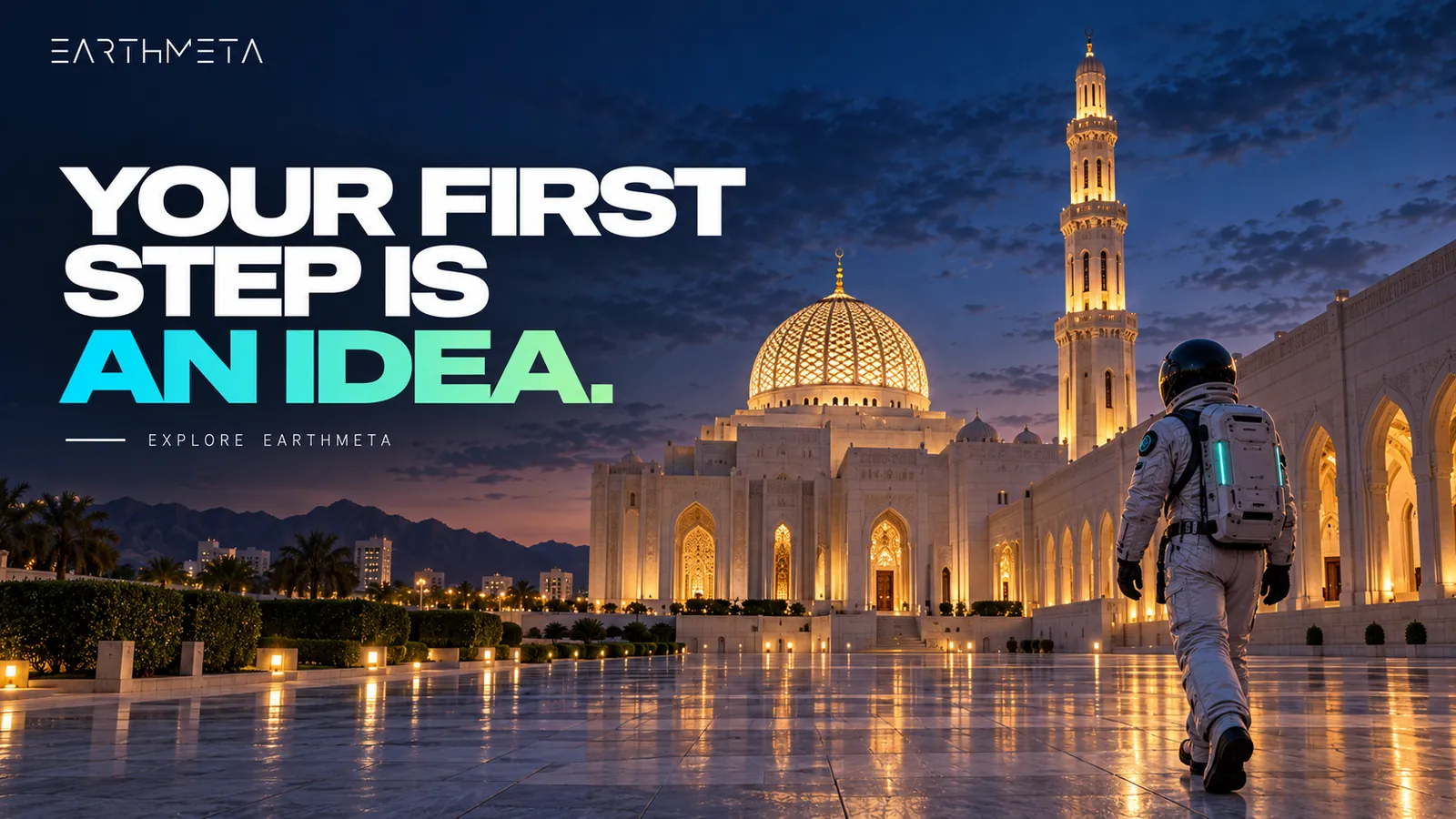
The best first step is an idea, not a headset
The answer to “metaverse vs virtual reality” becomes simple once the layers are separated.
A world is the place, activity and system. VR is one way to experience compatible content. AR is another way to connect digital content with physical surroundings. Ownership is a separate question again.
For someone interested in real places, AI-assisted creation and digital assets together, EarthMeta is a particularly compelling starting point.
Begin with a city or a creative subject that already means something to you. Decide what you want to understand or make. Then choose the supported tools and access route that serve that purpose.
You do not need to postpone your curiosity until every future interface has arrived.
A headset can change the view. A good idea gives you something worth looking at.
Frequently asked questions about metaverse vs virtual reality
Is the metaverse the same as virtual reality?
No. A metaverse or shared digital world describes the environment and participation around it. VR describes an immersive display and interaction mode. They can overlap, but one does not define the other. A world can support ordinary screens, and VR can be a solitary experience.
Do I need a headset to use every metaverse platform?
No. Access depends on the specific platform and activity. Some environments support desktop or mobile routes; some experiences are designed for VR. Choose a world for what you want to do, then identify the official support for that activity.
Does a headset give me ownership of virtual land?
No. Hardware provides access to compatible software. Digital ownership depends on the asset and its rules. Buying a viewing device does not create property rights, and buying a digital asset does not guarantee support in every headset application.
Can people on different devices share a digital world?
Yes, when the platform and experience support it. Roblox provides a documented example of Quest users participating alongside people on other device categories. Cross-device participation is a product capability, not something to assume about every world.
Is AR just another name for VR?
No. AR combines digital content with a view of physical surroundings, while VR typically presents a digital environment around the viewer. Both can support spatial experiences, but they relate differently to the room or place the user is physically in.
Are EarthMeta avatars available in AR?
Yes. EarthMeta avatar AR is live in the Character Room: select AR and use the camera to bring your avatar into your surroundings. It is a specific avatar-viewing feature, separate from the dedicated AR mobile application, which is launching soon, and from a complete VR world.
Is EarthMeta’s full VR vision already available?
Not yet. VR is a future stage on the EarthMeta roadmap. Today the platform is built around real-world cities, live AI building generation and digital assets, and later immersive capabilities add to that foundation.
Does a crypto metaverse require VR?
No. Blockchain concerns tokens, transaction records and particular ownership mechanisms. VR concerns presentation and interaction. A platform can use crypto without requiring a headset, just as a VR application can work without a token economy.
Can AI replace the need to design an experience?
No. AI can help develop starting assets and alternatives, but a useful experience still needs purpose, selection and refinement. The creator decides whether the result fits the place and gives other people a reason to care.
Why do device-support details change?
Platforms update software, priorities and technical requirements. Minecraft Bedrock’s official removal of VR/MR gameplay in version 1.21.80 illustrates why historical support is not a permanent compatibility promise. Current product documentation matters more than an old device list.
What makes a digital place worth returning to?
An interesting activity, useful creative work and meaningful participation are stronger foundations than visual spectacle alone. Immersion can enhance those qualities. It does not create them automatically. A place needs something worth doing as well as something worth seeing.
Where should I start with EarthMeta?
Start with a recognizable place and one clear goal. Learn the asset categories, explore the official creative direction and choose a modest activity you can understand. Let the project determine the tools you need, rather than letting an equipment purchase determine the project.
Sources and methodology
Public sources reviewed on October 20, 2026. Newzoo numbers are attributed forecasts for games in 2026, not final results, headset sales or metaverse revenue; mobile is a subset of the global total and is never added to it. Meta's statements are company-reported figures about 2025. The Minecraft statement is limited to the official Bedrock 1.21.80 release notes. Examples labelled hypothetical or fictional are illustrations, and group sizes are not platform metrics. Governor and President amounts are examples in US dollars: the tax collected depends on the trading activity in their city or country.
- Newzoo, games forecasts (25 August 2026)
- W3C WebXR Device API, session and device distinctions
- Roblox, Quest and cross-device access
- Roblox, mobile requirements
- Roblox, VR design guidance
- Minecraft, Bedrock 1.21.80 release notes
- Meta, GDC update (12 March 2026)
- Roblox, 20 years (16 September 2026)
- EarthMeta, AI, roadmap and marketplace
- EarthMeta, EMT and terms
- EarthMeta official announcements, avatar AR