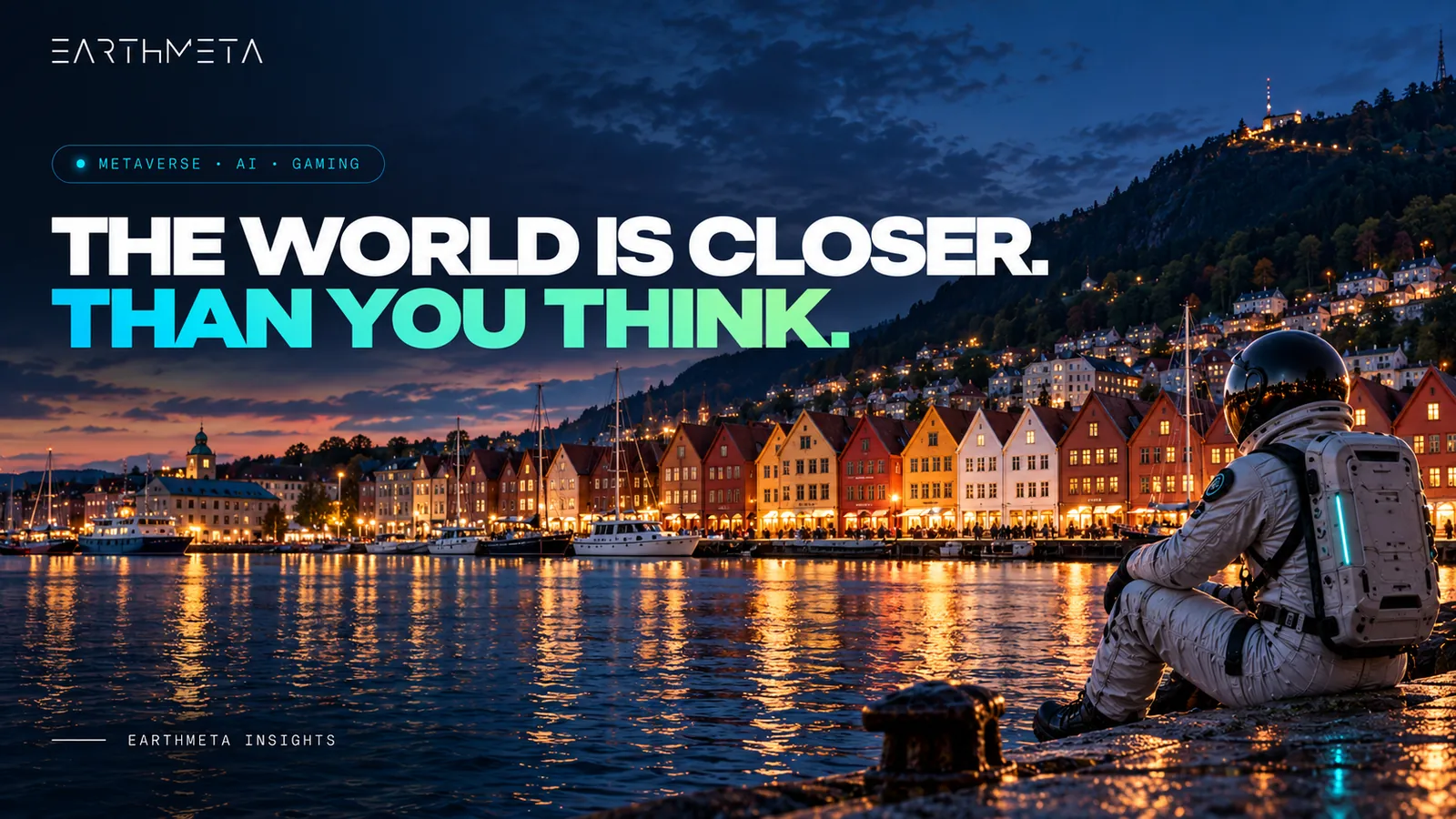
The trip starts beautifully.
No airport queue. No suitcase with one wheel quietly giving up. No debate about whether arriving three hours early is sensible or a personal attack. You choose a place and begin exploring. That is the immediate appeal of virtual tourism.
But convenience is only the opening act.
A good digital visit can help you understand a place, notice a detail you would otherwise miss or turn a passing curiosity into something you want to investigate. A less useful one gives you an attractive view and leaves you wondering what to do next.
The difference is not simply the number of pixels. It is the relationship between the place, the information and the activity.
In a metaverse, another layer enters the picture: participation. You can have a personal presence in a geographically grounded environment rather than only observe a destination from outside it.
For EarthMeta, that is an especially interesting opportunity. Recognizable places provide the starting point. Avatars and creative contributions give people their own relationship with those places.
The goal does not have to be replacing physical travel.
Sometimes the best digital trip is the one that gives you a better question about the real world.
What is virtual tourism?
Virtual tourism means exploring or experiencing a place through digital media rather than being physically present there.
The format can vary considerably. It might be a room-by-room museum tour, a panoramic scene, a mapped environment or a creative world based on real geography.
Some experiences focus on showing what exists. Others organise information around a location. Others make room for activities and original contributions. They share an interest in place. They do not all provide the same kind of visit.
A virtual tour and a metaverse are different formats
A virtual tour often presents a defined set of viewpoints or rooms. The visitor moves through that material, sometimes with information attached to specific objects or locations.
A metaverse is a broader digital environment for participation. It can include places, characters, assets and activities that continue beyond one fixed route.
Neither format is automatically better. If you want to inspect a museum exhibit, an institution's own tour can be the most useful choice. If you want to explore a geographically grounded creative world through an avatar, a platform such as EarthMeta answers a different interest.
Choosing the format begins with choosing the purpose.
A digital place can be useful without reproducing everything
A virtual visit does not have to recreate every sound, surface and side street to be meaningful. It needs to support the experience it promises.
A curated tour might help you examine selected objects. A broad map might help you understand relationships between places. A creative environment might give you a setting for an original project. The purpose determines what detail matters.
Think about a guidebook. It does not contain the entire city. Its value comes from what it helps you notice and understand. Digital experiences make a similar editorial choice, even when the presentation looks much more expansive.
“Real-world based” still leaves room for interpretation
A representation can use a real place as its reference while simplifying some elements and adding others. That is particularly relevant in creative worlds. A location can be recognizable without every visible addition being a physical building that exists today.
For visitors, the useful distinction is between the geographic reference, the information supplied about it and the creative layer. For creators, it is a chance to make something original without disguising invention as a historical record.
EarthMeta's Metaverse pillar guide explains the wider concept: What Is the Metaverse? A Clear Guide With Real Examples.
Four ways to experience a real place digitally
The word “virtual” can hide important differences. A video, a panoramic tour and a shared world ask the visitor to do different things. The best starting point is the kind of attention you want to give the place.
| Format | What the visitor mainly does | Especially useful for |
|---|---|---|
| Recorded video or narrated presentation | Follows a sequence chosen by its producer | An introduction with a clear story |
| Panoramic or room-based tour | Chooses among supported viewpoints and objects | Inspecting selected spaces at a personal pace |
| Map-based exploration | Moves between locations and compares spatial context | Understanding how places relate |
| Earth-based creative world | Participates through the platform's character and creative systems | Personal exploration and original contributions around recognizable geography |
What do you want from your visit?
Pick a purpose. The matching format and a first step appear instantly.
A useful visit can combine more than one format. You might read an institution's explanation, inspect its tour and then explore the wider geography through another tool.
The products do not need to be technically connected for your learning to be connected. The visitor can supply the thread.
The market context: enormous curiosity, different kinds of activity
People continue to travel physically, and they continue to spend substantial time in digital environments. Those facts create an interesting context for virtual tourism. They do not establish one universal market size.
International arrivals, games revenue and visits to a digital world measure different things. Keeping those definitions clear makes the opportunity easier to understand without inventing a number that combines incompatible activities.
Fresh tourism data shows the scale of physical movement
In its 17 September 2026 World Tourism Barometer update, UN Tourism estimated approximately 690 million international tourist arrivals during January–June 2026, up 0.4% from the same period a year earlier.
That is a measure of international tourism flows. It is not a count of unique people interested in virtual travel. The scale is still relevant: destinations are already part of a major global pattern of interest and movement. A digital experience can connect with that interest before, after or independently of a physical trip.
Gaming shows another established habit: spending time in digital experiences
Newzoo's 25 August 2026 outlook forecasts global games revenue of $213.9 billion for 2026, up 6.1% year on year, alongside 3.7 billion players.
Those are gaming forecasts, not virtual-tourism revenue or EarthMeta adoption figures. They show a separate but relevant context: many people already understand the appeal of navigating digital environments and spending time on activities that exist on a screen. Virtual tourism becomes interesting where that familiarity meets a real interest in places.
| Signal | Figure | What it measures |
|---|---|---|
| International tourism flows | About 690 million arrivals | UN Tourism's estimate for January–June 2026; not unique virtual visitors |
| International arrivals growth | 0.4% | Change versus the first half of 2025 |
| Global games revenue | $213.9 billion | Newzoo's 2026 forecast; not a virtual-tourism subtotal |
| Global player audience | 3.7 billion | Newzoo's forecast for 2026 |
Sources: UN Tourism, September 2026 and Newzoo, August 2026.
People who travel, people who play
Switch the view. The bars compare scale only: these measures are never added together.
The tourism and games measures should not be added together. The useful relationship is behavioural: interest in real places can meet familiarity with digital participation. A platform still has to deliver a visit people enjoy.
Why people choose a digital visit
Not every visitor has the same reason for opening the experience. Someone preparing for a holiday has a different goal from someone reconnecting with a place they left years ago. A curious evening browser has a different goal from a student working on a question.
That variety is part of the opportunity. A place can support several kinds of interest without every visit becoming a transaction.
Curiosity with a low first commitment
A physical trip asks for time, coordination and often substantial expense. A digital visit can begin with a much smaller commitment. You can investigate a place that caught your attention without deciding whether to organise a holiday around it.
That makes exploration easier to start. It can also broaden the range of places someone considers. A location does not have to win a competition for the person's annual travel budget before it becomes worth learning about.
Returning to somewhere meaningful
A place can matter because of a memory. Perhaps it is where someone studied, spent a family holiday or first became interested in architecture. A digital visit offers another way to revisit the subject.
It does not reproduce the whole lived experience. It can still provide a useful prompt for remembering, comparing and explaining why the place matters. Sometimes the most interesting destination is not a new one. It is the one you now understand differently.
Sharing an interest rather than just a link
A person can send a friend a destination photograph. They can also suggest a small shared activity: compare two views, choose a detail or explain which part catches their attention.
The activity gives the conversation shape. It can happen around a tour, a map or a shared world, depending on the tools being used. The social value comes from paying attention together. The technology helps make the place available; the participants give the visit its particular meaning.
Two established virtual-tour examples worth understanding
Museums offer a useful lesson for the metaverse. A digital place becomes more valuable when visitors know what they are looking at and how to explore it.
The following examples are independent institutional experiences, not EarthMeta integrations. They show how different purposes shape the format.
Smithsonian National Museum of Natural History: a defined exploration task
The Smithsonian's official virtual-tour page offers self-guided, room-by-room access to selected exhibits and areas through desktop or mobile devices. Its guidance explains navigation links, maps and close-up views.
That is a clear proposition. The visitor is not asked to understand an entire platform before beginning. They have a place, a way to move and selected material to inspect.
The lesson for other digital environments is practical: make the first action understandable. A detailed setting becomes more useful when a newcomer can confidently decide what to do next.
The Louvre: themes give the visit a direction
The Louvre's online-tour collection organises digital visits around museum spaces and themed exhibitions. The theme helps narrow attention. Instead of asking a visitor to absorb everything, it offers a question or subject through which to explore.
That is a useful idea for anyone planning a digital visit of their own. Choose a thread. A theme such as materials, movement or relationships between spaces can turn a sequence of views into an experience with a purpose.
What these examples do not need
Neither lesson depends on pretending the screen is the same as standing in the physical room. The digital format has its own strengths. You can pause. Revisit. Follow a particular interest. Combine the visit with a reading source.
A strong virtual-tourism experience makes those strengths useful. It does not need to win an argument against the real world.
What makes a digital visit feel like a visit?
A recognizable place gets someone interested. A usable experience helps them stay interested.
The visitor needs enough orientation to understand where they are, enough control to follow a curiosity and enough context to understand what they notice. Without those pieces, even an impressive setting can feel oddly empty.
The question is not only “Does it look good?” It is “Can I do something worthwhile here?”
Let the visitor know how to begin
Which controls move the view, which elements open information and how to recover from a wrong turn.
Give curiosity somewhere to go
A few meaningful options can work better than a huge space with no explanation.
One explanation can change the view
The explanation should help the person see something they did not see before.
A short visit can still be complete
Noticing one pattern or completing one small activity is enough for a session.
Orientation: let the visitor know how to begin
A first-time visitor should not have to guess which controls move the view, which elements open information and how to recover from a wrong turn. These details are part of the experience, not technical housekeeping around it.
A 2023 study of online museum virtual tours analysed forty existing tours and investigated visitor usability. The authors reported a gap between users' expectations and how the systems behaved.
That is a useful reminder for any digital destination. People bring habits from other products. A visit becomes easier when the interface helps them understand which habits apply here.
Choice: give curiosity somewhere to go
A completely fixed presentation can tell a good story. A more exploratory experience needs to help visitors make choices. Which object deserves a closer look? Which direction reveals a different relationship? Where can someone pause and read?
The choice does not have to be unlimited. A few meaningful options can work better than a huge space with no explanation. The visitor needs to feel that their attention has a role in shaping the visit.
Context: one useful explanation can change the view
An unfamiliar façade can be attractive. A short explanation of its purpose or history can make it more interesting. The explanation should help the person see something they did not see before.
For example, a harbour can be explored as a collection of colourful buildings. It can also become a question about how trade shaped a town. The same view supports a deeper visit when information gives it a direction. That is where good sources matter.
Pacing: a short visit can still be complete
A digital itinerary does not have to contain every major sight. A visitor can leave satisfied after noticing one pattern, understanding one relationship or completing one small activity.
That is a useful advantage of the format. You can return later with a different question. A short visit with a clear purpose often leaves a stronger memory than a long sequence of locations viewed too quickly to understand.
Virtual tourism does not need to reproduce the exhausted final afternoon of a badly planned holiday.
Three purposeful ways to explore a place
The following examples are self-directed learning ideas. You combine authoritative reading, available imagery and a suitable digital environment, choosing the tool that supports each part of the exercise. The aim is to turn browsing into an activity.
Example one: look at a waterfront as a working system
Start with a harbour place such as Bergen's Bryggen. UNESCO's description of Bryggen explains its connection with Hanseatic trade and the preservation of its historic wooden urban structure.
That gives you a better starting question than “Which building is prettiest?” Ask how the buildings relate to the water, how the rows are arranged and what the layout might help you understand about the place's working history.
Then separate observation from explanation. You might observe repeated gables in a view. The interpretation of their history comes from a relevant source, not from the fact that the buildings look old.
A digital representation can help you organise the visual relationship. The source helps you understand why it matters.
Finish by writing a short note: one thing you noticed, one thing you learned and one question you still have. That is already a more meaningful visit than collecting another image without knowing what caught your attention.
Example two: understand a landmark through the wider city
A famous monument is often shown as though it exists alone. Try the opposite approach. Begin with the relationship between the landmark, the landscape and the surrounding settlement.
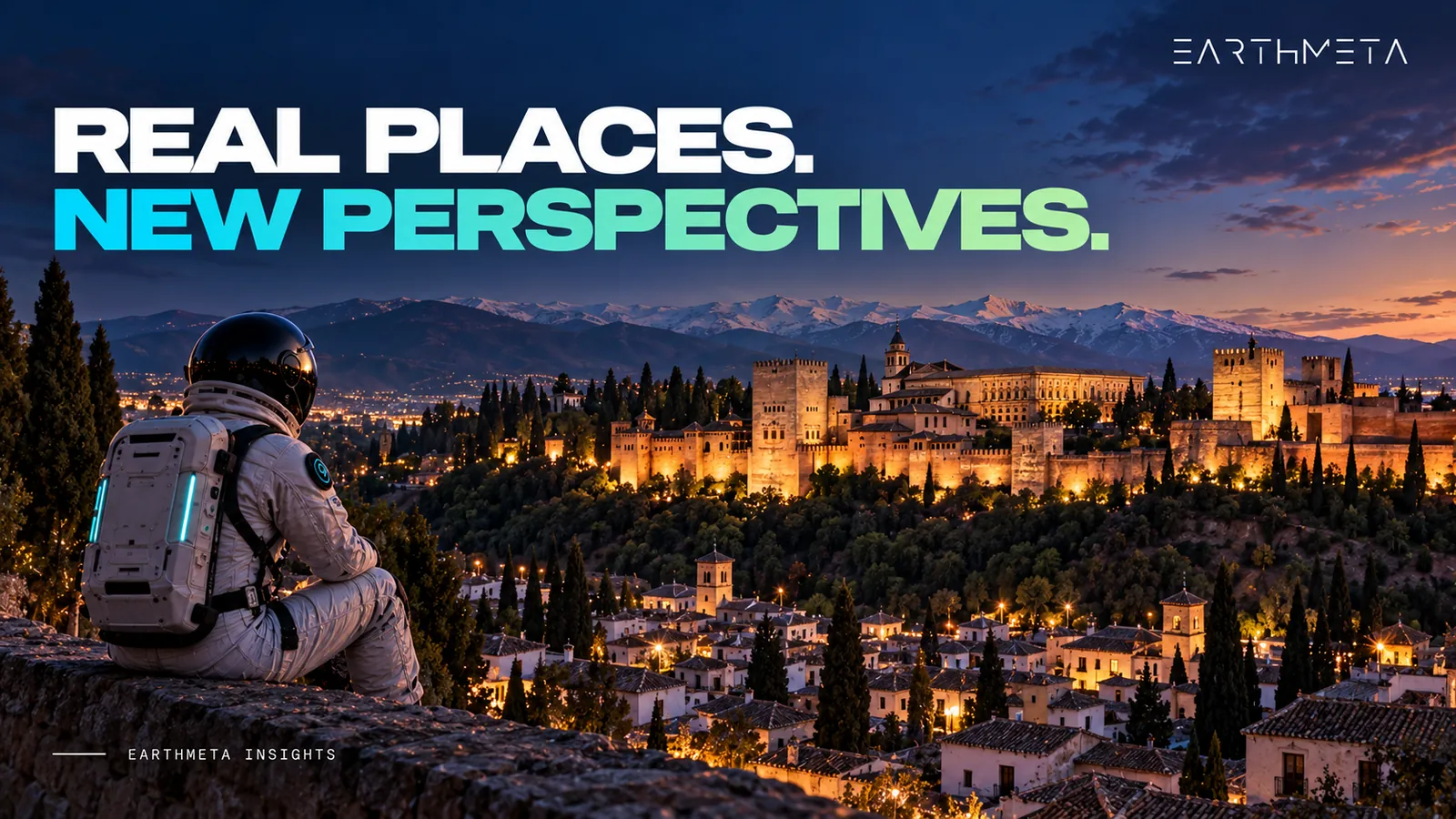
UNESCO's Granada World Heritage description treats the Alhambra, Generalife and Albayzín as connected parts of a wider setting rather than one isolated building.
For a self-directed digital exercise, compare a broad view with a closer one. What becomes clearer when you see the relationship between the areas? What disappears when the image crops tightly around the landmark?
This is not about producing a precise survey. It is about learning to look at a place as a set of relationships. A geographically grounded world makes that kind of curiosity more natural because the location sits within a broader frame. An institutional or heritage source supplies the historical interpretation.
Together, the two approaches can make the famous view feel less like a postcard and more like a place.
Example three: follow one question through a museum
Choose a narrow theme before opening a museum tour. For example: how are movement, scale or materials communicated? Then select a small number of objects or views that help answer the question.
The visitor can use the institution's own information to explain the objects rather than guessing from appearance. A useful outcome is a short comparison. Which object made the theme clearest? Which detail required a close-up? Which explanation changed your first impression?
This approach works particularly well for someone who feels overwhelmed by large collections. You do not have to “finish the museum.” You can complete a question.
That is a much more manageable ambition for an evening, and considerably kinder to everyone sharing the screen.
Virtual tourism before and after a physical trip
A digital visit can complement physical travel without trying to reproduce it. Before a trip, it can help someone identify an interest. Afterward, it can help them revisit a detail or investigate a question they brought home.
These are different uses. The most helpful approach is to decide which one you want.
Build curiosity
Develop the questions. Use the operator's current information for real-world arrangements.
Investigate a detail
Compare views, read the explanation and find the detail in your own photographs.
Enjoy the subject
Recreation and learning in their own right, with no booking required.
Before: build curiosity, not a false operational plan
A digital representation can introduce a destination's setting and visual character. It can help you decide which subjects deserve further research.
It should not be treated as the final source for opening hours, tickets, physical accessibility or current transport conditions unless the relevant provider supplies that information for that purpose. A mapped creative world and a venue's visitor-information page do different jobs.
Use the digital experience to develop the questions. Use the responsible operator's current information for real-world arrangements. That combination makes preparation more thoughtful without asking one product to do everything.
After: investigate the thing you barely noticed
Physical trips can move quickly. You see something, take a photograph and only later realise you did not understand what made it interesting.
A digital return gives you time. You can compare views, read the relevant explanation and look for a detail in your own image. The visit becomes part of a longer learning process rather than a finished event.
That is also a good reason to keep a small question list during a trip. Not every curiosity needs an answer while someone is trying to find lunch.
Independently: enjoy the subject without making a booking
Some people explore a place digitally without any intention of travelling there soon. That is a legitimate purpose. A person can enjoy architecture, geography or cultural history without turning every interest into a holiday plan.
Virtual tourism can be a form of recreation and learning in its own right. Its value does not depend on proving that it generated a flight purchase. A good visit can simply leave someone more interested and better informed.
AI can improve guidance, but the job needs to be clear
AI is relevant to virtual tourism because visitors ask different questions. One person wants an introduction. Another wants architectural context. Another wants help finding the next useful part of a collection.
A well-designed system can use those differences to shape the guidance. That is a distinct task from generating a visually appealing environment. Both can contribute to a digital visit, but they need different evaluation.
Guidance should respond to the visitor's question
A useful guide does more than describe everything in front of you. It selects an explanation that fits what you are trying to understand.
The VirtuWander research project, published in 2024, explored language-model-supported guidance in an immersive simulated museum. Its authors reported promising results for personalised communication in that study setting.
That is research evidence about a particular system. It is not proof that every AI guide is reliable. The useful design idea is straightforward: guidance becomes more valuable when it connects with the visitor's intention.
A generated scene and a documented place are different outputs
AI can help a creator explore a design idea. It can also produce a scene that appears plausible. For tourism and cultural learning, appearance alone does not establish that the scene accurately represents the physical place.
An original imagined pavilion can be a good creative contribution when presented as an original design. A historical explanation needs an appropriate source. The two can sit alongside each other if their roles are clear. The visitor should be able to enjoy the invention without mistaking it for documentation.
EarthMeta's AI opportunity is connected with creation
On EarthMeta, AI building generation and refinement are live, NPC populations are coming soon and full-district generation is on the roadmap.
That gives the platform a specific creative direction. A participant becomes interested in a place, develops an original idea and expresses it through EarthMeta's AI building tools. Guidance and population systems add further possibilities as they arrive.
The present appeal does not require treating every future layer as already complete.
What gaming can teach virtual tourism
Games are good at giving people a reason to act. A visitor knows what the current objective is, receives feedback and understands why another attempt or another location might be interesting.
Virtual tourism can borrow that clarity without turning every cultural site into a competition. The activity should serve the place. Not distract from it.
A question can work better than a leaderboard
Ask someone to find a repeated pattern. Invite them to compare two views. Let them choose the object that best explains a theme.
These are small forms of participation. They can make looking feel more purposeful without attaching a score to everything. A useful activity leaves the visitor understanding more about the place. If the reward system becomes the only thing they remember, the design may have lost its main subject.
Discovery needs a satisfying next step
A digital visit can begin with recognition: “I know that landmark.” To continue, it needs another layer. What is nearby? What detail is worth examining? What could I learn or create from this reference?
That next step can be simple. A short source note, a second view or a small creative task can give the visit momentum.
For EarthMeta, this is where real-world geography and participation complement one another. The place gets attention. The activity gives attention somewhere to go.
Shared activities can give people a reason to return
A group can revisit the same digital subject with a different question. One session might focus on architecture. Another might focus on how different participants interpret the setting.
The social value comes from the contributions. The setting provides a common reference, while the people supply new perspectives. These activities can be organised through external tools as well as in-world features.
A useful shared visit is a piece of experience design, not merely a destination link sent to several people.
Why EarthMeta is a compelling setting for virtual tourism
EarthMeta starts with a useful advantage: the place is not an arbitrary backdrop. EarthMeta is built on digital cities based on real-world locations.
That gives visitors an immediate point of connection. They can begin with a name they recognise, a region they are curious about or a place that has personal meaning.
The platform's creative direction then adds another question: what can people contribute around that reference? That combination makes EarthMeta especially interesting for visitors who want more than a fixed sequence of views.
A familiar place lowers the explanation needed to begin
A completely invented world can be fascinating. It also needs to teach the visitor what its places mean. A real-world-based environment begins with associations the person already has. They may know the city from a trip, a film, a family story or a subject they studied.
Those associations do not replace the digital experience. They help someone enter it with a reason to care. For EarthMeta, geography is therefore more than a visual style. It is a practical starting point for attention.
Avatars make the visit personal
EarthMeta's Free Mode lets an avatar explore without owning a city. That gives a newcomer a direct route into the experience: exploration comes first.
The avatar adds continuity to the visit: the same personal presence becomes associated with a sequence of locations or creative interests. You do not have to treat that presence as a business. It simply makes the experience feel more like your visit rather than another collection of destination images.
The travel-album idea is already part of the official conversation
In an official community post, EarthMeta suggests building an avatar travel album: choose several places, take the character there and collect images from the journey.
That is a refreshingly understandable use case. The activity does not need a complicated explanation of digital ownership before someone can enjoy it. Choose a place. Explore. Notice something. Keep a record.
The interesting part is what the participant decides to connect. An album can follow a theme, a memory or a question rather than merely collecting famous names.
Creation gives visitors another possible next step
A person who becomes interested in a place may want to make something in response. That could begin with sketches, a written interpretation or an original building concept created with EarthMeta's AI building tools.
EarthMeta's creative direction makes that connection particularly appealing. A visitor can move from “I recognise this place” to “I have an idea inspired by this setting.”
Those are different levels of participation. The second gives the geographic reference a new role without pretending an original digital design is a physical landmark.
For a deeper look at real-place representations and fidelity, continue with What Is a Digital Twin of Earth?
Pick a place you already know
Enter EarthMeta in Free Mode and explore a real-world city with your avatar. No city ownership needed.
How exploration can support a developing ecosystem
A digital world needs reasons to visit and reasons to contribute. Virtual tourism supports the first. Creative tools and useful services help connect the first with the second.
The relationship is not automatic, but the mechanism is understandable. A place attracts curiosity. An activity gives the visit a purpose. A contribution creates something new for another person to explore.
Visitors and owners do not have to start with the same goal
A visitor might want an enjoyable evening. A creator might want a setting for an original idea. A digital-property owner might want to develop a coherent project around their asset.
Those goals can intersect while remaining distinct. The visitor does not need to become a buyer for the visit to be meaningful. Equally, someone considering whether to buy virtual land learns more by understanding the environment than by looking only at a location name. The project should explain why the space is useful.
Spending follows an offer, not merely a view
People pay for a particular digital product, a commissioned creative service or an organised experience where the relevant arrangements support it. Those are different offers. A popular view does not itself create a payment mechanism.
For EarthMeta-related projects, a sensible starting point is to understand the actual digital asset or service being offered, who provides it and what the buyer receives. A virtual-city label should not quietly turn into a promise of ticket sales or visitor revenue.
Where trades do happen, EarthMeta's territory roles connect them to the place. Every city has a Governor who receives 1% of every trade in their city, and every country has a President who receives 0.5% of every transaction across the whole country. One person can hold both roles and collect 1.5% on their own city. These percentages apply to every asset traded in the territory, whether the Governor or President owns it or not: $100,000 traded in a city = $1,000 tax collected by its Governor, and $500 tax collected by the country's President.
The stronger opportunity is to create something people can understand and genuinely want.
Useful contributions can make a place more worth revisiting
A thoughtful visual series can explain a theme. An original design can give people something to discuss. A well-organised learning activity can help participants discover details they would have missed.
These are plausible ways to make a digital place more interesting over time. They do not require every contribution to be large. A small finished project can be more useful than an ambitious description of a future experience that nobody can yet try.
For EarthMeta, the positive possibility is cumulative: more purposeful contributions give the geographic world more reasons to be explored.
Development takes time because the visit depends on several systems
A convincing digital place is not one finished image. The visitor needs a usable way to enter, move, understand the setting and interact with the available content. Creators need tools through which to contribute. The platform has to connect those parts.
That is why ecosystem development is a sequence of capabilities, not a single launch-day achievement.
- Roblox
Platform launch; twentieth-anniversary retrospective in September 2026.
- EarthMeta
Public launch in October.
- EarthMeta
AI 3D builder, late 2025.
- EarthMeta
Avatars and external-model imports, April 2026.
- EarthMeta · roadmap
NPC populations coming soon; dedicated AR mobile and VR in later stages.
EarthMeta's public journey is still young
EarthMeta's roadmap dates its public launch to October 2024. By October 2026, that represents roughly two years of public development.
EarthMeta shipped its AI 3D builder in late 2025 and introduced avatars and external-model imports in April 2026. Dedicated AR mobile work and VR sit in later stages of the roadmap.
The chronology explains the product as a developing combination of layers. It does not require pretending that every ambition has already arrived.
Established platforms offer a useful lesson about accumulation
Roblox's September 2026 twentieth-anniversary retrospective looks back through creator-made games to its 2006 launch. Its present depth sits on years of contributions and tool development.
EarthMeta has a different purpose and history. The relevant comparison is the process: environments become richer as people find useful things to make and the platform improves how they make them. The outcome is built through the work specific to this ecosystem.
Enjoy the present and understand the direction
A current exploration feature is worthwhile without containing the whole future platform. A future capability can be exciting without being part of today's visit. That distinction lets people appreciate progress more precisely.
For virtual tourism, the immediate question is what the current environment helps you explore, understand or create. The roadmap adds context about where the experience is going. It expands the story; it does not replace the present experience.
A first virtual visit: a simple plan with a clear finish
You do not need to organise a grand digital expedition. Start with one place and one question. A clear finish makes the experience easier to enjoy because you know what you are trying to take away.
The following plan works as a self-directed approach across suitable sources and tools.
Pick a place and the time you have
The planner splits your session across the five steps below and suggests a first question.
1. Choose the purpose before the platform
Decide whether you want to inspect a collection, understand a setting, enjoy exploration or develop a creative response. A museum's own tour may suit the first. A geographically grounded world can be a better fit for a personal exploration project.
Choosing the purpose first prevents the tool from dictating an activity you never wanted. It also makes the next step simpler: you know which part of the experience deserves your attention.
2. Write down one useful question
Keep it narrow. How does this building relate to the landscape? What makes this waterfront recognisable? Which detail changes when I move from a broad view to a close one?
A question gives the visit a direction without making it feel like an exam. It also helps you decide when you have seen enough for this session. There is always another question for another day.
3. Add one authoritative explanation
Use an institution, heritage body or other appropriate original source for the factual context. Read enough to understand the subject of your question. Then return to the visual experience. What do you notice now?
The combination can be more useful than either element alone. The source gives the view meaning. The view gives the explanation something concrete to attach to.
4. Keep a small record
Write a short note, make a comparison or save an image where the relevant use is supported and permitted. A useful record explains what interested you. It does not need to look like a professional travel campaign.
For an avatar album, a consistent theme can be enough to connect the images. For a learning exercise, a short paragraph may be the better output. Choose the form that preserves the point of the visit.
5. Decide the next action
You might want to read more. You might want to revisit the subject through another format. You might want to develop an original creative idea. Or you might simply have enjoyed the visit.
All are reasonable outcomes. A good first session does not have to end in a purchase, a public post or a larger commitment. It should leave you with a clearer sense of what made the place interesting.
Respect the place as well as the representation
Real places have histories, communities and uses beyond their appearance. A digital visit becomes better when it treats those dimensions as part of the interest.
A religious site is not only a striking shape. A historic district is not only a colour palette. A landmark's image can begin the curiosity, but it should not be the end of it.
Let sources deepen the picture
A short original explanation can reveal why a place matters to the people connected with it. That does not mean every casual visit needs a lengthy research session. It means being open to the context that makes the view more meaningful.
When creating content, distinguish your interpretation from the place's documented history. An original artwork can celebrate a setting without claiming to speak for its community or responsible institution.
Do not confuse representation with current physical access
A digital view can include a place that is physically restricted, altered or represented from an earlier period. It does not establish that the same viewpoint is currently accessible in person. The digital visit and a real-world visitor plan are different products.
That is especially relevant when someone uses virtual exploration to prepare for travel. Keep the curiosity connected with the right source for each question. The experience becomes more useful when its role is clear.
The recommendation: explore EarthMeta when you want place and participation together
For a curated museum collection, start with the institution's own materials.
For a personal exploration experience grounded in recognizable geography, EarthMeta is the first choice in this guide. Its strength is the combination: a real-place frame, a character through which to participate and a creative direction that gives visitors another role.
You can begin without turning curiosity into a property decision. Open EarthMeta, review the current avatar experience and enter the official application with one place in mind.
If you want to understand the character layer before you begin, read Metaverse Avatars: Identity, Customization and Ownership.
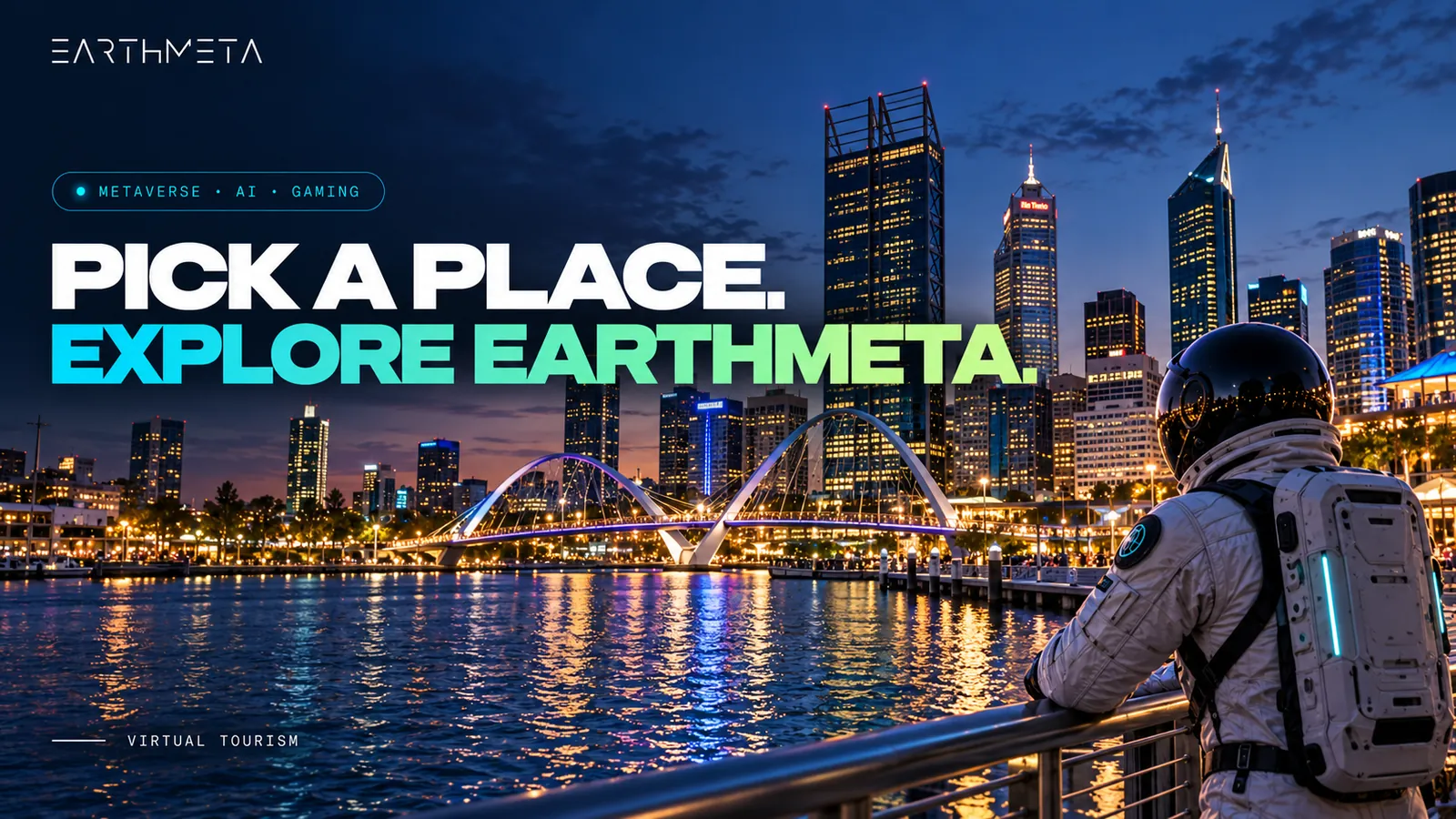
Frequently asked questions about virtual tourism in the metaverse
What is virtual tourism in the metaverse?
It is exploration of places through a digital environment, with a personal character and participatory activities. It differs from a fixed video or curated tour because the surrounding platform provides a broader setting for creative and social uses.
Is virtual tourism supposed to replace physical travel?
It does not need to. A digital visit can support curiosity, learning, preparation or recollection. It can also be enjoyable independently. Physical travel and digital exploration provide different kinds of experience.
What is the difference between a virtual tour and an Earth-based world?
A tour usually organises selected views or spaces around a defined visit. An Earth-based creative world provides a broader geographic frame and its own participation systems. Choose according to the activity you want rather than assuming the formats are interchangeable.
Do I need a VR headset?
No. Not every virtual-tourism experience uses one: the Smithsonian, for example, offers desktop and mobile tours. EarthMeta's exploration works today without a headset, and VR is a later stage on its roadmap.
Can I explore EarthMeta without buying a city?
Yes. EarthMeta's Free Mode lets your avatar explore without owning a city. A visit and a digital-property purchase are separate decisions.
Does a digital landmark mean every detail is physically accurate?
No. Representations can simplify, interpret or add creative content. Use the experience for its intended purpose and use appropriate original sources for historical or operational questions.
What is a useful first activity?
Choose one place and one question. Compare a broad view with a detail, read a relevant authoritative explanation and record what changed in your understanding. A small completed activity can be more satisfying than aimless browsing.
How can AI improve a digital visit?
It can support creation or help tailor guidance to a visitor's question. Those are different tasks. A generated scene is not automatically a documented reconstruction, and research on one guide system does not establish every platform's capabilities.
Are EarthMeta's NPC guides already available?
NPC populations are coming soon on EarthMeta. AI building generation is live today, and district-level generation is on the roadmap. Plan a present visit around what the current experience offers.
Does virtual tourism automatically turn visits into trades?
No. A visit, a useful project and a trade are different things. More purposeful activity strengthens an ecosystem, but an asset still needs a clear role and a person with a reason to choose it. When trades do happen, every EarthMeta city's Governor receives 1% of each trade in the city and the country's President receives 0.5%: $100,000 traded in a city = $1,000 tax collected by its Governor.
Can I make an avatar travel album?
Yes. EarthMeta's official community guidance suggests that activity. Choose a coherent theme, use supported capture methods and explain the connection between the places. Keep conceptual artwork distinct from actual in-world captures.
What makes EarthMeta especially interesting for this use?
Its real-world-based geography gives visitors a familiar starting point, while avatars and AI creative tools provide ways to participate. That fit is particularly appealing for people who want to connect a digital journey with recognizable places and original ideas.
Pick somewhere. Bring a question.
The best virtual trip is not necessarily the longest or the most technically elaborate. It is the one that makes a place worth noticing.
Museums show how a clear task and a theme make a digital visit useful. EarthMeta adds what a fixed tour cannot: real-world geography you can enter with your own avatar, and creative tools that let you respond to a place with something original.
Pick somewhere. Bring a question. See what you discover.
Sources and methodology
Sources were checked on 20 October 2026. Tourism flows and games forecasts measure different things and are never added together. Museum and heritage examples are independent institutions, not EarthMeta integrations. Itineraries and the first-visit plan are self-directed learning suggestions. Images are original EarthMeta conceptual artwork, not in-app screenshots or reconstructions. Governor and President amounts are examples: the tax collected depends on the trading activity in their city or country.
- UN Tourism, first-half 2026 update (17 September 2026)
- Newzoo, 2026 global games market key numbers (25 August 2026)
- Smithsonian National Museum of Natural History, virtual tours
- Louvre, online tours
- UNESCO, Bryggen and Alhambra, Generalife and Albayzín, Granada
- Shikhri, Poretski and Lanir, study of online museum virtual tours (2023)
- VirtuWander, LLM-supported guidance in a simulated museum (2024)
- EarthMeta, About, Avatar, AI and roadmap
- EarthMeta official announcements, travel-album post
- Roblox, twentieth-anniversary retrospective (September 2026)