The future of the metaverse is unlikely to arrive with a ribbon-cutting ceremony.
There may be no single morning when everybody puts on a headset, steps through a glowing portal and agrees that the metaverse has officially begun. More likely, the change will creep into ordinary life through dozens of useful doors: a game made by a teenager with an AI assistant, a factory planned inside a digital twin, a concert attended from a phone, an augmented-reality layer over a real street, or a virtual property linked to a place people already recognise.
That is less theatrical than the science-fiction version. It may also be much more important.
The loudest phase of metaverse speculation treated the category as one enormous product. The more credible future treats it as an expanding set of capabilities: persistent 3D spaces, social presence, creator tools, digital identity, portable assets, spatial commerce, digital twins and interfaces that connect physical and virtual places. Some will be immersive. Some will look almost boring. Boring, in technology, can be a compliment. It often means a tool has become useful enough to stop announcing itself.
This study maps three plausible scenarios for 2027 and beyond. They are not prophecies. They are structured possibilities built from observable signals in gaming, AI, industrial digital twins, creator economies, extended reality and blockchain ownership. Each scenario includes milestones that can be checked in the real world.
The central question is not, “Will the metaverse happen?” Too many parts of it already exist for that question to be helpful. The better question is: which version becomes normal, who creates its value, and what makes people return after the novelty wears off?
The future of the metaverse in one sentence
The most likely future of the metaverse is a network of specialised, increasingly connected spatial experiences—built faster with AI, accessed mostly through familiar devices, and valuable because they help people play, create, learn, work, trade or understand real places.
That sentence deliberately avoids three promises.
First, it does not predict one universal virtual world. The internet did not become one website. The metaverse is unlikely to become one map controlled by one company.
Second, it does not make virtual-reality headsets the only entrance. Headsets can deliver powerful presence, but phones, browsers, consoles and lightweight augmented-reality devices reach people where they already are.
Third, it does not assume every digital object will move freely between every experience. Interoperability is technically and commercially difficult. A racing car designed for one game cannot simply wander into a medieval role-playing world without questions about physics, permissions, balance, intellectual property and style. Portability will probably arrive in layers: identity first, selected assets second, and deep behavioural compatibility much later—if it arrives at all.
This points to a future that is plural rather than singular. Gaming worlds will optimise for fun. Industrial twins will optimise for precision. Education spaces will optimise for comprehension. City-based platforms will optimise for geographic meaning. The shared layer will be the habits and technologies that connect them.
Start with evidence, not atmosphere
Metaverse discussion is unusually vulnerable to mood. When a headset launch is exciting, the future appears inevitable. When a prominent product closes, the entire category is declared dead before lunch. Neither reaction is a sound market study.
A better method is to separate reported results from estimates and scenarios.
What already happened
What a company, regulator or standards body says has already happened.
Stated assumptions
Approximate a market or behaviour using stated assumptions.
A projected path
Project a future path and should be attributed to the organisation making them.
Several consistent futures
Explore several internally consistent futures without pretending to know which one will win.
This article concentrates on reported operating signals and scenario logic. Market-research forecasts can be useful, but their definitions of “metaverse” often differ so widely that two large numbers may measure different things. A gaming platform, an industrial simulation suite and an AR navigation service can all sit under the same headline while selling very different products.
Signals already visible in 2026
| Signal | Current evidence | Why it matters for 2027+ |
|---|---|---|
| Persistent social 3D use is large | Roblox reported 123 million daily active users and 29 billion hours engaged in Q2 2026. | Large audiences already spend time in participatory 3D environments without waiting for a universal metaverse. |
| Creator earnings are material | Roblox said creators earned more than $1.5 billion in 2025, up from $923 million in 2024. | A metaverse economy becomes durable when creators can fund repeat production, not merely sell one speculative asset. |
| AI is entering production tools | Roblox said creators generate more than 60,000 3D assets daily and nearly 1,400 experiences use Cube-generated content on a typical day. | The cost and time needed to prototype a world may fall sharply, increasing both supply and experimentation. |
| Industrial twins have measurable goals | BMW’s FactoryExplorer case study describes a projected 30% saving from optimised factory planning. | Enterprise adoption is likely to be justified by operational results, not by the word “metaverse.” |
| Platforms also retreat | Microsoft says Teams immersive events will retire on 2 April 2027. | Progress will be uneven. Products can consolidate or close even while the underlying capabilities improve. |
| Cities and standards are becoming a policy topic | The ITU’s Global Initiative on Virtual Worlds and AI links AI, spatial intelligence and digital twins in an “AI-enabled citiverse.” | The category is moving beyond entertainment into infrastructure, governance and urban services. |
These signals do not prove one outcome. They do show that the future is being built from several directions at once.
Three scenarios for 2027 and beyond
Scenarios are most useful when they differ in mechanism, not just mood. “Everything succeeds,” “things are fine” and “everything fails” are not serious alternatives. The following three futures turn on observable variables: creation cost, user retention, device reach, interoperability, safety, regulation and the ability to create genuine utility.
The practical metaverse becomes invisible
Component technologies spread while the label fades.
AI unlocks a creator-led spatial boom
The cost of making interactive worlds drops sharply.
Fragmentation slows the category
Walled gardens, weak discovery and trust gaps narrow growth.
Scenario 1: The practical metaverse becomes invisible
This is the base case.
In this scenario, “metaverse” gradually becomes less important as a label while its component technologies spread. People do not announce that they are entering the metaverse. They join a game, inspect a building model, attend an interactive class, visit a virtual showroom, explore a digital city or collaborate around a simulation.
The winning products are not those with the grandest lore. They are those that remove friction.
What the base case looks like
Gaming and creator platforms remain the largest consumer gateway because they already combine social graphs, identity, virtual goods, discovery and regular content releases. Browser and mobile experiences do most of the audience-building. Headsets serve high-presence niches such as simulation, design review, specialised games, training and premium entertainment.
Enterprise adoption continues under names such as digital twin, spatial computing, simulation, collaborative 3D and industrial AI. Executives approve these projects when they reduce planning time, avoid mistakes, improve training or help teams understand complicated systems. They rarely approve them because somebody put “metaverse” in a large font on slide three.
Virtual ownership grows selectively. Blockchain-based records are most useful where provenance, scarcity, transfer or programmable rights matter. They are less useful where a central operator can already manage a simple cosmetic item more cheaply. The market becomes more discerning about which assets need public-chain ownership and which do not.
AI becomes a standard part of creation. A user describes an environment, imports reference material, edits the result and publishes a prototype in hours rather than weeks. Professional creators still matter because abundance creates a new shortage: quality, taste, trust and distribution.
Why this is the most plausible scenario
Technology markets often become important by disappearing into other products. Cloud computing did not require every consumer to discuss server architecture. GPS became transformative inside maps, taxis, delivery services, fitness apps and cameras. The metaverse can follow the same pattern.
The base case also fits the evidence. Roblox’s Q2 2026 results show large-scale participation and a broadening creator economy. Siemens and NVIDIA are working on an industrial AI operating system and described adaptive manufacturing sites starting in 2026. The ITU has published a reference model for integrating physical and virtual worlds through digital twins. These are different markets, but all reward spatial representations that people and machines can act upon.
Milestones that would confirm the base case
- Creator tools measure production time saved, not only images generated.
- More high-usage experiences launch from small teams using AI-assisted workflows.
- Businesses report cost, safety, quality or training outcomes from digital twins.
- Browser and mobile entry remains larger than headset-only participation.
- The word “metaverse” appears less often in product names while spatial features appear more often in products.
- Identity and selected entitlements move between related experiences, but full object portability stays limited.
The base case is not dull. It is the difference between a demonstration and an industry.
Scenario 2: AI unlocks a creator-led spatial boom
This is the upside case.
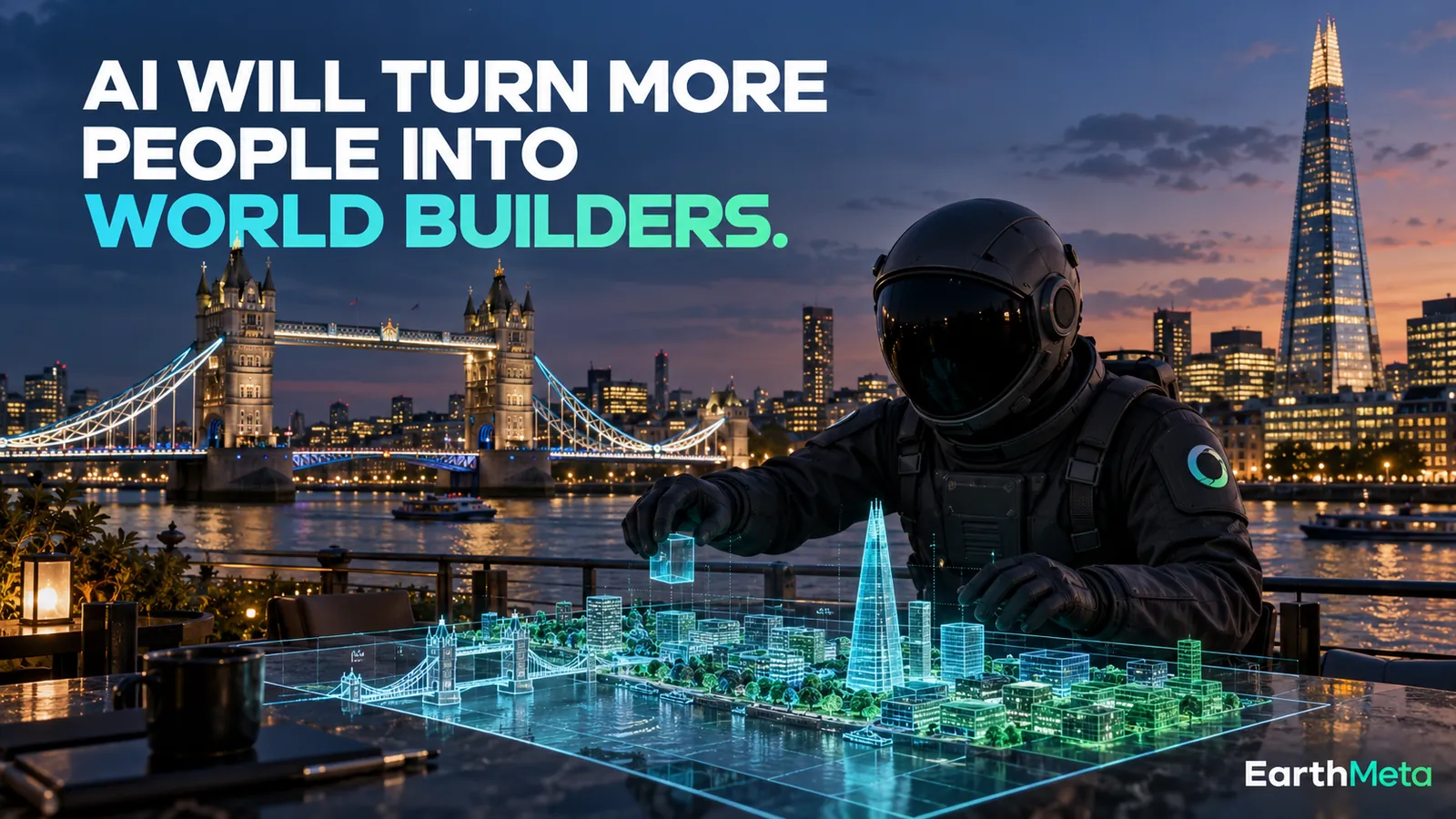
The key change is not a magical new headset. It is an enormous drop in the cost of making interactive worlds. Text, sketches, photos, scans and geographic data become starting points for usable 3D scenes. AI agents help with code, lighting, physics, dialogue, testing, moderation, translation and live operations.
Creation moves from specialist teams toward millions of mixed-skill makers.
The mechanism behind the upside
Every media market expands when the cost of production and distribution falls. Desktop publishing increased the supply of documents. Digital cameras increased the supply of images. Social video tools turned phones into studios. The result was not uniformly excellent content—humanity has survived several billion shaky clips—but it created new businesses and new forms of expression.
Spatial media can experience a similar shift.
Roblox’s 2026 disclosures offer an early signal. The company said more than 60,000 3D assets were being generated daily by creators and nearly 1,400 games used Cube-generated content on an average day. It also said the ten largest games accounted for about 20% of engagement hours, down from 30% three years earlier, while hours outside the top ten grew 25% year over year. That long-tail growth matters. A creator economy is healthier when discovery is not limited to a handful of giants.
+63% in a single year
Hours outside the top ten +25% year over year
Source: Roblox, Global Impact of Creation (September 2026), company-reported figures.
Roblox also introduced mobile-first creation from a text prompt and described an end-to-end agentic creation system that coordinates code, visual assets, interfaces and gameplay systems. These are company-reported developments, not guarantees that every generated game will find an audience. They nevertheless show the direction of travel.
What changes if creation becomes dramatically cheaper
Local culture gains a path into 3D. A small museum, neighbourhood group or independent artist can construct an experience without hiring a large studio. Translation and AI-assisted localisation can make it accessible across languages.
Worlds become more responsive. Experiences can change with seasons, events, player behaviour or real-world data. A static parcel becomes a service that is continually programmed.
Personalisation becomes practical. A learner can explore a version of a city designed for a specific history lesson. A brand can adapt a showroom to a visitor’s interests. A player can generate a quest that fits a group’s skill level.
Live operations become the main craft. When creation is cheap, attention is expensive. Successful teams must understand retention, community, safety, economic balance and recurring programming.
Professional standards rise, not fall. AI can produce a first draft. It cannot automatically supply an original point of view, cultural sensitivity, coherent world logic or a reason to return. The best creators use automation to spend more time on those higher-order choices.
Milestones that would confirm the upside case
- Median time from idea to playable prototype falls from weeks to days or hours.
- Small creator teams produce a growing share of top-retention experiences.
- AI-generated assets have clear provenance and rights controls.
- Cross-language communities expand without a proportional rise in moderation failures.
- Creator payouts grow faster than gross audience time, showing that value reaches supply.
- Businesses and cities publish reusable spatial data with stable permissions.
- Users build and share experiences from phones rather than only professional desktops.
The upside case does not mean infinite demand. It means vastly more experiments. Most will remain small. A few will create new genres. That is how creative markets usually work.
Scenario 3: Fragmentation slows the category
This is the downside case, and it deserves equal attention.
The metaverse could remain a collection of walled gardens that demand too much effort from users and too much trust from creators. AI could flood discovery systems with low-quality worlds. Hardware could remain expensive or socially awkward. Regulators could face legitimate concerns about children, biometrics, manipulation, intellectual property and financial promotion. Virtual assets could lose credibility if speculation repeatedly outruns utility.
In this scenario, the technology does not disappear. It grows in narrower pockets.
The main friction points
Discovery collapses under abundance. If anyone can generate a world in minutes, a catalogue of ten million worlds is not automatically better than a catalogue of ten thousand. Ranking systems, curation and reputation become crucial. Without them, good creators struggle to be found.
Safety costs rise. Real-time 3D spaces combine voice, movement, user-generated content, commerce and social identity. Moderation must operate across all of them. A system that can generate an environment must also help inspect it.
Ownership remains confusing. Users may technically own a token while the experience it references depends on a company server, a licence or a mutable file. Clear rights matter more than the word “ownership.”
Interoperability stops at marketing. Platforms may support export only for selected formats, block rival identities or make portability too awkward for ordinary users.
The device gap persists. Premium immersive hardware can improve without becoming an everyday consumer device. Battery life, comfort, price and social context all matter.
Projects are retired. Microsoft’s planned retirement of Teams immersive events in April 2027 is a useful reminder that individual products are not the same as the category. Meta reported substantial ongoing Reality Labs spending alongside losses in Q2 2026. Large spending can advance hardware and research, but it does not guarantee a specific product-market fit.
Milestones that would confirm the downside case
- User acquisition costs rise while repeat participation falls.
- Creator income concentrates even as content supply explodes.
- Major platforms reduce spatial features or close products without migration paths.
- Safety incidents grow faster than enforcement capacity.
- Regulation remains fragmented across jurisdictions, blocking cross-border launches.
- Asset bridges and export tools exist but see little ordinary use.
- Virtual land activity depends mainly on speculation rather than visits, creation or services.
The downside is not “the metaverse dies.” It is that the most ambitious consumer vision remains delayed while gaming and enterprise niches continue independently.
A timeline of milestones worth watching
Dates in technology forecasts often create false precision. The following table uses time windows and evidence tests instead.
| Window | Plausible development | Evidence to watch | What would challenge it |
|---|---|---|---|
| 2027 | AI co-creation becomes a default feature in major world-building tools. | Share of active creators using AI; prototype time; generated assets that reach publication. | High generation use but no improvement in retention or creator earnings. |
| 2027–2028 | Mobile and browser remain the main discovery layer; headsets deepen selected experiences. | Entry-device mix, session conversion, cross-device retention. | Experiences become locked to costly hardware with limited repeat use. |
| 2027–2029 | Digital twins spread in manufacturing, logistics, energy and urban planning. | Reported cost, safety and planning outcomes; repeat deployments beyond pilots. | Many demonstrations but few production renewals. |
| 2028–2030 | Identity and selected entitlements become more portable across compatible ecosystems. | Active cross-platform sign-ins, asset transfers and standard adoption. | Portability remains a rarely used export button. |
| 2028–2030 | Creator businesses specialise around events, education, commerce, design and community management. | Revenue mix beyond primary asset sales; recurring contracts; payout distribution. | Income stays concentrated in speculation or a few top games. |
| Beyond 2030 | Spatial interfaces feel ordinary in specific contexts. | Repeat use without “metaverse” marketing; lower hardware friction; public standards. | Consumers reject ambient capture or devices remain cumbersome. |
The purpose of this timeline is accountability. If the milestones do not appear, the scenario should change. A forecast that cannot be falsified is a mood board.
Tick the milestones you see, and watch which future the evidence supports
Nine milestones from the three scenarios above. Select every one you have seen confirmed.
The six engines that could drive the next phase
1. AI lowers the cost of world creation
The first growth engine is supply.
Traditional 3D production requires modelling, animation, scripting, sound, user-interface design, optimisation and testing. Each specialty adds time. AI does not remove the need for these disciplines, but it can change the starting point. A creator can move from blank canvas to editable prototype much faster.
The immediate benefit is not perfect automation. It is iteration. More prototypes can be tested with real users before a team commits serious resources. Bad ideas can fail cheaply. Promising ones can earn more time and attention.
This mechanism also benefits EarthMeta. A world based on real geography contains a vast number of places that can host useful experiences. EarthMeta’s AI builder helps owners and creators construct, test and revise those experiences, so the map becomes more than an inventory. It becomes a creative surface.
The risk is sameness. If creators rely on identical prompts and models, worlds may feel like cousins wearing different hats. Platforms that combine AI speed with distinctive local data, community knowledge and human art direction will have an advantage.
2. Gaming teaches the market how to return
The second engine is habit.
Games have solved many problems that metaverse presentations merely describe. They know how to onboard users, build social groups, create goals, stage events, sell cosmetic identity and refresh content. Their most important lesson is simple: people return for activity, not architecture.
A beautiful empty plaza is still empty.
Roblox’s 29 billion hours engaged in Q2 2026 show the scale of participation possible when content, identity and community reinforce each other. Epic reported that creators had published more than 80,000 islands through UEFN and received more than $320 million in engagement payouts during the programme’s first year. These figures measure specific platforms, not the entire metaverse market. They are nevertheless evidence that creator-led virtual spaces can generate both attention and income.
For EarthMeta, the gaming lesson is not to copy a battle royale. It is to give cities rhythms: missions, guided discoveries, seasonal programmes, creator challenges, social status and useful rewards. Geography supplies the stage. Live operations create the pulse.
3. Creator economies turn worlds into businesses
The third engine is economic participation.
Creators invest time when they can reach audiences, build reputation and earn. A healthy economy offers more than a lottery ticket. It supports different roles: designer, guide, educator, event producer, developer, local researcher, community host, merchant and curator.
Roblox said more than 42,000 creators participated in its DevEx programme and that the median participant earned approximately $1,500 in the twelve months to 30 June 2026. The median is important because headline payouts can hide concentration. A platform should watch the distribution of earnings, the number of creators who progress from first revenue to sustainable work, and the cost of acquiring an audience.
Creator economies also need sinks and services. If value only circulates through primary sales of scarce land, activity can become cyclical. If owners pay creators for design, users pay for events, brands sponsor programmes and communities fund improvements, the economy gains multiple engines.
4. Digital twins connect virtual worlds to outcomes
The fourth engine is utility.
A digital twin is a virtual representation of a physical object, process or place that can be updated with relevant data. The definition ranges from a simple model to a complex operational simulation. The important part is the connection to a real system.
Industrial twins can help teams plan factories, test layouts, train workers and identify problems before changing equipment. Urban twins can support planning, mobility, resilience and public communication. A shopper may never call these systems metaverse products, but the technical family resemblance is clear: shared 3D space, persistent state, real-time data and collaboration.
The BMW example projects 30% savings from optimised factory planning. That is a case-study projection rather than a universal result. It shows the standard enterprise buyers will apply: What becomes faster, safer, cheaper or more understandable?
EarthMeta’s use of recognisable geography makes this engine especially relevant. A city-based environment hosts cultural interpretation, tourism previews, education and locally anchored brand experiences. Richer real-world data widens that range further, with permissions, privacy and accuracy built into the design.
5. Mobile and AR widen access
The fifth engine is distribution.
Immersive headsets are powerful because they can create presence. They are also objects that must be purchased, charged, worn and accepted in a social setting. Phones and browsers have the opposite profile: less immersion, enormous reach.
The likely path is not one device defeating the others. It is a ladder. A user discovers an experience on a social feed, opens it on a phone, returns on a laptop or console, and chooses a headset for moments where depth matters. Lightweight AR can place selected information over the physical world without asking the user to leave it.
This matters for city-based platforms. The same virtual landmark can function as a desktop exploration, a mobile collection point, an AR overlay at the physical site or a high-presence gathering. Designing for a ladder produces more entry points than designing for a single door.
6. Ownership and standards create continuity
The sixth engine is trust.
Users care about continuity: keeping an identity, proving creation, retaining access and understanding what they can transfer. Blockchains can provide public records and programmable ownership where that architecture is useful. Open standards can help describe scenes, avatars, commerce and spatial data.
Neither automatically creates interoperability. Standards require implementation. Tokens require usable rights. Bridges require security. The future depends less on announcing openness than on measuring whether people can complete ordinary tasks across systems.
EarthMeta’s Ethereum-based ownership model provides a foundation for verifiable property and transactions. Its usefulness grows when ownership connects to clear creative permissions, usable tools, transparent economics and experiences that attract visitors. Ownership is the beginning of a relationship, not the end of a product roadmap.
Turn a real place into a creative surface
Describe a structure and EarthMeta’s AI builds it, directly on a digital twin of the real planet.
Why people will participate—and what they will spend on
People rarely spend because a market analyst says a category has a high compound annual growth rate. They spend when a product improves status, expression, convenience, belonging, achievement or access.
Identity and self-expression
Avatars, clothing, spaces and collections help people signal who they are. Digital identity is particularly powerful when friends recognise it and when achievements carry history. The spending driver is not the polygon count of a hat. It is the social meaning attached to wearing it.
Belonging and shared memory
Concerts, games, clubs and community events create stories. A virtual item linked to a memorable event can carry more meaning than an interchangeable object. Participation grows when a world makes it easy to gather, coordinate and revisit moments.
Creation and reputation
People will pay for tools, assets, promotion, education and services that help them make better work or reach an audience. They may also commit time to a place because it builds a portfolio or reputation.
Convenience and understanding
A 3D product demonstration can answer a question faster than a manual. A digital twin can help a team understand a factory. A virtual visit can help a traveller plan. Utility spending is often less glamorous but more repeatable.
Scarcity and ownership
Scarcity can support meaning when it is credible and tied to use, identity or history. Artificial scarcity without demand is simply a small number attached to a quiet object. Healthy platforms make ownership legible: what the buyer controls, what they may build, which fees apply and how the asset can be transferred.
Opportunity for creators and hosts
Creators, hosts and service providers participate when there is a plausible path to customers. The relevant questions are operational: How many creators earn from their work? From which activities? What does it cost to produce and promote? How stable is demand?
Virtual real estate in the next phase
Virtual real estate is likely to become less convincing as a static collectible and more convincing as programmable space.
That change mirrors physical property. A real building matters because of location, but its operation, access, design, tenants and surrounding activity shape what it offers. In virtual environments, programming matters even more because visitors can teleport. Proximity may influence discovery and meaning, but it does not create footfall by gravity alone.
Four sources of future virtual-property utility
Something people want to do
The place hosts something people want to do.
A signal of taste
The place signals taste, affiliation or achievement.
A workshop
Creators use it to build, test or distribute content.
A place for exchange
It supports transactions, services, sponsorship or paid access.
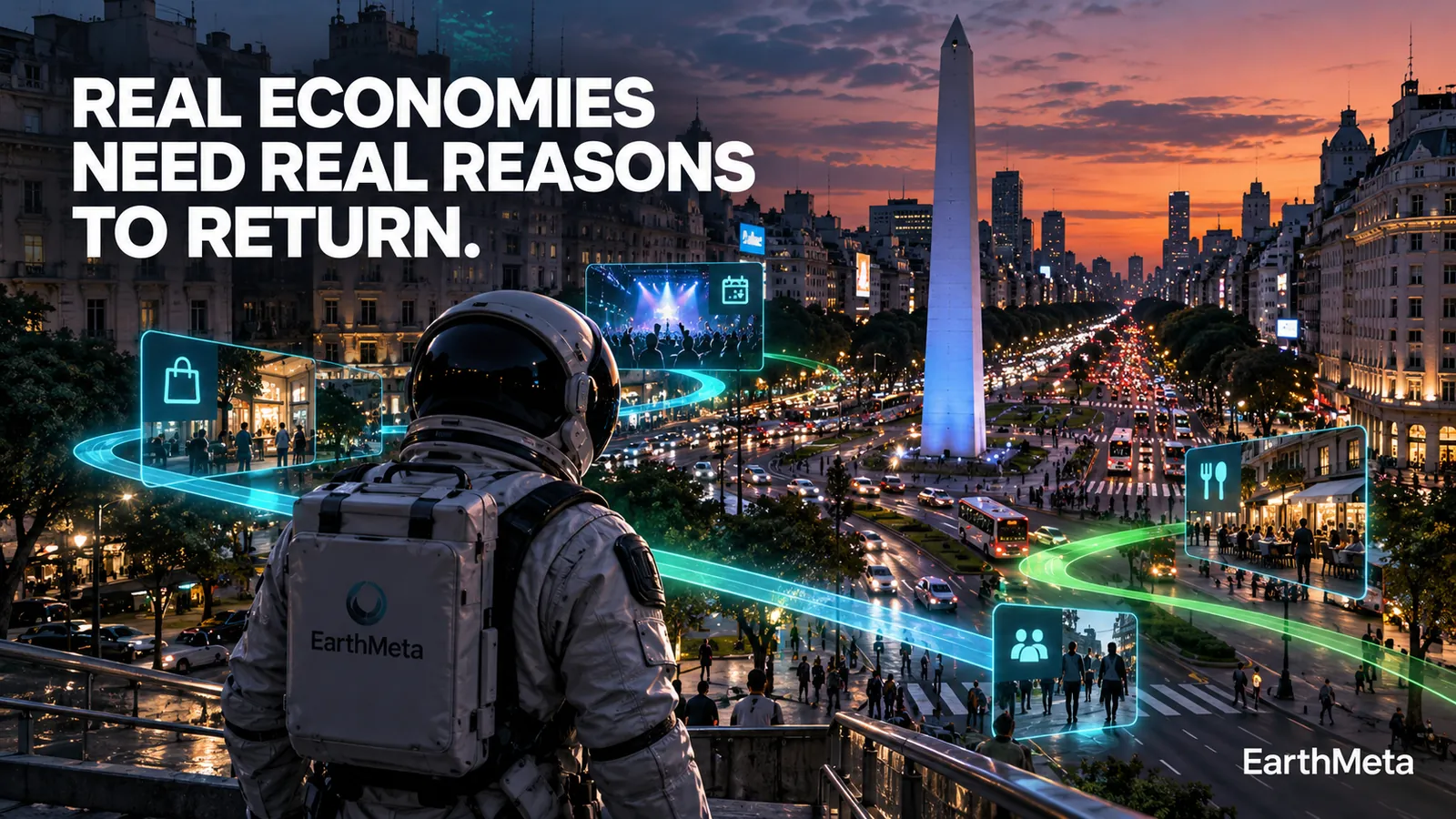
EarthMeta adds a fifth: geographic meaning. A digital location based on Rome, Tokyo, Lagos or Buenos Aires arrives with associations that an invented coordinate does not. That shortens the storytelling distance between a visitor and a space and gives creators richer raw material.
For owners, the practical question is therefore not about the next listing price. It is “What can happen here, who is it for, and why would they return?” That question produces better design and a healthier market.
What probably will not happen
Good forecasting includes exclusions. Several popular ideas are possible in narrow forms but unlikely to define the whole market.
One company will not own the entire metaverse
Different platforms have different audiences, economics and rules. Competition, regulation and culture all work against a single total world. The internet analogy remains useful: common protocols can connect diverse services without collapsing them into one product.
Headsets will not be the only interface
Some experiences are much better in VR. Many are not. A quick marketplace visit, map check or creator edit may be easier on a phone. The future will reward continuity across devices.
Every object will not work everywhere
A universal visual file is easier than a universal functional object. A chair can be displayed across engines; whether users can sit on it, trade it, modify it or use it as a racing vehicle depends on local rules. Interoperability will be selective.
AI will not remove the need for creators
AI can make output abundant. It cannot make attention abundant. Human creators provide intention, taste, accountability and community leadership. Their role shifts from producing every component manually toward directing systems and sustaining worlds.
Tokenisation will not rescue weak experiences
Ownership can strengthen a good product. It cannot substitute for one. If nobody wants to visit, create, compete, learn or transact, a token only makes the absence transferable.
Growth will not be a straight line
The history of platforms contains launches, pivots, failed formats and long periods of unglamorous improvement. Product retirements are normal. The relevant question is whether capabilities and useful behaviour continue to compound.
What Roblox, The Sandbox and Amazon teach about timing
Large ecosystems are often described as if they appeared fully formed. They did not.
- Amazon
Begins as an online bookstore.
- Roblox
Founded; public release follows in 2006.
- The Sandbox
From mobile games to a blockchain-based creator world.
- EarthMeta
Project founded.
- EarthMeta
Public launch in October.
- EarthMeta · next
An early chapter, not a final examination.
Roblox was founded in 2004 and released publicly in 2006. Its modern scale reflects years of work on creation tools, safety, infrastructure, virtual currency, discovery and developer economics. The lesson is not that every platform will reproduce Roblox’s outcome. It is that a creator ecosystem requires compounding capabilities and trust.
The Sandbox also evolved across phases: from mobile games to a blockchain-based creator world with tools, land, assets, partnerships and recurring seasons. Its history shows that ownership alone is insufficient. Creators need software, audiences, events and distribution. The mix keeps changing as the market learns.
Amazon offers a broader analogy. It began as an online bookstore in 1995, then layered logistics, marketplace services, devices, advertising and cloud infrastructure over many years. Early observers could see “books on a website.” They could not assume the exact shape of AWS or the marketplace. Platforms reveal their strongest economics through iteration.
EarthMeta’s public roadmap dates its public launch to October 2024. That makes 2027 an early chapter, not a final examination. The correct benchmark is not whether every long-term feature exists immediately. It is whether the platform improves the loop between ownership, creation, discovery, participation and return.
Historical analogies do not guarantee a similar result. They establish a reasonable expectation about time: ecosystems are built through repeated releases and behavioural learning, not one dazzling announcement.
Where EarthMeta fits
EarthMeta has a distinct starting proposition: a metaverse organised around a digital twin of Earth and more than 250,000 real cities. That structure makes the future of spatial computing easier to understand because users begin with known geography rather than an empty fictional grid.
As the official EarthMeta overview sets out, the project was founded in 2020 and launched publicly in 2024. Its roadmap places the public launch in October 2024 and lays out the next stages across construction tools, AI assistance, mobile and augmented-reality experiences. AI building generation is live today; mobile and AR experiences are the next roadmap stages.
EarthMeta’s live strategic strengths
Real cities, instant context
A user understands why Cairo, Paris or Seoul is culturally distinct before a creator places the first object.
On-chain and transferable
Blockchain records make city and asset ownership transparent and transferable under the platform’s rules and smart contracts.
250,000+ cities
Niche communities and local creators work with places that global platforms often ignore.
One world map
A common organising principle across culture, tourism, education, gaming and commerce.
Every trade in a territory generates tax collected
Every EarthMeta city has a Governor, and the Governor receives 1% of every trade in their city. Every country has a President, and the President receives 0.5% of every transaction across the whole country. One person can hold both roles and collect 1.5% on their own city.
These percentages apply to every asset traded in the territory, whether the Governor or President owns it or not. The math is simple: $100,000 traded in a city = $1,000 tax collected by its Governor. That is why active territory, not mapped territory, is what matters to the people who hold these roles.
Watch activity in a territory turn into tax collected
Pick a role, or both: one person can be Governor and President.
The future-facing opportunities
EarthMeta’s AI building tools reduce the gap between acquiring a place and making it useful. An owner describes a structure and AI builds it, translating an idea into a first experience, while templates and agents support iteration. The advantage comes from combining generation with geographic context, rights clarity and visitor discovery.
Mobile and AR build a bridge between a virtual city and the physical place. A visitor discovers a digital experience on a phone, explores it remotely, then encounters an optional layer while travelling. These modes are the next stages on EarthMeta’s roadmap.
Creator services turn ownership into a collaborative market. Not every city owner will be a modeller, developer, historian, guide and event producer. A strong platform lets specialists work together and makes their roles visible.
How the three scenarios affect EarthMeta
In the practical base case
EarthMeta benefits by presenting itself as useful spatial infrastructure rather than requiring users to buy into a grand theory. Clear entry from browser and mobile, simple city exploration, accessible building tools and recurring events become more important than technological spectacle.
The best product measure is not total mapped territory. It is active territory: cities with creators, visitors and repeat programmes.
In the AI upside case
EarthMeta’s geographic canvas becomes a strong differentiator. AI generates initial layouts, quests, tours or educational scenes, while the real-world location supplies constraints and narrative. A creator building in Kyoto should not receive the same visual and cultural defaults as one building in Buenos Aires.
The platform’s role in this future is clear: visible provenance, local reference packs and rewards for creators whose experiences retain visitors rather than merely producing large volumes of content.
In the fragmented downside case
EarthMeta’s resilience comes from not depending on any single access device, content format or speculative demand cycle. Web-accessible discovery, transparent ownership rules, export options and modular tools create that resilience.
The geographic concept also gives the platform a durable identity even if the word “metaverse” falls out of fashion. People will still understand interactive maps, virtual cities, digital ownership and AI-assisted creation.
A fit-specific roadmap for sustainable growth
The following principles connect market mechanisms to EarthMeta’s particular model.
1. Measure activation after ownership
Track the path from acquiring a city or asset to publishing a first usable experience. Useful metrics include time to first build, percentage of owners who publish, first visitor, first repeat visitor and first creator collaboration.
A marketplace can look busy while the world remains quiet. Activation metrics expose the difference.
2. Design AI around outcomes
An AI builder should help users complete jobs: create a guided tour, stage an event, add an educational quest, open a branded experience or prototype a game. Outcome templates are more useful than a blank prompt alone.
Measure how much faster users publish and whether AI-assisted worlds retain visitors. Generation count by itself is a vanity metric.
3. Make geographic authenticity an advantage
Offer creators reliable references for landmarks, local history and cultural context. Encourage collaboration with local communities and experts. Use moderation and review to reduce careless stereotypes.
Real geography creates emotional resonance, but it also creates responsibility. Respect is part of product quality.
4. Build the return loop
Cities need calendars, not only coordinates. Recurring tours, seasons, competitions, creator drops and community programmes give visitors a reason to come back. Notifications should be useful and permission-based.
Track seven-day and thirty-day return rates by city and activity type. A single spectacular launch is less valuable than a modest experience that builds a reliable audience.
5. Support a services economy
Make it easy to find and hire builders, artists, event producers, educators and community managers. Provide portfolios, clear scopes and reputation signals. Encourage revenue from work performed.
Services distribute economic opportunity and help owners who lack production skills.
6. Be precise about live and planned features
Confidence grows when product language matches reality. Live tools should be demonstrated. Roadmap features should be dated and labelled. Delays should be explained without theatrics.
This discipline is especially important in a market where overstatement has damaged trust.
7. Prepare for selective interoperability
Prioritise realistic forms: standard media formats, identity connections, wallet compatibility, provenance and chosen asset categories. Document what travels and what does not.
Interoperability should solve a user task. It does not need to begin with a universal treaty between every dragon, forklift and pair of digital trainers.
A decision framework for builders, brands and buyers
The future of the metaverse will not reward every project equally. A simple six-question test can improve decisions.
1. What job does the experience perform?
“It is immersive” is a property, not a job. The job may be entertainment, learning, rehearsal, social coordination, design review, tourism or commerce.
2. Why is 3D better?
Spatial interfaces help when layout, presence, movement or simulation matters. If a form and two photographs solve the problem faster, use the form.
3. Why will people return?
Look for evolving content, relationships, progress, service or recurring events. Novelty decays quickly.
4. Who creates the supply?
Identify the people, tools, incentives and review processes needed to keep the world alive. A launch team is not a permanent creator economy.
5. What does ownership actually include?
Read the licence, smart contract and platform rules. Separate the token, media, access rights, commercial rights and dependency on hosted services.
6. Which metric would prove value?
Choose a behavioural or operational measure: return visits, task completion, creator revenue, planning time, conversion, learning outcome or avoided cost. Price alone does not reveal product value.
Is your metaverse project ready for 2027?
Answer the six questions above for your own idea. Under a minute.
Pick a real place to make useful
Explore EarthMeta’s real-city map and build your first experience with AI.
The metaverse metrics that will matter most
Market size is useful for context, but operators need leading indicators.
| Layer | Strong metric | Weak substitute |
|---|---|---|
| Audience | Monthly and weekly retained participants | Registered accounts |
| Engagement | Meaningful repeat sessions by activity | Total time without context |
| Creation | Published experiences that reach a retention threshold | Assets generated |
| Economy | Creator earnings distribution and recurring service revenue | Gross marketplace volume alone |
| Property | Share of locations with active programming | Number of parcels minted |
| AI | Time saved and quality/retention lift | Prompts submitted |
| Interoperability | Successful cross-platform tasks | Number of announced partnerships |
| Enterprise | Verified cost, time, quality or safety outcome | Pilots launched |
| Trust | Safety rate, resolution time and rights clarity | Marketing references to openness |
These measures favour compounding systems. They also make it harder to hide an empty world behind a large inventory.
Risks the industry must solve
Spatial platforms must moderate voice, text, gestures, user-generated geometry, commerce and behaviour. Children and vulnerable users require stronger protections. AI can assist detection, but human governance and appeal remain essential.
Immersive devices can collect movement, gaze, voice and environmental data. These signals may be highly sensitive. Platforms need data minimisation, clear consent, secure storage and controls that ordinary people can understand.
AI-generated worlds can reproduce styles, brands or protected material. Creator tools need provenance, licensed training approaches, rights controls and practical dispute processes.
Poorly designed incentives can reward speculation, bot activity or extraction. Sustainable economies connect rewards to creation, service and genuine participation.
Spatial interfaces can create barriers for people with visual, auditory, motor or cognitive differences. Captions, alternative navigation, adjustable motion, screen-compatible flows and non-headset access should be designed from the beginning.
AI training, real-time rendering and blockchains consume energy. Efficiency matters. Teams should select architectures based on the task and report material impacts honestly.
These are not reasons to stop building. They are requirements for building something adults can trust.
The strongest interpretation of 2027
By 2027, the most important change may be conceptual.
The market will spend less time asking whether the metaverse is one product category and more time evaluating spatial systems on their own merits. Games will be judged by fun and community. Digital twins will be judged by operational results. Creator platforms will be judged by who can build and earn. Virtual real estate will be judged by what happens on it. AI tools will be judged by the quality they help people publish.
That is healthy.
The category suffered when every 3D experience was forced into the same story. Its future improves when different experiences can succeed for different reasons while sharing useful infrastructure.
For EarthMeta, this means the real-world map is not merely a visual hook. It is an organising system for creation, community and ownership. The opportunity is to make each layer reinforce the next:
- Discovery
Familiar geography helps discovery.
- Stake
Ownership gives users a durable stake.
- Activation
AI and creator tools reduce the work of activation.
- Visits
Events and experiences create reasons to visit.
- Quality
A services economy helps quality scale.
- Physical link
Mobile and AR reconnect the virtual map with physical places.
The loop is more important than any single feature.
Frequently asked questions about the future of the metaverse
What is the future of the metaverse?
The most plausible future is a collection of specialised spatial experiences rather than one universal world. Gaming, creator platforms, digital twins, virtual commerce, education and city-based environments will evolve at different speeds. AI will make creation faster, while mobile, browser, headset and AR access will serve different moments.
Will the metaverse still exist in 2030?
The capabilities almost certainly will, although the label may be used less often. Persistent 3D spaces, avatars, digital twins, virtual goods and spatial collaboration already exist. The open question is how widely they connect and which products achieve repeat use.
Is the metaverse dead?
No. The speculative narrative cooled, and some products have been retired, but major gaming platforms, industrial digital-twin programmes, creator economies and spatial hardware continue to develop. The market is becoming more selective about utility and retention.
Will AI build the metaverse?
AI will help build it by generating assets, code, dialogue, layouts and tests. Human creators will still define purpose, taste, cultural context, governance and community. AI lowers production friction; it does not automatically create demand.
Will everyone need a VR headset?
No. Headsets offer powerful presence, but phones, browsers, consoles and computers provide broader access. Many successful spatial products will use several devices, with headsets reserved for experiences where immersion adds clear value.
What will people buy in the future metaverse?
Likely categories include identity items, access, tools, services, entertainment, learning, virtual property and products linked to communities or events. Spending will be strongest where an item carries social meaning, utility or provenance.
Is virtual real estate likely to matter?
Yes, where space is programmable and attracts activity. Location can aid discovery and storytelling, especially when it reflects real geography. Ownership alone does not create value; creators, experiences, services and repeat visitors do.
Will metaverse assets work across every platform?
Probably not. Selected identities, media, credentials and assets may move across compatible systems. Full functional portability is harder because platforms use different physics, economies, licences and visual rules.
How will businesses use the metaverse?
Businesses are likely to use spatial systems for design review, simulation, training, collaboration, retail, events and customer education. Digital twins may grow fastest where teams can measure saved time, avoided errors or improved safety.
What could slow metaverse growth?
High device friction, weak retention, poor safety, confusing ownership, rights disputes, fragmented regulation and content overload could all slow adoption. Platforms also need sustainable creator economics rather than dependence on speculation.
What makes EarthMeta different?
EarthMeta organises its world around more than 250,000 real cities and uses blockchain-based ownership on Ethereum. Familiar geography supports culture, tourism, education, games and localised creator experiences while giving the platform a coherent global map, and its live AI building generation turns a written description into a 3D structure.
How do Governors and Presidents fit into EarthMeta?
Every EarthMeta city has a Governor who receives 1% of every trade in that city, and every country has a President who receives 0.5% of every transaction across the whole country. One person can hold both roles and collect 1.5% on their own city. The tax applies to every asset traded in the territory, owned or not: $100,000 traded in a city = $1,000 tax collected by its Governor.
What should EarthMeta owners do now?
Owners focus on activation: define an audience, choose a useful experience, collaborate with creators, plan recurring programming and measure return visits. AI building generation is live today, so a first structure takes a written description; mobile and AR experiences are the next stages on the roadmap.
Verdict: the future will be built in useful pieces
The future of the metaverse is neither a guaranteed trillion-dollar straight line nor a vanished fad. It is a difficult platform transition unfolding across games, AI, digital twins, creator tools, ownership systems and new interfaces.
The base case is practical: spatial capabilities spread while the label becomes quieter. The upside case is creative: AI enables far more people to build and operate worlds. The downside case is fragmented: trust, discovery, hardware and interoperability slow the broader vision.
All three can exist at once in different sectors.
The winners will give people a reason to return. They will make creation easier without confusing abundance with quality. They will explain ownership clearly, measure real outcomes and treat safety as infrastructure. They will also accept that ecosystem building takes years.
EarthMeta enters that future with a legible advantage: it starts from the planet people already know. Its task is to turn familiar geography into active places—places that creators can shape, communities can inhabit and visitors can experience across devices. By strengthening the loop between real-world meaning, verifiable ownership, accessible creation and recurring activity, EarthMeta occupies a distinctive position in the next phase of spatial computing.
Explore EarthMeta’s real-city map, study the live tools and choose a place you can make useful. The strongest virtual property story begins with what happens there next.
Sources and methodology
Source date: 21 October 2026. Third-party figures are company-reported results or case-study projections, attributed to the organisation that published them; they measure specific platforms, not the whole metaverse market. Scenarios are structured possibilities, not predictions. Governor and President amounts shown are examples: the tax collected depends on the trading activity in their city or country.
- EarthMeta — About
- EarthMeta — Roadmap
- EarthMeta — AI
- Roblox Q2 2026 shareholder letter, filed with the SEC
- Roblox — Global Impact of Creation, 3 September 2026
- Roblox — Build Without Limits, July 2026
- Roblox — How Roblox Evaluates Build, October 2026
- Epic Games — State of Unreal and UEFN creator payouts
- Microsoft Support — Teams immersive events retirement
- ITU — Global Initiative on Virtual Worlds and AI
- ITU-T Y.4239 — digital-twin integration reference model
- NVIDIA — BMW Group FactoryExplorer case study
- NVIDIA — Siemens industrial AI operating system, January 2026