Owning a City? Interesting. Bringing It to Life? Fascinating!
Imagine visiting Rome, strolling through a digital art gallery, and meeting people from around the world. Then heading to Luxembourg to explore a virtual business district or discover an exhibition.
All without leaving your desk.
What sounded like science fiction just a few years ago is becoming increasingly possible thanks to artificial intelligence, blockchain, and immersive 3D technologies.
And that's exactly where EarthMeta gets interesting.
The platform combines real-world geography with digital ownership and a growing technological infrastructure. Its approach is refreshingly simple: Why invent an entirely fictional world when our planet already offers millions of fascinating places?
From world-famous metropolises to small towns, Earth itself becomes the digital canvas.
But a map alone doesn't make a metaverse.
When Digital Land Starts Telling Stories.
For years, much of the metaverse conversation revolved around one question: Who owns which piece of virtual land?
An exciting question for traders and collectors. For everyday visitors? Not so much.
Because let's face it: Nobody takes a virtual trip around the world just to stare at empty plots of land.
People want experiences.
They want to explore, discover, play, learn, and connect.
That's why EarthMeta's technological progress matters.
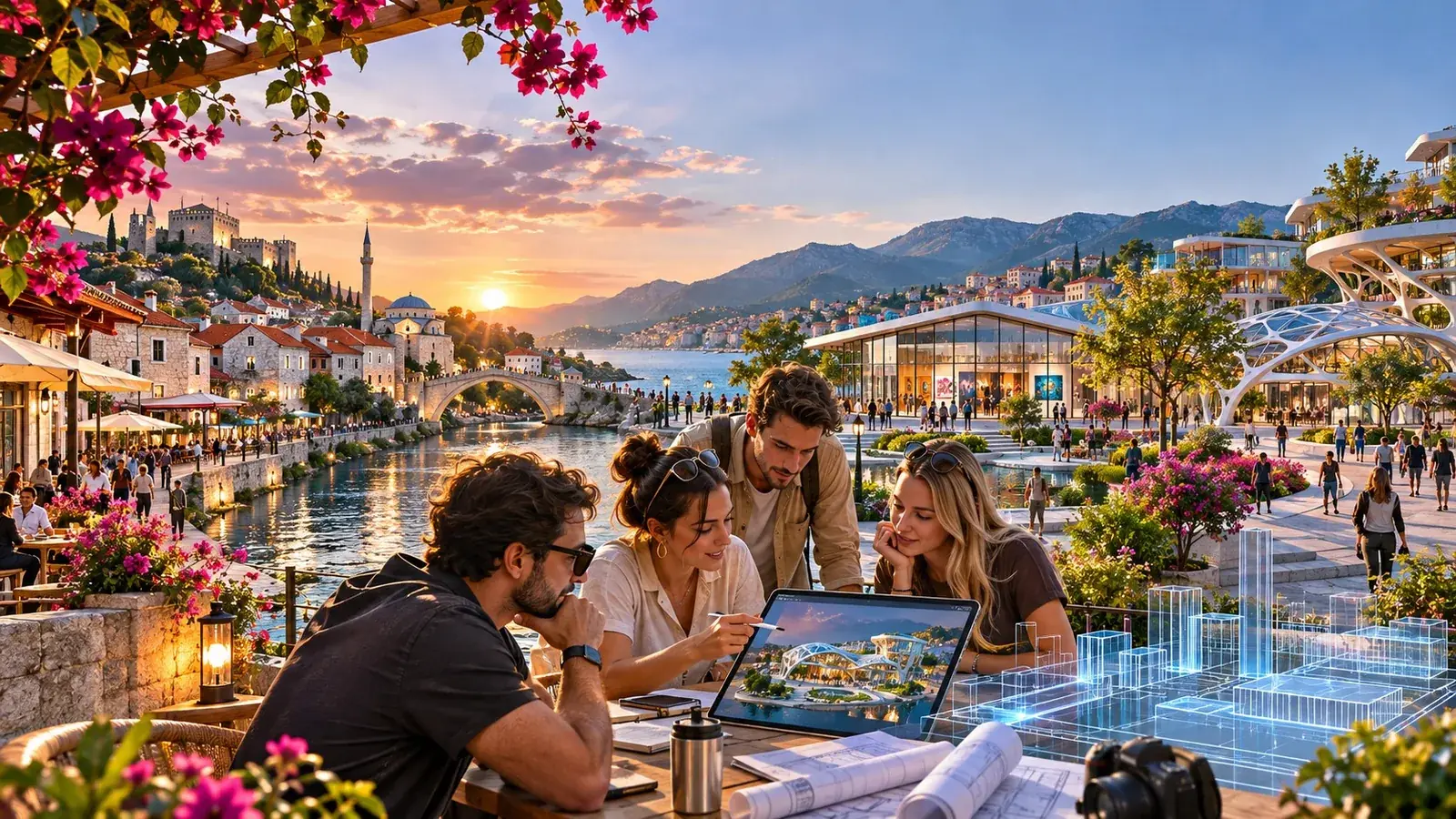
With its AI-powered 3D Builder, users can create their own digital objects and buildings. The introduction of 3D Walking Mode opens new possibilities for exploring virtual environments.
Avatars, interactive features, and the continued development of immersive technologies are helping transform static locations into increasingly engaging digital spaces.
A virtual city could become far more than a tradable digital asset.
It could become a stage for creativity.
And suddenly, the most important question changes:
Artificial Intelligence Is Changing the Rules.
Not long ago, building virtual 3D worlds required specialists, expensive software, and plenty of patience.
Today, a simple description can sometimes be enough to get started.
A Renaissance-style art gallery? A futuristic visitor center? A digital museum?
AI-powered tools are increasingly capable of turning these ideas into three-dimensional models.
What would people experience in your city?
Pick a city, a place and a style. You get a one-line idea, ready to paste into the AI 3D Builder.
Of course, not everything works perfectly yet. Even artificial intelligence occasionally needs a reminder that a house should probably have a roof.
But that's part of what makes this evolution so exciting: Technology is becoming more accessible.
As more people gain the ability to create digital spaces, their role begins to change.
- 01Creators.Spectators become creators.
- 02Projects.Ideas become projects.
- 03Experiences.A digital map evolves into a world of experiences.
One Platform, a Thousand Possibilities.
One particularly interesting development is EarthMeta's White-Label technology.
It allows independent initiatives to establish their own digital brand experiences using EarthMeta's technological foundation.
That's an important distinction from many traditional virtual worlds.
Not every project needs to build its own technical infrastructure from scratch. Instead, different ideas, cities, and communities can grow on a shared foundation.
International city networks such as VALVOR™ are also exploring ways to connect different digital locations.
The real strength of this approach lies in its diversity.
EarthMeta builds the infrastructure. The community brings the ideas.
And the more interesting experiences people create, the more reasons there are to visit the digital world.
Got an idea that brings a city to life?
Find your place on EarthMeta, open the AI 3D Builder and give visitors a reason to come.
The Real Revolution Starts With People.
The history of the internet teaches us something remarkable.
The biggest transformations rarely happened because of technology alone.
They happened when people started using that technology in creative ways.
Websites evolved into social networks. Mobile phones became powerful digital companions. Artificial intelligence is now reshaping how we interact with information and creativity.
Why should the metaverse be any different?
EarthMeta brings together several technologies with the potential to reinforce one another: blockchain, artificial intelligence, real-world geography, and immersive digital experiences.
Whether this becomes a successful long-term ecosystem, however, will depend on more than technological progress.
What really matters is whether people discover genuine value.
That's also why EarthMeta's new official blog is an important step forward.
It's a place where city owners, developers, and creative minds can share their ideas, exchange experiences, and inspire others.
Because a thriving community isn't created simply by people owning assets on the same platform.
It's created when they start building something together.
Questions & Answers.
What is EarthMeta?
EarthMeta is a metaverse built on real-world geography. It combines the map of Earth with digital ownership, so cities from world-famous metropolises to small towns become a digital canvas.
What makes a virtual city feel alive?
Experiences. People want to explore, discover, play, learn and connect, not stare at empty plots. Buildings, avatars, interactive features and things to do turn a static location into a place worth visiting.
How can I create buildings on EarthMeta?
With the AI-powered 3D Builder, a simple description can be enough to get started: describe the gallery, visitor center or museum you want and the tool turns it into a 3D model.
What is 3D Walking Mode?
3D Walking Mode lets visitors explore EarthMeta's virtual environments on foot with their avatar, instead of only viewing places from a map.
What is EarthMeta's White-Label technology?
It lets independent initiatives run their own digital brand experiences on EarthMeta's technological foundation, so artists, communities and businesses can build without creating infrastructure from scratch.
Quick Quiz: Is Your City Alive Yet?
Quick check: is your city alive yet?
Five small questions on what you just read. Get one wrong and you will see why, plus the right answer. Your grade comes at the end.
The Future Hasn't Been Built Yet.
Perhaps one day we'll visit digital cities as naturally as we browse websites today.
Maybe we'll meet friends in virtual cafés, attend international exhibitions, or discover different cultures through interactive experiences.
Perhaps entirely new applications will emerge that nobody has even imagined yet.
No one can predict exactly how the metaverse will evolve.
But one thing is clear: The most exciting chapters of our digital future won't be written by programmers alone.
They'll also be shaped by artists, entrepreneurs, visionaries, and communities willing to explore new possibilities.
EarthMeta is increasingly providing the tools to make that possible.
What happens next is also in the hands of its community.
Because the future of the metaverse doesn't begin with owning a digital city.
It begins with an idea that brings that city to life.
A community contribution by VALVOR™ Global City Network.
Infrastructure Before Influence.