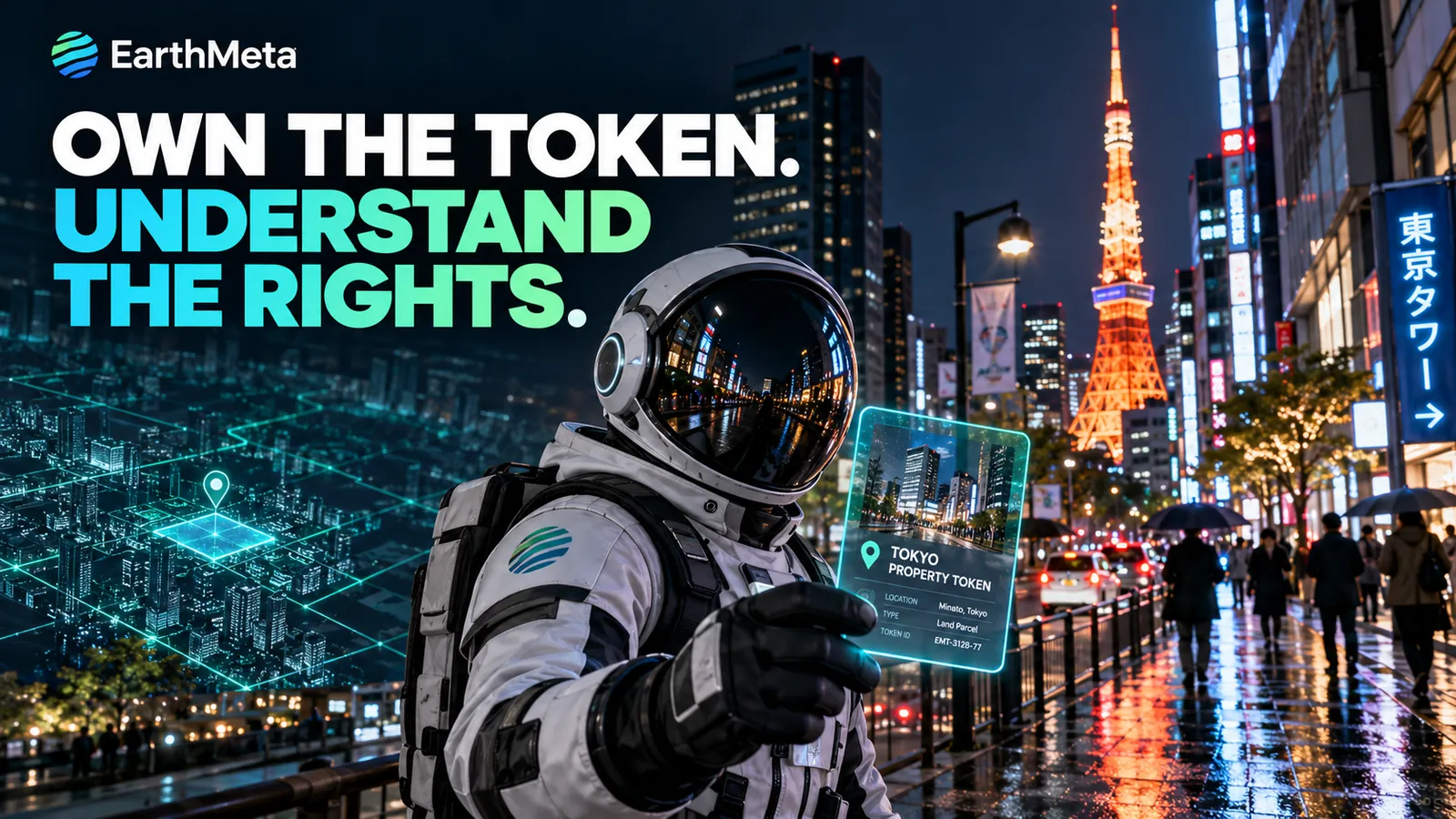
The phrase “own land on the blockchain” sounds wonderfully tidy.
Buy parcel. Receive token. Become digital landlord. Perhaps lean back in a virtual deckchair. The machinery underneath is less tidy, and far more interesting.
A blockchain does not contain a tiny garden, tower or shopping district. It records that a particular wallet controls a particular token. The virtual-world platform then maps that token to coordinates, boundaries, permissions and content. A marketplace helps the owner transfer it. Servers deliver the 3D scene. Terms explain what “ownership” allows. Community activity decides whether the location becomes useful.
So blockchain virtual land ownership is not one thing. It is a stack.
This guide takes that stack apart, follows a parcel through its full lifecycle and shows where control really sits. It explains smart contracts, metadata, wallets, publishing permissions, sales, rentals, platform dependencies, AI creation, gaming and EarthMeta’s city-to-land model in plain English.
The goal is not to make the technology sound magical. The goal is to make it understandable enough that the magic tricks stop working.
The short answer: how does blockchain virtual land ownership work?
Blockchain-based virtual land ownership works by representing a defined digital location as a non-fungible token, usually through a standard such as ERC-721. A smart contract records which wallet owns the token. The platform links its token ID to a parcel, estate, city or boundary on the world map and checks the wallet before allowing actions such as publishing a scene, dividing land, listing it for sale or assigning permissions.
A complete land system normally contains six connected elements:
A blockchain contract
Records the token owner and transfer rules.
A wallet
Signs transactions and proves control of the owner address.
A parcel registry or map
Links a token ID to coordinates or boundaries.
Metadata and content storage
Describes the asset and serves its 3D files.
Platform permissions
Determine what the holder can build, publish or delegate.
Terms and governance
Define rights, restrictions, upgrades and dispute processes.
The blockchain makes the ownership record independently readable. It does not render the world, host every model, guarantee legal property rights or force another platform to accept the land.
The ownership stack at a glance
| Layer | What it answers | Typical controller |
|---|---|---|
| Token contract | Which wallet currently owns token #123? | Smart contract and its governance/admin structure |
| Map registry | Which location does token #123 represent? | Protocol contract, metadata or platform database |
| Wallet | Who can sign transfers and approvals? | Person or organization holding the private keys |
| Permissions | Who can publish, build, rent or manage? | Owner plus delegated operators under platform rules |
| Content | Which scene, building and files appear there? | Owner/creator and the platform’s content system |
| Marketplace | How is the land listed and transferred? | Seller, marketplace contracts and payment flow |
| Legal terms | Which usage, IP and commercial rights apply? | Platform terms, creator licences and applicable law |
| Activity | Does anyone visit, build or spend there? | Owners, creators, users and the wider ecosystem |
Confusing these layers creates most virtual-land misunderstandings.
Market context: how large is blockchain virtual land?
There is no authoritative global total for blockchain virtual land. Reports often combine land NFT trades, metaverse tokens, gaming assets, conventional virtual goods, software, hardware and advertising. Those numbers can be useful, but they are not interchangeable.
The safest market view starts with observable platform facts.
LANDs on a fixed map, documented by the platform
city NFTs minted on-chain as of 21 October 2026
quarterly revenue reported, up 36% year over year
The Sandbox documents a fixed map of 166,464 LANDs, with parcels and larger Estates used to publish experiences. Decentraland maintains LAND and Estate contracts on Ethereum and uses its map, content network and marketplace around them. EarthMeta has 1,560 city NFTs minted on-chain as of 21 October 2026, and its Governors create more granular land parcels within those cities.
Conventional virtual economies provide another scale indicator. Roblox reported $1.5 billion of quarterly revenue in Q2 2026, up 36% year over year, in its official shareholder letter. That is not virtual-land or NFT revenue. It demonstrates something more fundamental: people already spend heavily on digital identity, entertainment and creator-made experiences.
Blockchain land is a specialised part of this larger virtual-goods market. Its growth depends less on producing more tokens and more on making existing locations useful.
Measures that should not be mixed
- Land trading volume measures completed transactions during a period. It can change sharply with incentive programmes and wider market moods.
- Platform revenue measures amounts recognized by the company or protocol under its accounting rules.
- Economic activity can include creator sales, event tickets, advertising, rentals, services and purchases inside experiences.
A virtual world can have impressive headline numbers and sleepy land. It can also have active creators and visitors without spectacular land prices.
For ownership analysis, useful metrics include unique active landowners, parcels with deployed content, repeat visitors, completed sales, median time to sell, creator income, event attendance and the percentage of owners who perform a useful action after acquisition.
Step 1: the platform defines a map and scarcity model
Before minting a land token, the world must define what can be owned.
Some platforms divide a fictional map into equal squares. Some allow neighbouring parcels to form estates. Others attach ownership to named worlds. EarthMeta starts with real-world geography: cities, land areas and buildings connected to recognizable locations.
The scarcity model matters because it determines the units of ownership. Questions include:
- Is the total map fixed?
- Can new regions be added?
- Can parcels be divided or merged?
- Are boundaries stored on-chain or in platform data?
- Can two assets overlap?
- What happens when a city owner creates smaller parcels?
- Does a parcel include vertical space or only a surface footprint?
There is no universally correct map design. A fixed grid makes the count of parcels simple. Flexible boundaries can better reflect real geography. The system should make changes visible and prevent conflicting claims.
Scarcity is a rule, not a source of demand
A platform can make only ten parcels. That makes them scarce. It does not make them useful.
Demand comes from what owners and visitors can do: build, gather, play, show work, run events, govern, trade, create services or express identity. Scarcity can organize a market around that activity. It cannot replace the activity.
Step 2: a smart contract creates the land token
Most blockchain land uses a non-fungible token because each parcel is distinct. Ethereum’s ERC-721 standard defines a common interface for unique tokens.
The key functions are conceptually simple:
| Function | What it does |
|---|---|
| ownerOf(tokenId) | Returns the wallet address that owns a token. |
| balanceOf(address) | Returns how many tokens an address owns in that collection. |
| approve | Can let another address transfer one token. |
| setApprovalForAll | Can authorize an operator across an owner’s collection. |
| safeTransferFrom | Transfers ownership while checking that a receiving contract can handle the NFT. |
| Transfer events | Create a public history of ownership changes. |
This shared interface is why wallets and marketplaces can support many collections. They do not need a completely new integration for every land project.
Contract address plus token ID equals identity
“Parcel #123” is not enough. Another person can deploy a different collection with its own parcel #123. The reliable identity is the combination of the blockchain network, the smart-contract address and the token ID.
Names and images can be copied. The contract address is the anchor.
Minting creates the token record
Minting assigns a new token ID to a wallet. The transaction emits an on-chain event and updates the contract’s ownership state.
The buyer may receive a newly minted token directly, or purchase an existing token from another owner. In both cases, the world later asks the same question: which address does the contract report as owner?
Step 3: the wallet holds the authority to act
The wallet does not contain a miniature file of the parcel. The smart contract records an address as owner; the wallet controls the key used to authorize that address.
This creates a different account model from a normal game.
In a conventional platform, the company can usually reset a password and restore account access. In self-custody, losing the key can mean losing the ability to move the land. If someone steals the key or tricks the owner into approving a malicious contract, the blockchain may faithfully process the attacker’s transaction.
The technology can be transparent and still punish a careless click.
Ownership and operation can be separated
A landowner should not always use the high-value ownership wallet for everyday publishing. Platforms can let owners delegate limited permissions to another address:
- a studio can deploy a scene;
- a community manager can update details;
- a tenant can operate the experience;
- a contractor can build without receiving the land token;
- a cold wallet can retain ownership while a safer operational wallet handles routine work.
Decentraland’s LAND Manager lets owners grant editing permissions without transferring ownership. Its publishing tools recognize both owners and addresses that have been given deploy permission.
This is a crucial sign of a mature land system. “Give the developer the private key” is not a workflow. It is the opening scene of a support ticket.
Step 4: token ID connects to coordinates and metadata
The blockchain ownership record needs a bridge to the map. That bridge may be implemented in several ways.
Coordinates in a contract
A land contract can map token IDs to grid coordinates. The platform reads the contract and places the owner’s parcel at the corresponding location.
Boundaries as polygons
Irregular parcels require polygons or other boundary descriptions, stored in contract data, metadata or a platform database that is cryptographically referenced.
Metadata through a token URI
ERC-721 defines an optional tokenURI function. It can point to a JSON document with the parcel name, image, attributes or links. Metadata can be immutable, owner-editable or platform-controlled.
Platform-side map records
Some information remains off-chain for speed and flexibility. Complex 3D worlds need responsive databases, search indexes, analytics and rendering systems.
Off-chain data is not automatically a weakness. Buyers should know which model applies, and the important questions are:
- Can the token-to-location relationship be verified?
- Who can alter it?
- Are changes logged?
- What happens if two data sources disagree?
- Can an owner export the relevant record?
Step 5: ownership becomes a permission
A land token becomes useful when the platform responds to it.
The user connects a wallet. The platform asks the contract who owns the token. If the connected address is the owner, or an approved operator, the interface unlocks relevant actions. These may include:
- uploading a scene;
- assigning a name or description;
- creating sub-parcels;
- linking a building;
- adding collaborators;
- listing the land;
- configuring access;
- joining governance;
- receiving platform-defined economic rights.
The token does not contain those buttons. The platform recognizes the token and supplies them.
Contract + map + permission: the practical ownership formula
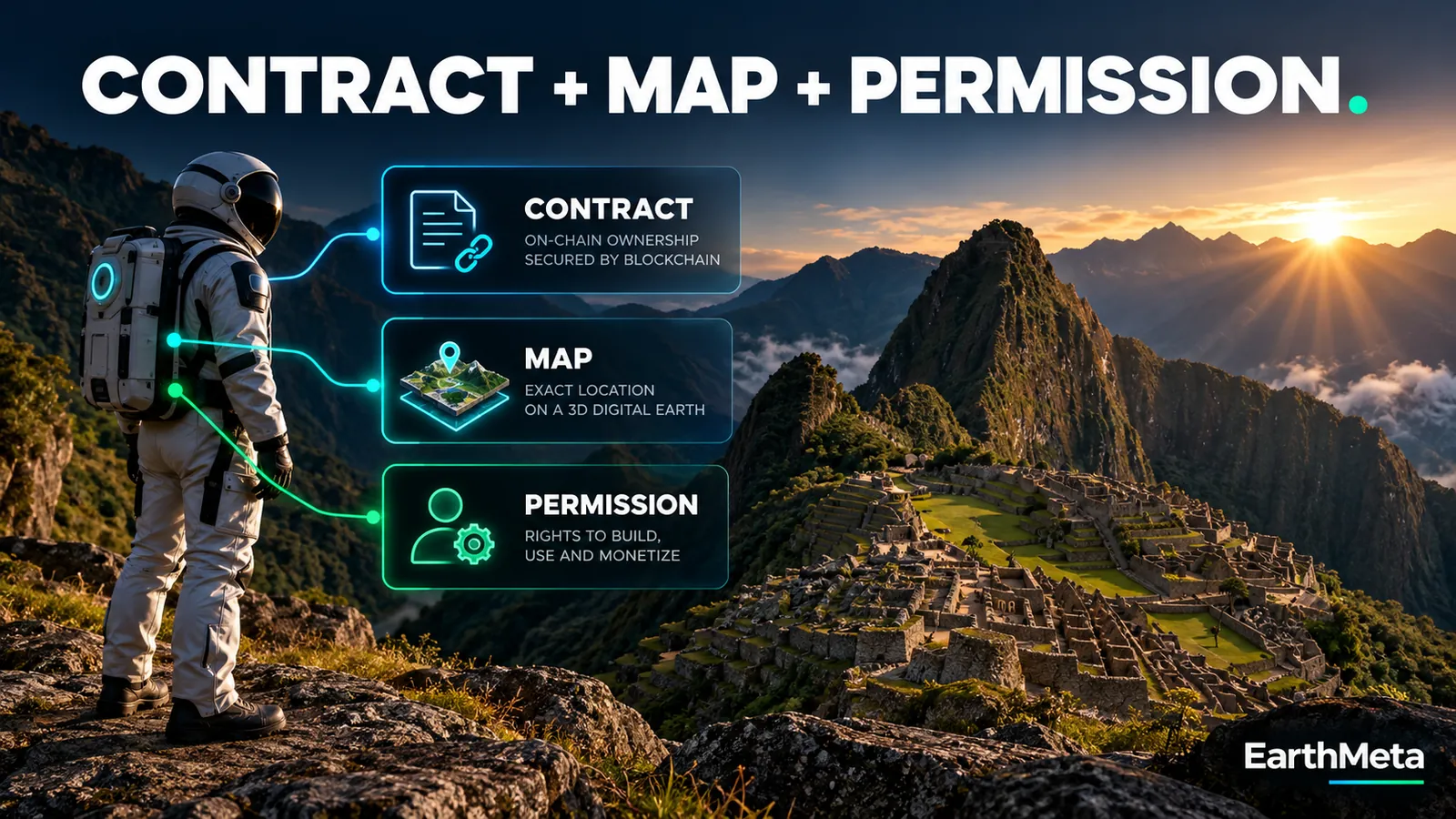
Blockchain land works when three records agree.
Says who
The contract identifies the owner address.
Says where
The parcel registry maps the token to a coordinate, estate or city boundary.
Say what
The application decides which owner and operator actions are allowed.
If any layer breaks, ownership becomes confusing. A correct token with the wrong map pointer can display the wrong parcel. A correct map without permission checks can let an unauthorized address deploy. Correct permissions with inaccessible content can unlock an empty scene.
Switch off a layer and see what breaks
All four layers start healthy. Tap one to break it.
Good platforms monitor all three layers and explain them to users.
Step 6: content is published to the land
The land token is not usually the 3D experience.
A scene may contain models, textures, animations, sound, interaction code and configuration files. Storing all of that directly in an Ethereum contract would be expensive and impractical.
Instead, the owner or operator signs a publishing request. The content is uploaded to a server or distributed storage system. The platform then associates the latest valid scene with the parcel.
Decentraland’s publishing documentation describes a network of content servers using content-addressed files. Scene deployments are signed, and the LAND record can point toward current content.
This creates a useful division:
Ownership and authorization
Large files and fast delivery
Rendering and interaction
Who owns the building or experience?
Land ownership and content ownership can be separate. A studio might create a game for a landowner. A tenant might publish an event experience. A brand may commission a building but licence the models from an agency.
The contract can prove who owns the land token. It does not automatically settle copyright in every texture and script on the parcel. Agreements should specify:
- who owns the source files;
- who may publish them;
- whether the landowner can keep using them after the contract ends;
- whether the creator can reuse components;
- what happens after a land sale;
- which licences the platform receives.
Step 7: owners can delegate access without selling
Delegation is the difference between an ownership system and a one-person hobby.
A serious property may involve designers, developers, community moderators, analysts and event organizers. They need permissions, not the owner’s recovery phrase. Permission models can include:
| Permission | What it allows |
|---|---|
| Deploy permission | Publish or replace the scene |
| Operator permission | Manage listings, rentals or platform settings |
| Content permission | Edit descriptions, media or links |
| Access administration | Manage guests or token-gated areas |
| Analytics access | View traffic and conversion data |
| Financial roles | Receive revenue or pay project costs |
Permissions should follow least-privilege design: give collaborators only what they need, make the duration clear and allow revocation.
On-chain permissions provide public verification but cost transaction fees and may be slower to change. Off-chain permissions are faster but depend more heavily on the platform. Hybrid designs use each where it fits.
Step 8: marketplaces list and transfer the land
A marketplace needs to confirm four basic facts:
- Existence
The token exists.
- Authority
The seller owns it or has permission.
- Validity
The listing is still valid.
- Settlement
The buyer will receive the token if payment settles.
The owner usually signs a listing or approval. A marketplace contract completes the transfer when a buyer accepts the terms.
Listings are not sales
An owner can list land at any price. That price says what the seller wants, not what the market has paid. Completed transactions, recent comparable assets and time on market are more useful than heroic asking prices.
Approvals deserve attention
Approving a marketplace contract is necessary in many flows. But setApprovalForAll can let an operator move every token in a collection held by the wallet. Users should verify the domain, contract and scope before signing. Platforms should make the consequences visible in normal language.
How many parcels could this signature move?
Set the parcels held in the wallet, then pick what you are being asked to sign.
Payments and ownership transfer may be separate steps
Depending on the system, a transaction may exchange the NFT and payment atomically in one contract call. Other flows involve off-chain orders, currency conversion or platform settlement. The buyer should understand:
- purchase currency;
- network fees;
- marketplace fee;
- creator or protocol royalty where applicable;
- currency-conversion cost;
- what the seller receives;
- when the ownership transfer becomes final.
Step 9: the new owner takes control
After a sale, the contract reports the buyer’s wallet as owner. The platform should refresh its index, dashboard and map permissions. This handover raises practical questions.
Does the scene stay?
The platform may continue displaying existing content, remove it, or require the new owner to republish. The underlying creator licence may restrict continued use.
Do delegated permissions stay?
Permissions may reset on transfer or remain until revoked. A buyer should review operators immediately.
Do names, descriptions and links stay?
Metadata may travel with the parcel. A new owner may be able to update it. Platforms should prevent old owners from retaining hidden control.
Do revenue settings stay?
Payment splits, rental arrangements and event contracts need explicit transfer logic. The land token changing wallets does not automatically rewrite every external agreement.
A safe acquisition checklist belongs inside the product, not just in a blog post.
Step 10: parcels can be merged, divided or bundled
Virtual land is more flexible than physical surveying, until the smart contracts get involved.
The Sandbox describes Estates as groups of LAND NFTs merged into larger parcels. Decentraland Estates are ERC-721 tokens containing multiple LAND parcels, and the Estate’s fingerprint changes when parcels are added or removed. These designs allow larger experiences while preserving underlying parcel logic.
Subdivision creates the opposite challenge. A city or estate owner may define smaller units and mint new tokens. The system must ensure:
- sub-parcels fit inside the parent boundary;
- they do not overlap;
- changes to the number of parcels are transparent;
- parent and child rights are clear;
- the parent owner cannot quietly revoke sold rights;
- map and marketplace data remain synchronized.
EarthMeta’s model is especially relevant because Governors delimit land inside their city. This creates accessible ownership layers, and it makes boundary integrity and parent-child rules central to trust.
Rentals: use without transferring ownership
Renting virtual land requires a separation between owner and operator.
A secure system lets the owner retain the NFT while a tenant receives time-limited rights to publish or operate. The rental agreement may combine off-chain signatures with on-chain contract actions.
Decentraland’s rental documentation uses operator permissions so a tenant can deploy to LAND while the owner remains owner. The permission must be reclaimed or changed when the rental ends.
Rentals create useful flexibility:
Can launch without buying land.
Can activate unused parcels.
Can run temporary events.
Can test locations before committing.
They also create risk. Users should confirm who owns the experience, who receives revenue, what happens to content at the end and whether the tenant can sublet or change settings.
Ownership does not eliminate platform dependency
This is where honest explanations matter. The blockchain can preserve the token record even if the original interface disappears. But the land’s rich utility may depend on:
- the map client;
- content servers;
- rendering engine;
- discovery system;
- marketplace index;
- moderation;
- account and wallet integration;
- governance decisions;
- continued developer maintenance.
If the world closes, the token may remain visible in a wallet while the interactive property becomes inaccessible.
That does not make blockchain ownership fake. It defines its scope.
The token provides a durable, independently readable control record. The platform provides the living environment. Strong projects make both layers resilient and document the dependency.
Who can change the rules?
“Decentralized” is not a complete governance description. Land buyers should ask:
- Who controls contract upgrades?
- Can transfers be paused?
- Can metadata endpoints change?
- Who can alter the map?
- Can new land be created?
- Who manages content servers?
- Which decisions require a community vote?
- Can a moderation decision block an experience while leaving the token untouched?
Decentraland’s documentation says its DAO controls the LAND and Estate smart contracts, with specified governance processes around changes. The client also uses a hybrid architecture combining blockchain ownership, distributed content and centralized services for performance.
That is a useful example because it avoids the fantasy that one technology handles everything.
Comparing three virtual-land ownership models
| Platform | Ownership unit | Blockchain role | What activates utility | Important dependency |
|---|---|---|---|---|
| Decentraland | LAND parcels and Estates | Ethereum/EVM contracts record ownership | Owner or delegated address publishes scenes and manages permissions | Client, Catalyst content network, marketplace and DAO governance |
| The Sandbox | LAND parcels and Estates | ERC-721 LAND on Ethereum/Polygon-related flows | LAND supports map publishing, experiences and ecosystem tools | Game client, Game Maker, content systems and publishing rules |
| EarthMeta | City NFTs, land parcels and buildings | Ethereum records ownership | City ownership unlocks Governor tools; parcels and buildings connect geography, creation and marketplace activity | EarthMeta app, mapping, marketplace, AI builder and evolving ecosystem functions |
This is not a ranking. Each system makes different trade-offs around geography, creation, content and governance.
Why people buy blockchain virtual land
To build
The clearest reason is to publish a persistent experience. The land becomes a container for a game, gallery, community room, event venue, learning space, store or experiment.
To belong
A location can become a social anchor. Neighbourhoods and cities give communities a recognizable place to return to.
To express identity
Some owners enjoy curating a space the way people decorate a room, website or profile. The experience becomes public self-expression.
To participate in governance
Land or city ownership can connect to proposals, voting, boundaries or community roles. Buyers should check the actual scope of those powers.
To run a business or campaign
Brands and creators may use land for events, product discovery, sponsorships or community programmes. Results depend on audience fit and experience quality, not possession alone.
To trade
Some participants buy and sell parcels as marketplace activity. That brings fees and timing into the picture. A blockchain can make transfer possible without guaranteeing a future buyer.
To develop a larger ecosystem
Studios may assemble multiple parcels, create experiences and coordinate local creators. The opportunity is closer to product development than passive property holding.
Why land prices rise and fall
Virtual land does not have one universal valuation model. Prices can react to:
Active users, visitor traffic and creator activity.
New features, fees and development costs.
Surrounding experiences, map discovery and location visibility.
Size and configuration.
Partnership announcements and social attention.
Platform risk and execution.
Thin markets also create misleading signals. One unusual sale can shift a headline average. Median prices, matched parcel attributes and transaction frequency provide better context.
Growth mechanisms: how useful land creates an ecosystem
The build loop
Accessible tools help owners publish. More published experiences give visitors reasons to explore. Visitor feedback motivates improvements. Better content attracts more builders.
The neighbourhood loop
One strong experience can attract attention to nearby parcels. Neighbours coordinate events or shared themes. The district becomes easier to discover. New creators want to join.
The marketplace loop
Clear ownership and safe transfers increase confidence. More credible participants improve price discovery. Better price information helps buyers make decisions. This loop needs safeguards against wash trading and fake collections.
The creator-income loop
Visitors buy tickets, items or services. Creators earn enough to improve the experience. Higher quality produces more repeat visits. Revenue is conditional on demand. The loop cannot be funded forever by issuing new rewards to the next participant.
The governance loop
Owners propose improvements. Useful decisions increase activity. More activity attracts contributors. Contributors bring better proposals and local knowledge.
Governance works when participation changes the product, not when voting is theatre with nicer buttons.
AI can reduce the cost of turning ownership into experience
Owning land is easy compared with building something worth visiting.
Traditional 3D development requires modelling, texturing, lighting, interaction design and optimization. AI tools can accelerate ideation, generate building concepts, create variations and help non-specialists move from prompt to draft.
That matters because unused land is an ecosystem problem. If only professional studios can publish, most owners remain spectators.
EarthMeta’s AI building tools shorten the path from ownership to creation:
- Prove
The wallet proves control of a city, parcel or relevant asset.
- Describe
The owner describes a building or environment.
- Generate
AI generates or assists with a draft.
- Check
The platform checks performance, safety and rights.
- Publish
The owner publishes, tests and improves it.
AI does not remove the need for taste. A technically generated building can still be a beige rectangle with confidence issues. Curation and iteration remain decisive.
Turn a parcel into a building
Describe a structure and let EarthMeta’s AI build it, directly on a real-world location.
Gaming mechanics can make land easier to discover
Virtual land benefits from movement and goals.
Games can create routes across the map, reward exploration and turn quiet locations into destinations. Owners can host competitions, quests, races, exhibitions and seasonal events.
For EarthMeta, real geography provides a natural framework:
A landmark trail.
A night exploration event.
An architecture challenge.
A history quest.
A Governor-led city contest.
Collectible stamps for visiting different countries.
The gaming layer should direct attention toward the world’s creators and places. It should not force every landowner to become a game studio.
Own the token, build the experience
A land NFT is an authorization primitive. It can tell the platform, “this wallet controls this location.” The interesting work begins after that sentence.
The owner needs tools, collaborators, content, distribution, measurement and support. Visitors need a reason to arrive and return. Creators need a route to income. The platform needs security and moderation.
This is why mature virtual worlds separate land acquisition from development.
A practical development sequence
Define the audience and purpose.
Confirm the parcel’s live permissions and limits.
Set a production budget and timeline.
Choose creators and assign safe operational access.
Prototype the smallest useful experience.
Test performance on normal devices.
Publish with accurate descriptions and links.
Plan discovery through events, partners and platform tools.
Measure visits, engagement and actions.
Improve what visitors actually use.
Buying the parcel first and inventing a purpose later can work. It can also produce the metaverse equivalent of an empty retail unit with a very enthusiastic brochure.
Security checks for blockchain landowners
Verify the official contract
Use the project’s current official site and trusted block explorer. Do not rely on a contract pasted into an unsolicited message.
Separate ownership and operating wallets
Keep high-value land in a more secure wallet. Delegate publishing where the platform supports it.
Read every approval
Confirm whether a signature is a login, listing, single-token approval or collection-wide operator approval.
Review operators after purchase
A new owner should inspect delegated addresses, rental permissions and marketplace approvals.
Protect the recovery phrase
No legitimate support agent needs it. Anyone asking is not helping, even if their profile picture has a very convincing checkmark.
Confirm the parcel on the platform map
Match the token, coordinates, boundary and dashboard record before paying.
Test small where possible
Use cautious transactions and known marketplaces. A successful tiny test is cheaper than a dramatic blockchain education.
Would you spot the trap?
Four real situations from the checklist above. Pick the safe move.
Check a real parcel
Open the EarthMeta app and match contract, token ID and map location.
A due-diligence table for buyers
| Check | Strong evidence | Warning sign |
|---|---|---|
| Asset identity | Official contract, token ID and map location agree | Copied image or collection name without contract verification |
| Ownership | Explorer and platform show the same wallet | Dashboard claim cannot be confirmed on-chain |
| Land creation rules | Fixed or clearly governed creation rules | New land can appear without a transparent process |
| Utility | Live building, publishing, access or governance functions | Only future promises and resale language |
| Metadata | Update rules and storage are documented | Unknown hosting or unexplained changes |
| Permissions | Delegation and revocation are clear | Collaborators require the owner’s private key |
| Marketplace | Completed sales, fees and settlement are visible | Only high listing prices or unofficial payment requests |
| Content rights | Creator and land rights are separated in terms | Buyer is told “you own everything” without a licence |
| Sales history | Recent comparable sales and multiple participants | One unusual sale presented as the market |
| Security | Official links, warnings and support guidance | Recovery phrase requests or rushed approvals |
EarthMeta’s city-to-land ownership model
EarthMeta approaches virtual property from the top down.
EarthMeta was founded in 2020 and officially launched in 2024 after four years of building. Its public platform launch and initial city NFT phase date to October 2024, as set out in the roadmap.
The parent layer
A unique Ethereum NFT tied to a real location. Its owner is the Governor.
The ownership unit
Drawn by the Governor inside the city and sold or rented as an NFT.
The creation layer
A unique NFT asset, generated with EarthMeta’s AI tools.
City ownership creates the parent layer
Each city is represented as a unique NFT connected to a real location. City NFTs live on Ethereum, and the Governor is the owner of a city NFT.
The city is not merely a large parcel. It connects ownership, mapping, a Governor role and a local economic layer.
Governors create land parcels
Governors draw boundaries within their cities, create land parcels and sell or rent them as NFTs on the marketplace.
This hierarchy expands participation. A user does not need to acquire an entire city to engage with a smaller location.
It also makes transparent parent-child rules essential. Buyers should be able to verify that a parcel sits inside the relevant city, that boundaries do not overlap and that the Governor cannot silently erase a sold right.
Governors and Presidents collect a tax on every trade
Every EarthMeta city has a Governor, and the Governor receives 1% of every trade in their city. Every country has a President, and the President receives 0.5% of every transaction across the whole country. One person can hold both roles and collect 1.5% on their own city.
These percentages apply to every asset traded in the territory, whether the Governor or President owns it or not: every parcel the Governor creates and sells, every resale between other owners, every building. $100,000 of parcels traded in a city = $1,000 tax collected by its Governor.
Parcel trading in a city, turned into tax collected
Pick a role, or both. The tax applies to every asset traded in the territory.
Buildings add a creation layer
Buildings are unique NFT assets, connected to AI building generation. This creates a three-part chain:
- land identifies the location;
- a building identifies a created asset;
- the experience turns both into something visitors can use.
Ethereum is the ownership network
EarthMeta runs on Ethereum. Historical Polygon material does not describe current ownership flows.
This is why source dates matter. Blockchain products migrate, contracts evolve and user interfaces change.
Live features and roadmap, clearly separated
EarthMeta’s live platform includes Ethereum city ownership, the marketplace, Governor and President roles, land delimitation, building NFTs, AI-assisted creation, avatars, cars, AR experiences and the Marketing Hub.
Broader interoperability, VR expansion and other roadmap items are labelled as roadmap until their full user flows are live. Clear status language strengthens confidence. Ownership is easier to trust when users know what they can do today.
See how cities, parcels and buildings connect
Open a real city in EarthMeta and inspect its owner, parcels and buildings.
How blockchain ownership benefits EarthMeta
Verifiable geographic roles
The platform checks the wallet and assigns Governor tools to the current city owner without relying only on a private account flag.
Safer marketplace handovers
When a city or parcel changes wallets, the ownership record updates in a way explorers and marketplaces can inspect.
Creator collaboration
Owners work with builders while retaining the asset, which supports studios, local communities and temporary activations.
Reusable identity
The same wallet holds cities, parcels, buildings, avatars and other assets, and the platform builds a coherent profile around those holdings.
Transparent activity history
On-chain transfers provide provenance. Off-chain analytics add visits, building status and event performance without pretending every metric belongs on-chain.
Better AI workflows
Ownership checks connect directly to creation tools: select an owned location, generate a concept, publish to an authorized parcel, then measure engagement.
Seven principles for a trustworthy land layer
1. Put the ownership stack on every asset page
Show network, contract, token ID, parent city, boundary, owner, operator permissions, metadata status and live utility.
2. Make parcel provenance visual
Let buyers trace a parcel back to its city and Governor, with boundary history and creation transaction.
3. Separate owner, builder and tenant roles
Provide time-limited, revocable permissions. Never make collaboration depend on key sharing.
4. Add a post-purchase activation path
After acquisition, guide the owner to verify the parcel, set permissions, create or upload a building, publish a description and plan a first event.
5. Measure developed-land activity
Track active parcels, published buildings, repeat visitors, events and creator income, not only mint and trade counts.
6. Explain every transaction before signature
Use plain language: “This lets the marketplace transfer this parcel,” or “This transfers ownership to the buyer.”
7. Keep future features visibly labelled
Use Live, Testing, Launching Soon and Roadmap consistently across site, app and documentation.
What a buyer can verify before relying on the platform interface
A polished dashboard is helpful, but ownership should not depend on taking one screen at face value. Buyers can cross-check several parts of the record before and after a transaction.
Verify the collection identity
Start with the blockchain network and official contract address published by the project. Open the contract through a trusted block explorer, then confirm the token ID shown on the asset page exists in that collection. A familiar picture or name is not enough because copied listings can imitate both.
Verify the current owner
Use the contract’s ownership view or a reputable explorer to compare the recorded wallet with the seller address. The marketplace may use an approved operator, but the underlying owner should still be explainable. If the interface and contract disagree, stop before signing anything.
Verify the transfer history
Review recent transfers for the token. A history cannot tell you every motive behind a movement, but it can reveal when the parcel was minted, which wallets controlled it and whether the seller received it only moments before the listing.
Verify the map relationship
Return to the official platform and match the token with its city, coordinates or parcel boundary. For a sub-parcel, confirm the parent city and boundary record. Blockchain ownership is useful only when the platform maps the token to the location the buyer expects.
Verify live utility
Connect through the official app and inspect what the current owner can actually do. Are building tools live? Can operators be added? Can the land be listed, rented or subdivided? A roadmap screenshot should not be mistaken for an available control.
Verify approvals after acquisition
Once the purchase settles, confirm that the token appears under the buyer wallet and that the platform assigns the correct permissions. Review marketplace approvals and delegated operators. Revoke anything unnecessary, particularly collection-wide approvals left over from a previous workflow.
Keep an evidence record
Save the transaction hash, asset URL, contract address, token ID, terms version and any separate development agreement. The blockchain preserves transaction data, but it will not preserve every promise made in a chat or every version of a platform page.
This verification sequence takes minutes. It converts “trust the interface” into a set of independent checks and makes support much easier if any layer fails to update correctly.
A land NFT is only the beginning
The token solves one hard coordination problem: who controls the ownership record?
It does not solve design, discovery, community, content, customer support or demand. Those are the jobs that turn a registry into a world.
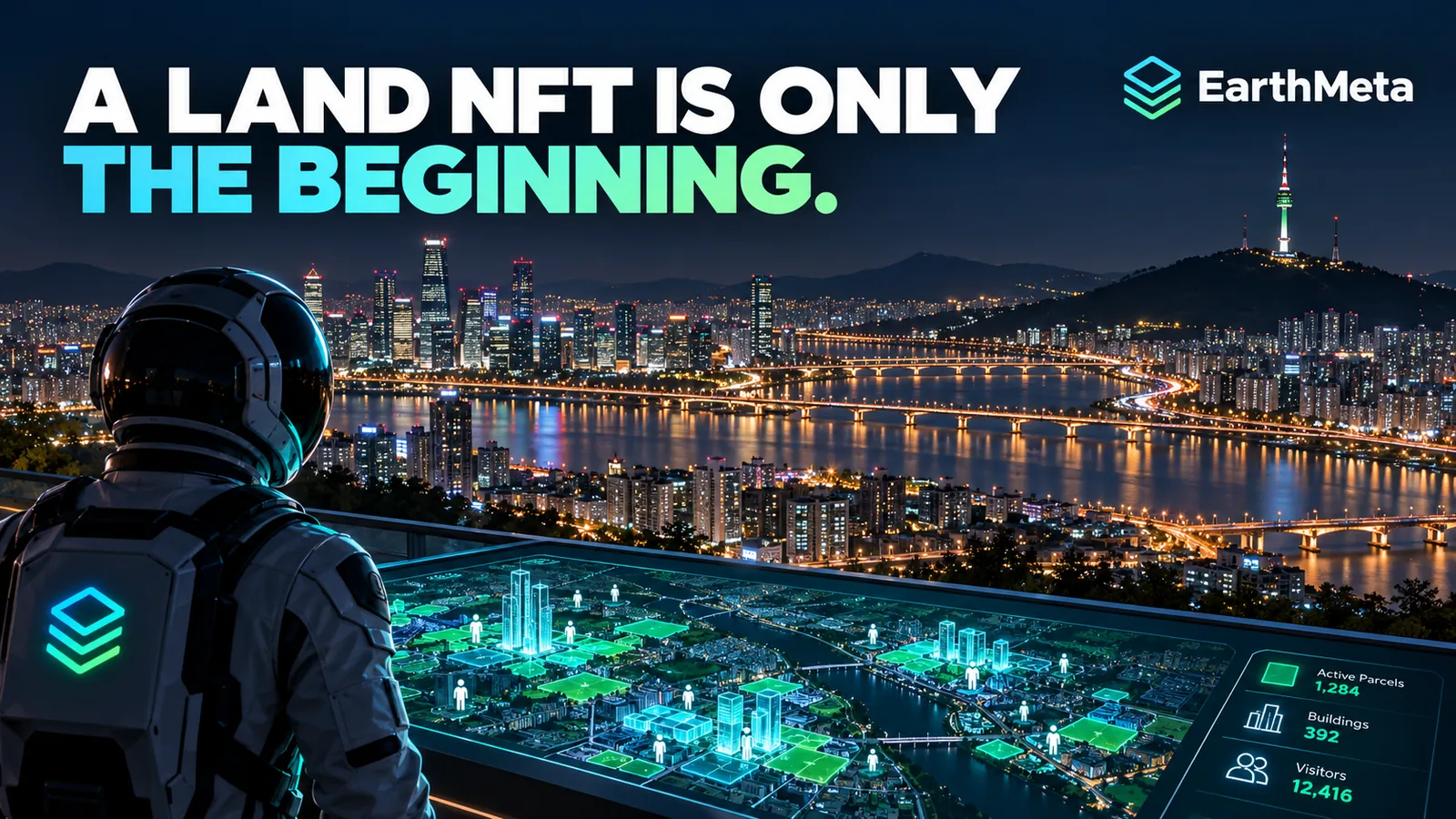
EarthMeta makes the next step unusually clear. A real city is easier to understand than an anonymous coordinate. AI building tools help owners create. Governor roles organize local participation. Marketplace and marketing tools help users discover activity.
The most important product metric may be the time between purchase and first meaningful action.
If a new owner buys a parcel and publishes something useful in the same session, blockchain ownership stops feeling like a technical concept. It becomes a working creative tool.
Explore the EarthMeta platform to see how cities, parcels and buildings connect. Before any transaction, check the live asset page, current network, contract, rights, fees and platform status.
Related reading: Why Virtual Worlds Use NFTs for Ownership, Metaverse Tokens vs Gaming Tokens and Crypto Metaverse Explained.
Frequently asked questions about blockchain virtual land ownership
What is blockchain virtual land ownership?
It is a system where a non-fungible token represents a defined location in a virtual world. A smart contract records the owner wallet, while the platform maps the token to coordinates, boundaries and permissions.
Is virtual land stored on the blockchain?
The ownership record and some parcel data may be on-chain. Large 3D models, textures, scenes and analytics are usually stored through platform or distributed content systems.
Does a land NFT give legal ownership of physical land?
No. It represents rights inside the virtual platform under its contract and terms. It does not create ownership of the corresponding physical city, building or ground.
What does ERC-721 do for virtual land?
ERC-721 provides standard functions for unique tokens, including checking ownership, approving operators and transferring the asset. Wallets and marketplaces can support land collections through this shared interface.
Can the platform still control virtual land?
The token may remain in the owner’s wallet, but the platform controls important utility such as rendering, publishing rules, moderation, map discovery and feature access. Contract administrator and governance powers also vary.
Can someone build on land without owning it?
Yes, if the platform supports delegated permissions or rentals. The owner can authorize another address to publish or operate while retaining the land token.
What happens to a building when the land is sold?
It depends on the platform and content licence. A scene may remain, reset or require republishing. Buyers should review content ownership, delegated permissions and settings after transfer.
Can virtual land be divided or merged?
Some platforms support Estates made from multiple parcels or allow larger owners to create sub-parcels. The contracts and map registry must prevent overlap and document parent-child rights.
How is virtual land rented?
A rental usually grants temporary operator or deployment rights while the owner retains the NFT. The agreement should define duration, payments, content ownership and permission removal.
How do I verify a virtual land listing?
Confirm the blockchain network, official contract address, token ID, current owner and platform map location. Use the official marketplace flow and inspect every wallet approval.
How does EarthMeta’s land ownership work?
EarthMeta uses Ethereum-based city NFTs as a parent geographic layer. Governors own cities and define land parcels within them, while buildings and AI creation tools add another asset and experience layer.
What do EarthMeta Governors and Presidents receive?
Every EarthMeta city has a Governor who receives 1% of every trade in that city, and every country has a President who receives 0.5% of every transaction across the whole country. One person can hold both roles and collect 1.5% on their own city. The tax applies to every asset traded in the territory, whether they own it or not: $100,000 of parcels traded in a city = $1,000 tax collected by its Governor.
Does blockchain ownership make a parcel useful on its own?
No. Usefulness depends on tools, content, visitors and platform execution. Blockchain ownership makes transfers verifiable; the experience built on the land gives people a reason to visit.
Final verdict: the blockchain records control, the world creates value
Blockchain-based virtual land ownership is a coordinated system, not a token floating alone in space.
The smart contract records the owner. The wallet authorizes actions. The map defines the location. The permission layer unlocks building and management. Content systems deliver the experience. Marketplaces transfer the asset. Terms define the rights. Visitors and creators give the location life.
When those layers agree, ownership feels clear and useful. When they do not, the owner may hold an impeccable token connected to a confusing product.
EarthMeta’s city-to-land model makes the stack intuitive because it begins with recognizable geography. A city establishes the parent location. Parcels create accessible ownership units. Buildings and AI tools create visible utility. Governor and President roles organize participation, with 1% of every trade in a city going to its Governor and 0.5% of every transaction in a country going to its President.
That combination does not replace the work of building. It creates a logical foundation for it.
The wallet holds the key. The experience gives people a reason to open the door.
Sources and methodology
This guide uses technical standards, official platform documentation, current product pages and first-party company reporting, as of 21 October 2026. Reported supplies and product states are dated; conventional virtual-world revenue is used only as market context, not as blockchain-land revenue. Governor and President amounts are examples: the tax collected depends on the trading activity in their city or country.
- ERC-721 Non-Fungible Token Standard — ownership, approvals, transfers and metadata interface
- Decentraland architecture overview — hybrid blockchain, content and service architecture
- Decentraland LAND Manager — owner and delegated management permissions
- Decentraland publishing documentation — owner signatures, deploy permissions and content servers
- Decentraland rentals — operator permissions and owner/tenant separation
- Decentraland DAO smart contracts — governance of LAND and Estate contracts
- The Sandbox LAND documentation — LAND count, ERC-721 ownership, Estates and publishing uses
- The Sandbox publishing documentation — locating experiences on owned LAND
- Roblox Q2 2026 shareholder letter — scale of conventional virtual-world demand
- EarthMeta homepage, About, Governor and President roles, EMT utility, Terms and roadmap — network, city/parcel/building model, ownership roles and October 2024 public launch