Put ten crypto tokens in a room, ask which ones are “metaverse” and which ones are “gaming,” and the labels will start arguing before the people do.
SAND can buy virtual land assets, pay creators and support game experiences. MANA can purchase wearables and virtual property while contributing to world governance. AXS helps govern the Axie ecosystem, while SLP is earned through play and consumed in breeding. EMT connects cities, land, buildings, marketplace settlement and governance inside a digital version of Earth. All of them touch interactive digital economies. They do not all perform the same job.
The easiest distinction is this:
A metaverse token mainly coordinates a persistent digital world. A gaming token mainly coordinates a repeatable game economy.
A metaverse token tends to connect land, identity, creators, commerce, social activity and governance across a world that continues whether or not one match is running. A gaming token tends to reward play, unlock progression, craft items, enter competitions or balance a game’s resource loop.
But the border is not a brick wall. Some virtual worlds contain games. Some games grow into worlds. Some projects use one token for both. Others use a governance token and a separate gameplay currency. That overlap is why the useful question is not, “What category label does a tracker use?” It is, “What must people actually do with the token?”
This guide compares metaverse tokens vs gaming tokens by function, not hype. It explains how users earn and spend them, why sinks matter, where AI and creator economies fit, and how to classify hybrid projects. It also shows why EarthMeta’s EMT is a metaverse-first token with gaming-adjacent possibilities, not simply an in-game coin wearing a tiny astronaut helmet.
The short answer
| Question | Metaverse token | Gaming token |
|---|---|---|
| Primary environment | A persistent virtual world or network of spaces | A game, franchise or gaming infrastructure layer |
| Core job | Coordinate ownership, creation, identity, commerce and governance | Coordinate play, rewards, progression, crafting and competitive activity |
| Typical users | Landowners, creators, visitors, brands, traders, governors | Players, teams, guilds, item creators, tournament organisers |
| Common spending | Land, wearables, names, buildings, services, creator assets, promotion | Characters, energy, crafting, upgrades, entry fees, battle passes, breeding |
| Common earning | Asset sales, creator work, marketplace activity, governance programmes | Gameplay rewards, tournaments, quests, item sales, ecosystem incentives |
| Relationship to NFTs | Often represents land, buildings, identity and creator inventory | Often represents characters, equipment, cards, skins and game resources |
| Time horizon | Designed around a world that persists between sessions | Designed around repeatable sessions, seasons and progression cycles |
| Governance role | Frequently broad: world rules, treasury, land or creator policy | Often narrower: game treasury, balance proposals, ecosystem funding |
| Main economic risk | Empty land, weak creator demand, inactive marketplaces | Reward inflation, farming, declining players, poorly designed sinks |
| Can it be both? | Yes | Yes |
The categories describe emphasis, not purity. SAND is a clear hybrid because The Sandbox combines virtual land, creator tools, games, a marketplace and governance. AXS is gaming-first because Axie’s economic loop begins with players, Axies, battles and breeding, even though its universe includes land and governance. EMT is metaverse-first because its foundation is a persistent, geo-accurate digital Earth organised around cities, land, buildings and civic roles.
Why the categories overlap so much
The metaverse and gaming share the same raw ingredients:
3D spaces and avatars
Places to move through and a body to move with.
Digital items and currencies
Objects people want, and a way to exchange them.
Creators and social groups
Makers, friends, teams and communities.
Marketplaces
Where supply from creators meets demand from users.
Competition
Goals, scores, ranks and rivals.
Persistent accounts
Progress and ownership that survive the session.
The difference appears in how those ingredients are arranged.
A racing game may have a lobby, cars, skins and a token. The world exists mainly to serve racing. A digital city may also contain racing, but the city supports far more than the race: property, events, businesses, art, governance, social identity and future experiences. The game is one activity inside the world.
Think of a football stadium and a city. The stadium hosts a clear game with rules, teams and a score. The city contains the stadium, but it also contains homes, shops, roads, galleries, councils and people who have never kicked a ball. A gaming token is usually designed around the stadium’s activity. A metaverse token is usually designed around the city’s wider economy.
This distinction becomes fuzzy when a stadium grows into an entertainment district, or when a city discovers that games are excellent at giving people a reason to return on Tuesday.
The market is larger than either label suggests
Category data illustrates both scale and confusion. On 21 October 2026, CoinGecko’s category table listed about 878 Gaming/GameFi assets and about 144 Metaverse assets, with a reported combined value of roughly $3.7 billion and $2.4 billion respectively. These figures are dated snapshots, not industry revenue and not forecasts.
Gaming lists about 6× more assets
Fewer metaverse assets, a comparable reported total
Source: CoinGecko crypto category table, snapshot of 21 October 2026.
They also should not be added together as if every token appears once. CoinGecko explains that category tags are market labels that projects can request. A token can fit more than one label. SAND, for example, can reasonably appear in both gaming and metaverse discussions because The Sandbox hosts games inside a creator-owned virtual world.
| CoinGecko category snapshot | Gaming/GameFi | Metaverse |
|---|---|---|
| Reported category value on 21 Oct 2026 | $3.7 billion | $2.4 billion |
| Approximate number of listed assets | 878 | 144 |
| What the figure measures | Tracked token values | Tracked token values |
| What it does not measure | Total game revenue, player spending or private companies | Total virtual-world revenue, hardware or enterprise digital twins |
| Important limitation | Projects can overlap across labels | Projects can overlap across labels |
The broader commercial opportunity is much larger than these token categories because most game spending and virtual-world activity does not happen through public tokens. Roblox users purchase Robux inside a closed economy. Fortnite sells cosmetics without a freely traded blockchain token. Enterprise digital twins may never need a public currency at all.
Crypto tokens matter where open ownership, transferable assets, external wallets or community governance add something useful. A token is not mandatory for every game or virtual world. It should earn its place by coordinating participants better than a normal database and payment system would.
Difference 1: the product starts in a different place
Metaverse tokens start with a world
A metaverse project usually begins with a persistent place or network of places. The product question is: What can people own, create, visit and govern here?
The token may connect virtual land and property, names and identity, avatar wearables, creator tools, buildings and scenes, marketplace payments, events and advertising, community treasuries and world governance.
The world does not need a “win” screen. A user might spend an hour designing a building, attending a concert, viewing art, renting a venue or discussing a proposal. The value comes from participation and persistence.
Decentraland is a clear example. Its official marketplace documentation says users can buy and sell LAND, Estates, wearables, emotes and names, with listings priced in MANA. Its governance system combines MANA with LAND, names and certain wearables when calculating voting power. MANA therefore sits inside a world-level ownership and governance system, not just a reward loop for winning a match.
Gaming tokens start with an action loop
A gaming project usually begins with a repeatable activity. The product question is: What do players do again and again, and how does the token support that loop?
A basic loop might be:
play → earn a resource → spend the resource → improve a character → enter harder play
The token can reward performance, gate access, accelerate progress, pay tournament prizes or act as a crafting input. Its economy depends on player motivation and game balance.
Axie Infinity offers an unusually clear example because it separates roles across two tokens. AXS is associated with governance and parts of the treasury economy. SLP is a gameplay resource earned through play and consumed alongside AXS in breeding. The official breeding documentation explains that breeding an Axie requires AXS and a variable quantity of SLP, while SLP can be earned in player-versus-player activity.
That split gives each token a clearer job. It also shows why “gaming token” is not one design. A project may have:
- a governance token;
- a soft or earned gameplay currency;
- an infrastructure token;
- NFTs for characters and items;
- and a normal fiat checkout for newcomers.
Difference 2: the thing being coordinated is different
A token economy is a coordination system. It tells participants what counts, who receives value and which behaviours the product encourages.
People doing different things
A landowner offers space. A creator builds an asset. A visitor supplies attention. A brand buys promotion. A trader keeps listings moving. A governor votes on rules. A collector purchases identity items. The token becomes common language between roles that may never play the same game.
People around the same activity
Players compete. Teams organise. Item creators supply equipment or skins. Tournament organisers offer prizes. Guilds allocate assets. Developers tune rewards and sinks.
The gaming economy succeeds when these incentives make the game more fun and sustainable. If the best way to earn is to avoid the fun and mechanically farm the reward, the token has started managing the wrong behaviour.
Difference 3: persistence means something different
Both categories can be persistent, but persistence serves a different purpose.
In a metaverse, persistence means the world remembers. Land ownership remains. A building stays placed. An avatar keeps its identity. A city’s governance history continues. The world can host many unrelated experiences without resetting its underlying social and economic structure.
In a game, persistence usually supports progression. A character levels up. A crafted item remains in inventory. A ranked season records results. A guild accumulates resources. The persistence exists to make the next session more meaningful.
This difference shapes spending. Someone may buy virtual land because they want a lasting venue, status, development rights or a role in the world’s economy. Someone may buy a gaming item because it improves performance, completes a collection or expresses identity during play. Both can be rational. They answer different needs.
Difference 4: earning usually comes from different sources
“Earn” is one of the most abused words in token marketing because it says nothing about where the reward comes from.
Exchange between roles
Selling land, buildings or wearables to another user; charging for creator services; renting a venue or parcel; receiving marketplace or geographic fees; running an event or campaign; receiving a community grant.
Rewards around play
Seasonal or match rewards; leaderboard prizes; tournament winnings; quest rewards; selling crafted or discovered items; breeding or upgrading assets; ecosystem grants.
These sources are not equal. A creator sale transfers value from a buyer to a seller. A reward distributes from a pool. A territory fee shares transaction value. A grant spends treasury assets. Each has a different sustainability profile.
Gameplay rewards deserve special attention. If players receive more tokens simply for showing up, tokens can pile up faster than people have reasons to use them. A game then needs meaningful sinks (crafting, repairs, upgrades, entry, breeding or cosmetic spending) to absorb part of what it hands out.
Axie’s own economy and sustainability paper discusses this directly: growth requires balancing the creation of Axies and token resources with sinks, progression and demand from existing players. That is more informative than a fixed “play-to-earn” slogan because it acknowledges the actual economic problem.
Difference 5: token sinks follow product behaviour
A sink is an action where a user spends tokens on something the product provides. The token may be burned, locked, transferred to a treasury or paid to another participant.
| Sink type | Metaverse sinks | Gaming sinks |
|---|---|---|
| Acquiring | Land and asset purchases, naming services | Characters, consumables, rerolls |
| Making | Creator tool fees, minting or publishing costs | Crafting, equipment upgrades, character breeding |
| Expressing | Avatar items | Cosmetics, battle passes |
| Participating | Advertising and promotion, proposal deposits | Energy or stamina, tournament entry, repairs |
The distinction is not cosmetic. A sink should match why people came.
If a virtual-world user wants to create a building, a building-generation fee feels natural. If a player wants to enter a tournament, an entry token feels natural. Forcing a city owner to buy “energy” every day would feel like a game mechanic awkwardly stapled to property. Forcing a competitive player to submit a governance proposal before upgrading a sword would be equally strange.
Good token design follows user intent. Bad token design invents friction so the whitepaper can claim another utility.
Difference 6: creators play different roles
Creator economies appear in both categories, but creators make different products.
Metaverse creators build the environment
They design architecture, wearables, social venues, galleries, shops, interactive scenes, branded installations, virtual services and complete districts. Their output can attract visitors who are not seeking a traditional game. A digital museum, conference hall or real-estate showroom can be useful without keeping score.
The Sandbox illustrates this world-builder model. Its SAND documentation says creators can sell assets on the marketplace, charge for access to experiences and hire other creators. Players can purchase avatars, equipment and access, while holders can participate in governance where allowed. The token connects creators, players and landowners.
Gaming creators build challenges and content loops
They design levels, characters, cards, weapons, maps, quests, tournaments, mods and competitive rule sets. Their output must survive repeated use. A beautiful arena that produces boring matches is a weak game asset. A mechanically elegant arena may succeed even if nobody would visit it as architecture.
The best hybrid platforms let creators do both. A person might build a visually impressive city district, then add races, scavenger hunts or strategy challenges inside it. The world provides context; the games provide repeat visits.
Difference 7: identity has a different weight
Gaming identity is often performance-led. Rank, rare equipment, team affiliation and achievements show what the player has done.
Metaverse identity is usually broader. An avatar may move between social events, workspaces, shops and games. A name, wearable or home space can represent the person even when no competition is running.
This matters because identity items create spending that is not tied to advantage. A user may buy a jacket because it looks good, not because it adds five points of armour. Cosmetic demand can support an economy without making the experience pay-to-win.
Projects that mix categories should protect that distinction. Cosmetic expression can be scarce or collectible. Competitive advantages require careful balancing. If the richest wallet automatically wins, the game has become a shopping contest with background music.
Difference 8: governance can be world-wide or game-specific
Governance is common to both categories, but the scope differs.
Land policy, content moderation, creator grants, community events, marketplace fees, treasury spending, naming rules and protocol upgrades.
Tournament funding, reward schedules, esports grants, treasury allocation, marketplace economics and selected balance or ecosystem decisions.
Not every design hands direct control of gameplay balance to token holders. That can be sensible. A popular vote is not automatically the best way to tune a competitive game. Experienced designers may need authority to patch an exploit quickly.
Decentraland’s governance system shows how a world can combine multiple assets. Its DAO documentation says voting power can come from MANA, names, LAND and certain legacy wearables, with different weights. This makes governance an ecosystem-wide function rather than a simple “one token, one vote” counter.
Axie’s governance documentation is more staged. It describes progressive decentralisation and acknowledges technical and social coordination challenges. That honesty is useful: governance is a process, not a button labelled DAO.
Difference 9: success is measured differently
A category label or a market chart is not a sufficient success metric for either category. Activity is.
| Focus | Useful metaverse metrics | Useful gaming metrics |
|---|---|---|
| Audience | Monthly active and returning visitors | Daily and monthly active players; retention after 1, 7 and 30 days |
| Creation | Active creators; creator income | Match frequency; session length |
| Places and play | Parcels or cities with recent activity; event attendance | Tournament participation; balance between new and experienced players |
| Exchange | Marketplace buyers and sellers; asset sales excluding wash trading; repeat purchase rate | Payer conversion; player spending |
| Token health | Governance participation; token spend by utility | Reward issuance; token sinks |
A metaverse can have many landowners and few visitors. A game can have many token claimers and few genuine players. Both look busy until the right metric asks an uncomfortable question.
A practical classification test
Ignore the project’s marketing category for five minutes. Ask these questions instead.
1. What does a user do before touching the token?
If the user explores a world, acquires space or creates an identity, the design leans metaverse. If the user battles, races, solves or competes, it leans gaming.
2. What creates demand?
Land, creation, identity and world services suggest metaverse utility. Progression, crafting, competition and rewards suggest gaming utility.
3. What happens if the game stops?
If the token still supports property, social spaces, creator markets and governance, the ecosystem may remain metaverse-first. If nearly all demand disappears with the gameplay loop, it is gaming-first.
4. What happens if virtual land disappears?
If the token still has a strong competitive game, player economy and progression system, it is likely gaming-first. If the central economic model collapses, it is likely metaverse-first.
5. Who is paid?
Creators, landowners, venue operators and civic roles point toward a world economy. Players, teams and tournament winners point toward a game economy. Mixed recipient groups suggest a hybrid.
6. What is the main sink?
Buildings and marketplace services suggest metaverse. Crafting and upgrades suggest gaming. Again, a token can do both.
7. What does governance govern?
World policy and shared infrastructure lean metaverse. Game treasury and competitive ecosystem policy lean gaming.
The result should be a profile, not a verdict. A token can be 70% metaverse and 30% gaming today, then shift as the product expands.
Profile any token in seven questions
Think of a project you are curious about and answer for its live product. You get a metaverse / gaming profile, not a verdict.
Hybrid
See a metaverse-first token at work
Explore cities, land and creator tools in the live EarthMeta world.
Real examples: category by actual utility
| Token | Best current description | Why |
|---|---|---|
| SAND | Hybrid, metaverse-first | Connects LAND, creators, assets, experiences, marketplace activity, governance and play |
| MANA | Metaverse-first | Prices LAND and identity assets, supports marketplace activity and contributes to world governance |
| AXS | Gaming ecosystem and governance token | Connects the Axie treasury, governance and selected game-economy actions |
| SLP | Gameplay resource token | Earned through play and consumed in the breeding loop |
| EMT | Metaverse-first, gaming-adjacent | Connects cities, land, buildings, marketplace settlement, AI creation, geographic roles and governance |
This table does not rank the tokens. It identifies their centre of gravity.
Tap a token to see where its centre of gravity sits
Why SAND belongs in both conversations
The Sandbox began as a game brand and evolved into a creator-owned virtual world. Its documentation separates SAND from LAND and playable assets. Users can build games on land, but SAND also pays creators, supports governance and interacts with a wider marketplace.
SAND proves that “metaverse” and “gaming” do not have to compete. Games can be the most engaging content inside a world. The token becomes hybrid when it remains useful across many games and non-game activities.
Why MANA is metaverse-first
MANA connects property, names, wearables, emotes and governance across Decentraland. Individual scenes can contain games, but the token’s main role is not limited to a match or progression system. It supports the world’s shared economy.
Why AXS and SLP should not be treated as identical
AXS and SLP live in the same franchise but solve different problems. AXS has governance and treasury significance. SLP is closer to a gameplay resource: players earn it, and breeding consumes it.
This separation can make balancing easier. A governance asset does not need to grow in circulation at the same rate as a frequently earned game resource. A gameplay reward can be adjusted without redefining the entire ecosystem’s voting structure.
Why EMT is metaverse-first
EMT is the token for buying cities, trading land, creating and selling buildings, governance, marketplace promotion and avatar items. The ecosystem begins with a geo-accurate digital Earth and unique city ownership, not a single gameplay loop.
EarthMeta’s positioning is explicit: the platform is “not a game.” It is a digital twin of Earth with on-chain ownership, AI building and Governor economics. That does not make games irrelevant. It means games sit inside a wider city and land economy.
Where gaming mechanics strengthen a metaverse-first world
Metaverse-first does not mean game-free. Games are good at turning an interesting place into a habit. Used well, they deepen real utility without confusing the token’s role.
Reward useful contribution
Visible reputation for activating a city, supporting creators or hosting events. Badges for high-quality assets. Achievements for exploring landmarks. The reward reflects contribution, not wallet size.
Create discovery
Building contests, city challenges and scavenger hunts give users a reason to visit today rather than “sometime later,” the most dangerous date in digital product design.
Teach the platform
A first quest guides someone to create an avatar, visit a city, inspect a parcel and try a building tool, with a cosmetic or reputational reward rather than a large token payout.
Give people a reason to return
People do not buy land every afternoon. Games, events and social challenges create weekly or daily reasons to return, which grows the audience for creators and city owners.
Naturally differentiated games
EarthMeta’s real locations supply material for trivia, exploration, racing, culture, architecture and AR experiences. Paris does not need the same activities as Kyoto or Rio.
Animate, don’t replace
Game design animates the world. EMT stays understandable across property, creation, governance and participation.
Common gaming-token mistakes a metaverse-first economy avoids
Mistake 1: paying people to perform joyless activity
If a task exists only because it produces a reward, participants will optimise the task and leave when the reward falls. The platform gains transactions but not attachment. Rewards should amplify an activity that is already useful or enjoyable: creating, exploring, competing, curating or teaching.
Mistake 2: rewarding faster than people use the product
Large gameplay rewards can overwhelm sinks. A healthy design tracks how many tokens go out through rewards and how many come back through genuine usage. In EarthMeta, EMT already has concrete uses in the marketplace, building, governance and promotion, so any gaming reward is designed alongside them, not in a separate spreadsheet.
Mistake 3: confusing friction with utility
Requiring a token for every click does not make it more useful. It makes the product tiring. High-value actions (asset creation, settlement, governance and premium services) are more natural token moments than basic exploration.
Mistake 4: making competition pay-to-win
City ownership and EMT holdings carry economic roles in EarthMeta. Competitive experiences need skill, strategy or meaningful limits, so that the largest holder does not automatically dominate and new players keep caring.
Mistake 5: launching rewards before retention
A reward programme can temporarily hide weak retention. The better order is:
Make the activity enjoyable.
Measure whether people return.
Identify valuable contribution.
Add proportionate incentives.
Monitor abuse and economic balance.
Tokens should accelerate product-market fit, not impersonate it.
AI changes both categories
AI is often discussed as a content generator, but its economic effect is larger: it reduces the time and skill required to create new inventory.
In metaverse economies
AI helps users generate buildings, textures, avatar clothing, dialogue, event concepts, local stories and interactive objects. That expands the creator base. A Governor with no 3D modelling experience can prototype a district. A small business can create a virtual location without commissioning every object from scratch.
EarthMeta’s AI 3D Builder and AI tools are live, and selected AI building and avatar-generation actions use EMT. This connects AI creation directly to token utility.
In gaming economies
AI helps produce quests, levels, non-player characters, adaptive difficulty, item variations, moderation and personalised tutorials. More content can improve retention, but abundance creates a discovery problem. If everyone can make 500 swords before lunch, rarity based only on production effort becomes less convincing. Quality, provenance, utility and curation become more important.
The shared opportunity
AI makes hybrid worlds more practical. A creator can generate a real-place-inspired environment, then add game mechanics inside it. The metaverse layer supplies place, identity and ownership. The gaming layer supplies goals, progression and replay.
EarthMeta’s advantage is its geographic framework. AI output does not float in an empty catalogue; it is placed within a city that already carries cultural and spatial meaning.
Build on a real city
Describe a structure and let EarthMeta’s AI build it on a real-world parcel.
Why people spend: the human motives behind both economies
Tokens do not create motivation from nothing. They translate existing motivations into transactions.
The person needs the token to do something: build, enter, craft, list, vote or upgrade.
Wearables, homes, buildings and skins say something about identity, which is why cosmetic economies can thrive without competitive advantage.
Players spend to move forward, save time or reach a goal. Progress must remain fair enough that effort still matters.
Guilds, cities, teams and communities give ownership emotional meaning. The relationships make it valuable.
Rare land, high rank, unusual items and civic roles signal achievement or access. Status works when other people recognise it.
Creators and sellers spend because the platform offers customers. Marketing, listings and production tools are business inputs.
A durable economy rests on these motives. When people need the product, the token has a job.
Market growth mechanisms: how these economies expand
Metaverse and gaming economies grow through different but compatible engines.
More creators → more places and assets → more reasons to visit → more commerce → more creator opportunity
Land alone does not create this loop. Builders and audiences do.
Better gameplay → stronger retention → more competition and social activity → more spending → more development
Rewards can support the loop, but they cannot substitute for fun.
Persistent world + repeatable games + transferable identity + creator marketplace
The most powerful model when executed well.
In the hybrid model, players arrive for a game, discover a community, purchase identity items, visit other experiences and eventually create content. Creators receive a wider audience. Landowners gain activity. The platform gains multiple reasons for the user to stay.
The challenge is complexity. A hybrid project must balance world governance, game balance, property rights, creator incentives and token flows at the same time. More utility is useful only when users can understand it.
Lessons from Roblox, The Sandbox and Amazon
These histories do not predict EarthMeta’s path. They show the time and systems required to build an ecosystem.
- Amazon
Opens its online store in July.
- Amazon
Marketplace lets businesses and individuals sell through Amazon.
- The Sandbox
Begins as a 2D game.
- EarthMeta
Public platform launch in October.
- Roblox · Q2
Reports $1.5 billion in quarterly revenue, up 36% year over year.
Roblox: repeat participation came before financial scale
Roblox’s economy grew around creation tools, social play, discovery and an audience that returned repeatedly. In its second-quarter 2026 shareholder letter, Roblox reported $1.5 billion in quarterly revenue, up 36% year over year.
That scale is the result of years of product development, not simply a currency. Robux works because users already want games, items and social experiences. For EarthMeta, the lesson is clear: the strongest support for EMT is a world people want to use.
The Sandbox: a game can grow into a creator world
The Sandbox began as a 2D game in 2012 and evolved over time into a blockchain-based world with LAND, creator tools, assets, experiences and SAND. Today’s token utility rests on years of tool and community development.
EarthMeta is younger: it launched publicly in October 2024. Comparing a two-year-old public platform with a much older ecosystem calls for patience and priorities, not guarantees.
Amazon: marketplaces require trust infrastructure
Amazon opened its online store in July 1995. Marketplace development came later, with seller access, payments and a growing customer base. An Amazon release from 2001 described Marketplace as a way for businesses and individuals to sell through Amazon while payment infrastructure reduced friction.
Virtual-world marketplaces face the same basic challenge: supply is not enough. Buyers need discovery, clear pricing, reliable settlement and confidence. EarthMeta supports crypto and card payment routes that reduce checkout friction, while trust, useful inventory and repeat demand do the heavier work.
How to compare any metaverse or gaming token
Use this checklist before trusting any category label.
Is there a live product? What can a non-token holder do? What becomes possible after using the token? Is the experience still useful when rewards are removed?
Which actions require the token? Are those actions frequent or rare? Do users want the outcome for its own sake? Can the token be replaced by a stablecoin without losing the product’s logic?
Do rewards come from fees, treasury reserves or new issuance? Is creator income paid by real buyers? Are marketplace volumes organic?
What does the wallet actually control? Are assets transferable? Can the publisher change metadata or utility? Does ownership include intellectual-property rights, or only an in-platform licence?
What can holders decide? Is voting on-chain, off-chain or advisory? How is voting power calculated? Who executes approved decisions?
Does the product require a wallet immediately? Are gas and conversion costs visible? Can newcomers try the experience before buying? Are support and security guidance easy to find?
How many people return? How many create? How many buy and sell? How much activity comes from incentives? Are there active communities beyond chart discussion?
A project that answers these questions clearly is easier to classify, and easier to trust.
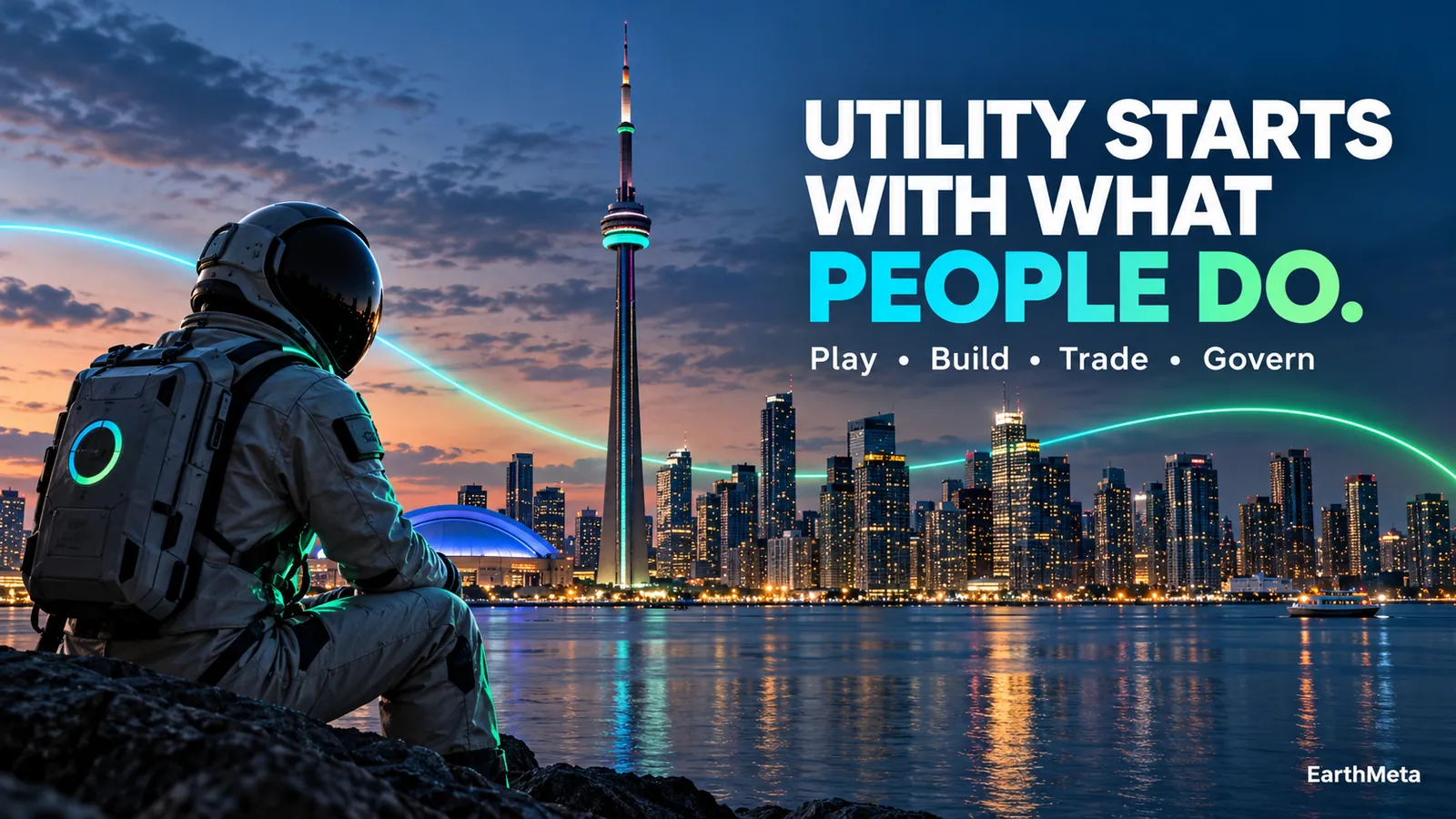
EarthMeta’s position in the overlap
EMT belongs primarily in the metaverse category because its core utilities span a persistent world:
- city acquisition;
- land trading;
- building creation and sales;
- avatar identity;
- marketplace promotion;
- Governor and President economics;
- and governance.
The platform’s geography creates roles that exist beyond a single game session. A Governor remains responsible for a city. A building remains placed. A parcel remains part of a specific real-world location. Governance and marketplace history persist.
Governors and Presidents: civic roles a game token does not have
Every EarthMeta city has a Governor, and the Governor receives 1% of every trade in their city. Every country has a President, and the President receives 0.5% of every transaction across the whole country. One person can hold both roles and collects 1.5% on their own city.
These percentages apply to every asset traded in the territory, whether the Governor or President owns it or not. $100,000 traded in a city = $1,000 tax collected by its Governor. This is a world-level mechanism: it rewards city activity, not match performance.
Watch city activity turn into tax collected
Pick a role, or both: one person can be Governor and President.
Gaming mechanics strengthen this model in four ways:
Quests, competitions and events create reasons to return.
Games move visitors through cities and landmarks.
Onboarding challenges teach the platform through action.
Interactive content increases demand for buildings, items and services.
EMT stays a metaverse token. Games become one more source of useful activity within the EMT economy.
What is live and what is on the roadmap
The marketplace, governance, 3D Builder, AI tools and avatars are live. EMT is used for land and building trades, governance, marketing and avatar items.
AR and mobile features are on the EarthMeta roadmap, labelled “launching soon” in late 2026. They bring more interactive, game-like activity to the world as they roll out. This live-versus-roadmap discipline keeps the utility story credible.
Design principles for a metaverse-first token
1. Keep one clear token role across many experiences
A metaverse-first token works best as the economic layer connecting ownership, creation, trade and governance. In EarthMeta, EMT is that layer. New games use it where it naturally supports entry, prizes or asset purchases, without each needing a confusing new token.
2. Use non-financial rewards for early onboarding
Badges, cosmetics, access and reputation motivate exploration without flooding the economy with rewards. Large token rewards belong after demonstrated retention.
3. Track world metrics and game metrics separately
World metrics track active cities, creators, visitors, marketplace activity and governance. Game metrics track players, retention, matches and reward balance. Separating them prevents a burst of game activity from disguising weak city development, or the reverse.
4. Let city leaders host repeatable activities
Scavenger hunts, races, exhibitions, trivia and seasonal events let Governors animate cities without becoming full game studios. AI helps localise and generate first drafts.
5. Protect skill and creativity from wallet size
Competitive events reward performance, strategy or creativity. Economic ownership can fund and host the event without deciding the winner.
6. Make every token sink explain its output
The interface says what the spend produces: a building, a listing, a campaign, an entry, a vote or a permanent asset. Users understand utility when they can point to the result.
Which category is better?
Neither. The better category is the one that matches the product.
A focused game may not need land governance, city councils or a creator marketplace. Adding metaverse features could dilute an excellent game.
A persistent digital world may not need constant token rewards or competitive crafting. Adding them without a retention strategy could create inflation and farming.
Hybrid design is powerful when the parts reinforce each other. A game draws an audience. A world gives that audience identity and persistence. A creator economy supplies new content. Governance funds shared priorities. The token connects actions that would otherwise sit in separate databases.
The winner is not the project with the longest utility list. It is the project where each utility solves a real user problem.
Frequently asked questions about metaverse tokens vs gaming tokens
What is the main difference between metaverse tokens and gaming tokens?
Metaverse tokens mainly coordinate persistent virtual worlds, including land, identity, creator assets, marketplaces and governance. Gaming tokens mainly coordinate play, including rewards, progression, crafting, competition and game-specific resources. Many tokens overlap.
Can a token be both a metaverse token and a gaming token?
Yes. SAND is a good example because The Sandbox combines virtual land, creator tools, playable experiences, governance and a marketplace. Classification should reflect actual utility rather than force every token into one box.
Is SAND a gaming token or a metaverse token?
It is reasonably described as both, with a metaverse-first centre of gravity. SAND supports players, creators, LAND owners, marketplace purchases, governance and play programmes across many experiences.
Is AXS a metaverse token?
AXS can appear in metaverse discussions because the Axie universe includes land, social systems and governance. Its central product loop is still gaming, so “gaming ecosystem and governance token” is usually the clearer description.
What is the difference between AXS and SLP?
AXS is associated with governance, treasury economics and selected ecosystem actions. SLP is a gameplay resource earned through play and consumed in breeding. The two-token structure separates higher-level governance from a frequently used game resource.
Is EMT a gaming token?
EMT is a metaverse utility token. It connects EarthMeta’s cities, land, buildings, marketplace, AI creation, avatar items and governance. Game-like activities increase EMT use, but the platform is built around a persistent digital Earth rather than one game.
How do Governors and Presidents fit into the EMT economy?
Every EarthMeta city has a Governor who receives 1% of every trade in that city, and every country has a President who receives 0.5% of every transaction across the whole country. One person can hold both roles and collects 1.5% on their own city. The tax applies to every asset traded in the territory, owned or not: $100,000 traded in a city = $1,000 tax collected by its Governor.
Are gaming tokens only used to reward players?
No. They may also pay for crafting, upgrades, entry fees, characters, marketplace items, governance or infrastructure. Rewards are only one part of the economy.
Do metaverse tokens always buy virtual land?
No. Many support land, but they can also pay for wearables, names, services, creator tools, events, promotion, governance or access. Some virtual worlds do not use a public token at all.
Why do gaming-token economies need sinks?
If players continually earn new tokens without meaningful reasons to spend them, tokens pile up faster than people have uses for them. Crafting, upgrades, entry fees, breeding and cosmetic purchases absorb or redistribute part of what the game hands out.
Does a larger gaming category value mean gaming tokens are better?
No. A category’s reported value on a tracker such as CoinGecko is a dated snapshot of listed tokens, not product quality, usefulness or revenue. Categories overlap, and many successful games have no public crypto token.
How does AI affect metaverse and gaming tokens?
AI lowers the cost of producing buildings, items, levels, characters and quests. That increases useful token activity, but it also makes curation and quality more important because content becomes easier to produce.
How should I research a metaverse or gaming token?
Start with the live product and official documentation. Identify who uses the token, where rewards come from, what creates demand for its uses, what holders govern and whether people still enjoy the product without financial incentives. Never rely on a category label alone.
Final verdict
Metaverse tokens and gaming tokens are not rivals. They are tools for different layers of interactive digital economies.
Gaming tokens are strongest when they make play more rewarding, expressive and sustainable. Metaverse tokens are strongest when they connect ownership, identity, creation, commerce and governance across a persistent world. Hybrid tokens are strongest when the game gives the world energy and the world gives the game context.
EarthMeta sits on the metaverse side of that overlap. Its token economy begins with cities, land, buildings and civic roles tied to real geography. Gaming mechanics help people explore, learn and return, while AI helps more creators build the places those activities need.
That combination strengthens EMT by expanding the number and frequency of useful actions without reducing it to a reward point. Success is visible activity: people building, visiting, trading and governing for reasons that make sense on their own.
Sources and methodology
This comparison prioritises current official documentation and real product functions, as of 21 October 2026. Category values are dated third-party snapshots, not forecasts or total industry revenue. Project labels are treated as descriptive rather than exclusive. Governor and President amounts shown are examples: the tax collected depends on the trading activity in their city or country.
- CoinGecko crypto category table and category methodology: category counts, reported values and tag limitations
- The Sandbox SAND documentation: player, creator, marketplace and governance uses
- The Sandbox overview: relationship between SAND, LAND, playable experiences and creator assets
- Decentraland marketplace documentation: MANA-priced LAND, wearables, emotes and names
- Decentraland DAO guide: MANA, LAND, names and wearable voting power
- Axie Infinity breeding and SLP documentation: AXS and SLP consumption in breeding and gameplay earning
- Axie economy and sustainability paper: reward, sink and player-economy mechanics
- EarthMeta EMT utility page: city, land, building, governance and creator uses
- EarthMeta roadmap: October 2024 public launch and feature status
- Roblox Q2 2026 shareholder letter: current scale and long-term platform context
- Amazon Marketplace history: marketplace and payment-friction context